Coin Community Family of Web Sites Join Thousands of Coin, Bullion, & Money Collectors
Shop for APMEX Bullion on eBay!Coin, Banknote and Medal Collectors's Online Mall Join Thousands of Coin, Bullion, & Money Collectors Specializing in Modern Numismatics 300,000 items to help build your collection! Royal Canadian Mint products, Canadian, Polish, American, and world coins and banknotes. Vancouvers #1 Coin and Paper Money Dealer


Username:
Password:
Save Password
Forgot your Password?


This page may contain links that result in small commissions to keep this free site up and running.

Welcome Guest! Registering and/or logging in will remove the anchor (bottom) ads. It's Free!

Die Attrition

To participate in the forum you must log in or register.
Author Previous TopicReplies: 6 / Views: 2,032Next Topic  
Moderator
Learn More...
John1's Avatar
United States
56855 Posts
 Posted 07/18/2009  09:04 am Show Profile   Bookmark this topic Add John1 to your friends list Get a Link to this Message Number of Subscribers
Could some one describe what Die Attrition is and post some photos?
Are these classified as an error or a variety? What value do they have?
John1
Bedrock of the Community
coop's Avatar
United States
62064 Posts
 Posted 07/18/2009  5:03 pm  Show Profile   Bookmark this reply Add coop to your friends list Get a Link to this Reply
John1 :
Could some one describe what Die Attrition is and post some photos
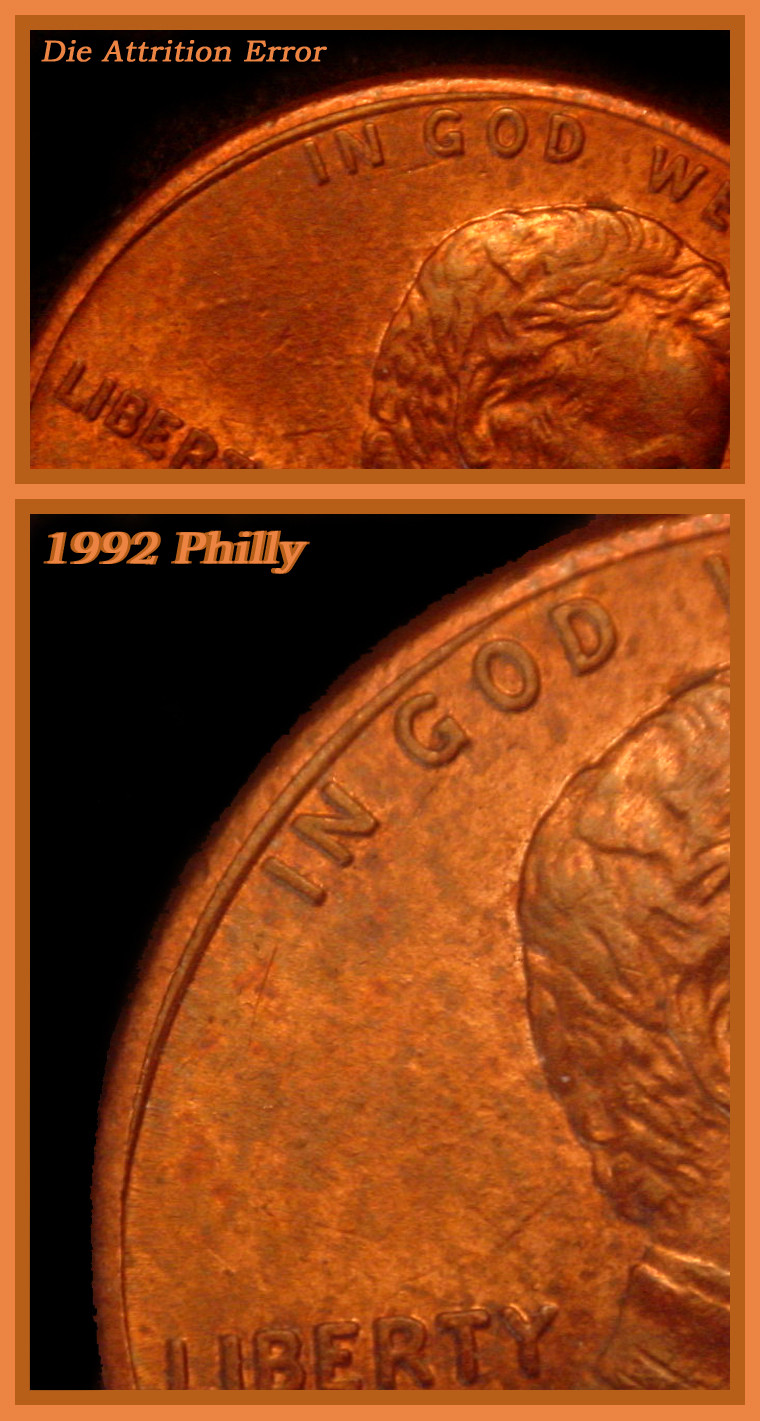
Definition is on Attrition: A wearing away as if by rubbing. Die attrition is caused by the edge of the die being rubbed in connection with MAD (Miss Aligned Die) rubbing. After continued use the wearing removes part of the edge of the die. You can see this on many coins as an angled edge next to the rim. Eventually an area gets worn down so much that the devices start to wear off. With all the MAD coins we find, the mint doesn't view it as important enough to correct the problem so it just continues happening. Here is an example of mild attrition:
Die-Attrition
Note how it look just like another MAD coin? But look closer. Look at the distance between the rim and the devices. Do you see the edge of the die getting closer to the devices in one area and normal in another area? That is die attrition. But they eventually get worse and then they are collect able:
Die-Attrition
Note the loss of the devices? When the die wears like this there is nothing to from the coin during the strike.

Are these classified as an error or a variety?
Lets look at the definition of a variety. Doubled dies are hubbed into the die with either two different hubs/ two different stages of the same hub/incorrect alignment/hub warped/hubbed rotated. So the first coin struck with this die and the last have the same doubled/triple hubbing. A RPM is also a variety. The first coin and the last coin have the same miss punching. On RPMs wear also changes shape of them, but they are all varieties. An error is caused by different circumstances affecting the normal striking process. Wrong planchets/striking through debrie/dies shattering/off center strikes/broad struck out of collar/brokerage/cuds/incomplete planchets/double struck/strong die clashes and others I've forgotten. So die attrition I feel would also be included if the devices were affected.

What value do they have?
That one I don't know, but they are rare to find. I've only found the first one posted and didn't realize what it was till Mike Diamond pointed it out. But I look on every coin for this now that I know what I'm looking for.
Coop
John1
Moderator
Learn More...
John1's Avatar
United States
56855 Posts
 Posted 07/19/2009  07:54 am  Show Profile   Bookmark this reply Add John1 to your friends list Get a Link to this Reply
Thanks very much coop, I knew you would know.
John1
Pillar of the Community
Peter THOMAS's Avatar
Australia
2830 Posts
 Posted 07/19/2009  6:50 pm  Show Profile   Bookmark this reply Add Peter THOMAS to your friends list Get a Link to this Reply
Coop: great pics !
Peter in Oz
Pillar of the Community
coppercoins's Avatar
United States
7629 Posts
 Posted 07/20/2009  10:10 am  Show Profile   Bookmark this reply Add coppercoins to your friends list Get a Link to this Reply
Die attrition is without question an error. A die error to be specific.

Die varieties are created on the die before the die is placed into use. They are a part of the initial design on a single die used to mint coins. The design imperfection (usually doubling) transfers to every coin minted by that die.

Errors occur either in the way the planchets were made (planchet errors), as a mistake of the striking process (striking errors), or something that develops on the die during use (die errors). Planchet and striking errors are generally a single coin to single coin occurrence - meaning that an error could occur between strikes of two completely normal coins. Die errors, because of their nature (on the die), start on a single coin somewhere during the life of the die and often progress in size and severity as the die is used, but they always leave their mark on every coin minted after the error occurs.

The biggest difference and the big question to ask in determining whether a flaw is considered a die variety or an error is to figure out whether what you are seeing would have been on the die when it was placed into use.

Could that die have minted completely normal coins? If so, then it's an error.

Or is the anomaly something that was on the die when it was first hung on the press to mint coins -- meaning there's no chance that die minted completely normal coins? If so, then it's a die variety.
Pillar of the Community
killians76's Avatar
United States
985 Posts
 Posted 07/20/2009  9:30 pm  Show Profile   Bookmark this reply Add killians76 to your friends list Get a Link to this Reply
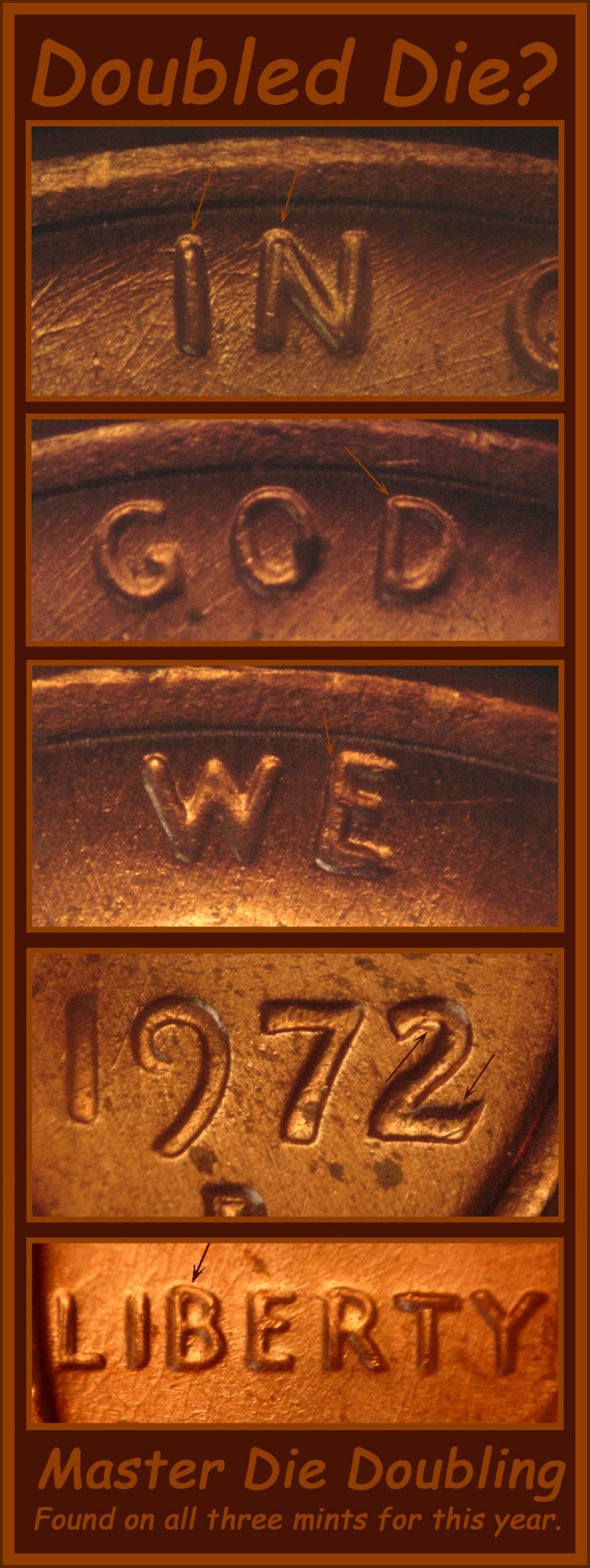
so the 1972's are die varieties with all the mints having a problem with the master die making that year?
Bedrock of the Community
coop's Avatar
United States
62064 Posts
 Posted 07/20/2009  9:45 pm  Show Profile   Bookmark this reply Add coop to your friends list Get a Link to this Reply
They are called Master Die Doubling. The master + that made Master hub - which made the hubs + which made the dies - . Because the master was doubled, all hubs & dies would carry this same master doubling. The roblem is that a large percentage of the Cents were made from the doubled master. Thus making them common as normal coins. No extra value for them.
Die-Attrition
  Previous TopicReplies: 6 / Views: 2,032Next Topic  

To participate in the forum you must log in or register.


Disclaimer: While a tremendous amount of effort goes into ensuring the accuracy of the information contained in this site, Coin Community assumes no liability for errors. Copyright 2005 - 2026 Coin Community Family- all rights reserved worldwide. Use of any images or content on this website without prior written permission of Coin Community or the original lender is strictly prohibited.
Contact Us  |  Advertise Here  |  Privacy Policy / Terms of Use

Coin Community Forum © 2005 - 2026 Coin Community Forums
It took 0.24 seconds to rattle this change. Forums