| Author |
 Replies: 22 / Views: 10,062 Replies: 22 / Views: 10,062 |
|
Valued Member
United States
324 Posts |
Can anyone tell the difference between a 5 Cents 1903 Large H and a Small H? Also, can anyone post an image of a Large H and a Small H. Seems to me that any differences are very subtle on this variety....
|
|
|
|
Pillar of the Community
Canada
904 Posts |
mkb, the following is from the Canadian Coins Charlton Book. The large H is the variety that is worth more in value.  |
|
Pillar of the Community
Canada
1931 Posts |
I think once you have the two next to each other to compare it is quite easy to see what you have. I have some images from charlton and also from from charest and will post them as soon as I get them loaded up.
|
|
Pillar of the Community
Canada
1931 Posts |
|
|
Pillar of the Community
Canada
1931 Posts |
 oops d23 got there before me and I didn't even see it! lol sorry about that. |
|
Valued Member
 United States
324 Posts |
Thanks malissadawn and D23. The Small H/Large H from the Charest book is for the 1902H, and its easy to distinguish not only due to size. But as for the 1903 H, this is another matter. I have looked at a number of certified coin images, and cannot tell the difference. But the resolution of the images is limited. Below are four images of an H from 1903 5 cents coins. As I look at them, whatever difference there is in size could easily be explained a wear in the punch or movement in the punch as the letter was struck. Whatever difference in size there is is very subtle, and impractical for most folks to distinguish while visually viewing a coin. 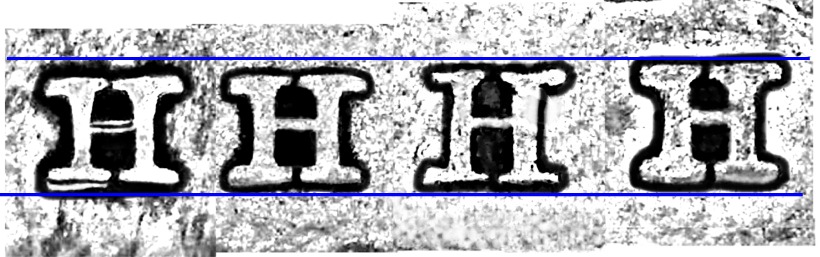 |
|
Valued Member
United States
324 Posts |
It seems to me that the H listed in the Charlton book as having Die Deterioration is actually a 3rd H. This woold correspond to the third H from the left in the image I posted. Any suggestions for a name for this H? Its inbetween large and small, and is not as bold (especially on the serifs) as the large and small - how about Thin H? |
|
Pillar of the Community
Canada
1051 Posts |
I find the 1903 large H / small H very tough to tell apart when looking at only one coin.
In theory, a line drawn vertically down to the rim from the bottom left corner of the large H *should* intersect a denticle, whereas the small H should not. I don't know how practical this method is in actual use though.
|
|
Valued Member
United States
324 Posts |
After studying these H's for a while, my system works using the size and shape of the lower cavity in the H. On the Large H, this cavity is the smallest, and it has the shape of a square. On the Small H the cavity is larger, and it has the shape of a rectangle lying down, and on the Thin H, the cavity is the largest, and has the appearance of a rectangle standing upright. Using this method, one can tell without taking an image of the H and comparing it with exact size images of other H's. I have tested it with the coins I have and it works fine. But, ho knows, there may be other variations of this H I am currently unaware of.
|
|
Pillar of the Community
Canada
650 Posts |
I have always had a hard time with this as well ,loking forward to a difinetive explanation.
|
|
Bedrock of the Community
United States
10045 Posts |
Here's a photo of my 1903 5c--any guesses?   |
|
Valued Member
United States
324 Posts |
Large H (likely doubled at the base) with a die break across the entire reverse. Nice one.
|
|
Bedrock of the Community
United States
10045 Posts |
mkb, you're right--this one does have a break from rim to rim.  |
|
Valued Member
United States
324 Posts |
DVCollector, that's a nice image. What did you use to take it?
|
|
Bedrock of the Community
United States
10045 Posts |
Thanks! I used a Nikon D70S with the 60mm macro lens.
|
|
Valued Member
United States
324 Posts |
Your camera takes good images. No fringing or chromatic distortion at the edges. As for lighting, many digital cameras have a function that allows for automatically eliminating the excess yellow that comes from most in home light sources.
|
| |
Replies: 22 / Views: 10,062 |










 Posted 08/29/2009 02:10 am


