| Author |
 Replies: 14 / Views: 6,928 Replies: 14 / Views: 6,928 |
|
|
Rest in Peace
United States
4849 Posts |
Anyone want to take a shot at grading this coin? It's a one escudo. I always liked these because they reminded me of pirate gold...  ARRR! edit: shoot, I just realized it is in the wrong forum. My apologies. Feel free to move. These circulated in the US, so that should count for something  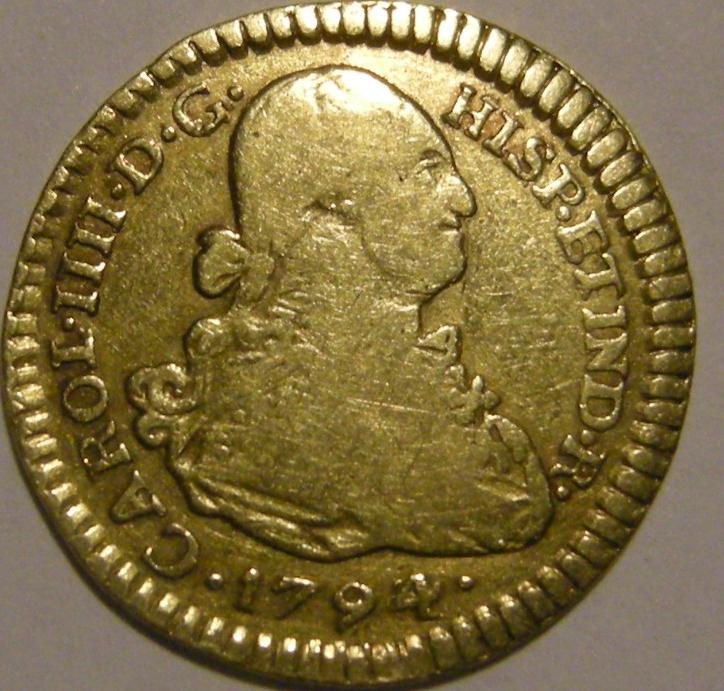 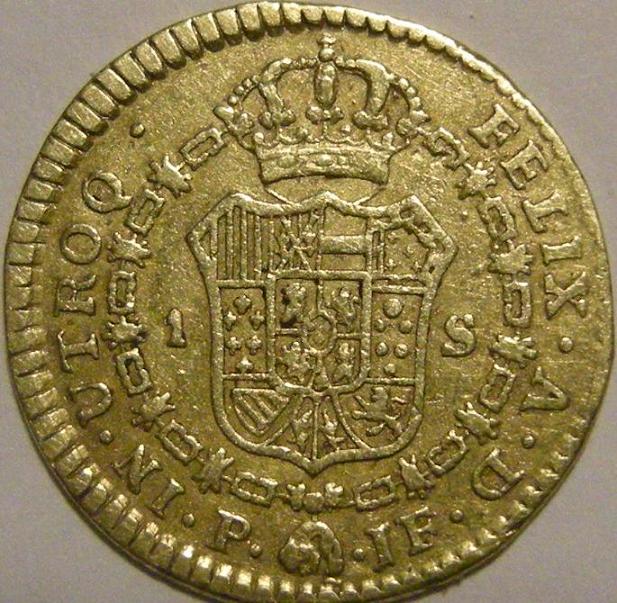 Edited by johnny54321
09/06/2009 11:56 pm
|
|
|
|
Pillar of the Community
United States
7123 Posts |
The coin looks to be in EF-40 as a detail grade , but it shows signs of a harsh cleaning , that will affect the final grade.
Im not a fan of net grading so my label would look like this
EF-40 details cleaned
|
|
Pillar of the Community
United States
1571 Posts |
I believe that is actually a ONE shilling coin. The legend indicates it is Spanish, and refers to the king being Charles IIII, King, by the grace of GOD, and Emperor of India, or The Indies. Probably the latter. I'm not that "up" on those.
It does not look like the 8 Escudos, (gold), I saw in Mexico, in 63-66. They are known as "Alasanes". The 8 Escudos were at one time equal to 16 reales. They were minted in Culiacan, Sin. MEx., among other mints. I have seen them from Guanajuato, Culiacan, and Mexico.
Dick
|
|
Pillar of the Community
United States
6442 Posts |
Sure looks like a 1 escudo coin to me ('S' is the abbreviation for Escudo). I'd venture a split grade for this one: VF20 obverse, EF40 reverse. The obverse detail looks pretty weak and this side shows hairlines from some kind of mishandling or light abrasive cleaning. The color however looks pretty natural. The 4 in the date looks odd; could this possibly be an overdate of some kind?
I like it, and would be happy to have it in my world gold collection.
|
|
Rest in Peace
 United States
4849 Posts |
|
|
Pillar of the Community
United States
3499 Posts |
johnny54321- Nice! This is in fact a 1794 1 Escudo that was minted in Colombia (hence the "P" mint mark at about 6:30 on the reverse). I would grade this guy at about F15. I wouldn't necessarily conclude that it has been cleaned. Remember that gold does not tarnish nor does it necessarily naturally develop a dark toning. Since I do see some darker toning around the lettering and around the outline of the king's bust, this may in fact be the original toning.
Jaobler is right in that the "S" to the right of the shield on the reverse is an abbreviation for "escudo." Also, the value of the escudo to the real is a bit higher than has been mentioned on this thread so far. One escudo was actually equal to 10 reales.
1 Escudo = 10 Reales
1 Real = 34 Maravedis
So 1 Escudo = 10 Reales = 340 Maravedis
And just for good measure:
8 Escudos = 80 Reales = 2720 Maravedis
Also, would it be possible for you to post a couple of pictures of the edges of this coin? I must admit that I have never handled Spanish gold from Colombia. So I am quite curious.
Edited by Archraz
09/07/2009 4:37 pm
|
|
Pillar of the Community
United States
1571 Posts |
Thanks for the update. It has been many years, and a lot of water has passed under the bridge! The "P" would be S.L. Potosi, Right? BTW, I checked the link, and joined. My question is that the date shown IS 1794, and it has been stated," it is in fact a"1780". Where did I miss the 'boat"? who switched coins on me?  Dick Edited by livingdinasaur
09/07/2009 3:57 pm
|
|
Pillar of the Community
United States
1571 Posts |
speakimng of the edges, were thse coins cast? I ask, because of the bit of the edge, in the first photo. I was under the imp[ression that they weremade in presses. maybe it has been longer than I thought! Thanks,  Dick |
|
Bedrock of the Community
United States
10045 Posts |
I also noticed that raised lip on the edge, and wondered what caused it?  As this is totally out of my experience, I look forward to learning something. Perhaps Swamperbob can help out there? |
|
Pillar of the Community
United States
3499 Posts |
livingdinasaur- These were in fact struck coins. I see what you mean at about 1:00 o'clock in the first picture. This does not appear to be a seam from casting to me. Rather, if you look at the left side of the coin, you will see how the border dentals are partially "cut off." Well, they were not literally cut of, but they ran off the edge of the coin due to the coin being struck a bit off-center on the blank. These dies were often larger than the blanks on which these were struck. Since these were not collar dies, and the edging of many Spanish coins at the time was done separately with two edger dies, often this would result in the dentals not being of equivalent length all around the legend of the coin. In short, these coins were usually a bit off center, so in the case of this coin you have only the inner half of all the dentals on the left side of the coin and most of all the dentals on the right (and the full dental and then some at the 1:00 o'clock position).
|
|
Pillar of the Community
United States
1571 Posts |
Yes,. I think that would be a good idea. I am no expert, and was curious about the edge. It is not a sand-cast. I imagine it, (the sandcasr) was used to make a mold of mild steel, and the halves were nit exactly aligned. I have never seen one in hand, so it is only a thought.
Dick
|
|
Pillar of the Community
United States
5362 Posts |
I saw my name in this post so I checked it out.
First of all the coin certainly looks real. The details are correct for the dies and I see no evidence of casting. The explanation regarding the strike by archraz is correct. The coin was struck in an open sided screw press with dies just slightly larger than the planchet which was pre-edged with a diagonal pattern. The dentils are uneven which is NORMAL.
The "raised" edge is a different matter. Any spur or extraneous metal at the edge is NOT RIGHT for an open sided press - unlike a collar where metal can rise into a worn collar nothing in an open press causes a true "raised" segment. The one exception is a chipped die but that leaves the original planchet surface where the dentils were chipped out. A raised edge can be created by several forms of post strike damage, however. Often they are from edge filing (like clipping to remove gold) or scrapes (accidents) that turn a curl of edge metal up. The presence of an edge bump can also raise a short segment. That is the most likely source. Finally a raised edge can also be a sign of mounting in jewelry.
But that said, I really do not see a true "raised edge" at all. Perhaps a trace of a small bump near L.IIII - but nothing really serious.
You should always check a coin of this general type for an off metal strike. Colombia was an early source of Platinum which on occasion was substituted for gold even by mint workers. Remember in 1794 Platinum was a new discovery and the metal was considered to be WASTE. A heavier than normal coin or one with a higher than normal SG could point to a platinum alloy. (This is a remote possibility but one I always confirm on South American Gold Colonials. The fact that the Platinum forgeries are MORE EXPENSIVE than originals is reason enough.)
The one thing I really do not agree with in this post is a grade of EF. The original dies had far more detail than I see here. There is significant wear on the King's head and on the details of the crown. In my opinion it is a VF tops.
|
|
Pillar of the Community
United States
1801 Posts |
Archraz, I think you may have a diferent scale of values than what is generaly accepted. A gold doubloon, (8 Escudos) was worth 16 8reales by most accounts.
Here is the breakdown for Spanish Coins
8 Escudos = 4352 Maravedies (mrs)
4 escudos = 2176 mrs
2 escudos = 1088 mrs
1 escudo = 544 mrs
8 Reales = 272 mrs (thus 16 8 reales = 4352 mrs = 8 Escudos
4 Reales = 136 mrs
2 Reales = 68 mrs
1 Real = 34 mrs
1/2 Real = 17 mrs
The simple concept in Spanish coinage was each coin was worth 2 times the value of the coin below it on the above scale.
One of the various names for an 8 escudo coin was a "doblon de 16 pesos"
Interesting side note, the copper mrs served as the Royal Standard for determining relative values between coins.
|
|
Pillar of the Community
United States
3499 Posts |
jfransch- hmm I really did not know that. My scale was based upon what a friend and fellow 8 collector told me years ago. Thanks for the info!
|
|
Valued Member
United States
309 Posts |
Did anyone get the mint correct yet? It is a 1794 one escudo of Charles IV from the Popayan Mint, with assayers intials "JF," a common date / mint mark as escudos run.
|
| |
Replies: 14 / Views: 6,928 |
|









 Posted 09/07/2009 01:11 am


