Coin Community Family of Web Sites Join Thousands of Coin, Bullion, & Money Collectors
Royal Canadian Mint products, Canadian, Polish, American, and world coins and banknotes. Vancouvers #1 Coin and Paper Money Dealer Shop for APMEX Bullion on eBay!Specializing in Modern Numismatics 300,000 items to help build your collection! Join Thousands of Coin, Bullion, & Money Collectors Coin, Banknote and Medal Collectors's Online Mall


Username:
Password:
Save Password
Forgot your Password?


This page may contain links that result in small commissions to keep this free site up and running.

Welcome Guest! Registering and/or logging in will remove the anchor (bottom) ads. It's Free!

1899 Mexico Centavo - Struck Over ?

To participate in the forum you must log in or register.
Author Previous TopicReplies: 4 / Views: 5,746Next Topic  
Pillar of the Community
swamperbob's Avatar
United States
5362 Posts
 Posted 09/17/2009  10:09 am Show Profile   Bookmark this topic Add swamperbob to your friends list Get a Link to this Message Number of Subscribers
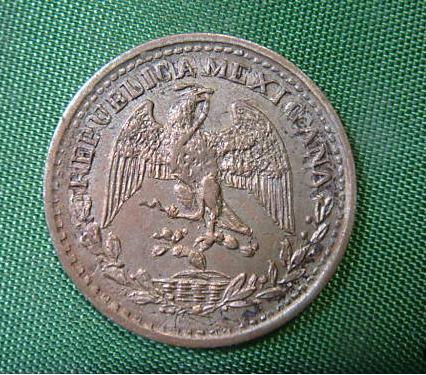
There is an interesting "counterfeit" coin on ebay that has drawn some significant bids. The coin is a re-struck centavo. The date of the host coin is uncertain, but some of the leaves are clearly visible as are the stems of the wreath. If you look closely the original M mint mark is just to the left of the new M. The thick stems on the host coin identify it as the KM 415 (which was made between 1905 and 1949). The coin being copied is the KM 394.1 dated 1899 from Mexico City which is a very rare key date coin worth over $300 in EF.

Here is the coin:


1899-Mexico-Centavo---Struck-Over-?????


1899-Mexico-Centavo---Struck-Over-?????

The new coining dies are COUNTERFEIT. The seller noted that the coin was a "FAKE" in his description. http://cgi.ebay.com/ws/eBayISAPI.dl...260476096108 The dies are a hand engraved fantasy engraving which copies the 1899 Centavo. The pictures are good enough to make out the engraving strokes in the details. Look specifically at the 1 Cent symbol, the leaves and the Eagle's feathers. There is also a stray line near the edge to the right of the date. Die lines can be identified because they are RAISED on the coin - not like scratches.

I know this coin fairly well, I own a copy that was once in the collection belonging to Virgil Hancock. My copy was struck over an MS centavo dated in the middle 1940s (I recall it being a 1946, but it is buried someplace in my collection.) It was a very common MS date in any event and it fixed the date of production at some point after WWII.

The coin is therefore a Modern Non-Circulating Numismatic Forgery.

Just thought that a bid over $100 on a Modern Numismatic Counterfeit was FAR TOO HIGH.
Edited by swamperbob
09/17/2009 10:10 am
Pillar of the Community
Archraz's Avatar
United States
3499 Posts
 Posted 09/17/2009  12:51 pm  Show Profile   Bookmark this reply Add Archraz to your friends list Get a Link to this Reply
Very interesting, Swamperbob. I just wonder why they bothered to strike the coin over a genuine later centavo rather than just make their own copper blanks.

Also, out of curiosity, who is Virgil Hancock?
Bedrock of the Community
DVCollector's Avatar
United States
10045 Posts
 Posted 09/17/2009  3:05 pm  Show Profile   Bookmark this reply Add DVCollector to your friends list Get a Link to this Reply
The coin's rim caught my attention immediately--interesting writeup!
$100 is quite a bit for a crude fake from the late 40s.
Pillar of the Community
swamperbob's Avatar
United States
5362 Posts
 Posted 09/17/2009  5:47 pm  Show Profile   Bookmark this reply Add swamperbob to your friends list Get a Link to this Reply
Archraz I guess I am showing my age. As a kid coin collector, Virgil Hancock was a "Big Name". He was one of the guys if not THE guy responsible for our present coin grading system and the instigation of all TPG outfits. Back in 1970, before he was ANA President (1975-77) he proposed that a book of grading standards be published. That book got everything going - they adopted Sheldon's grading scale and the rest is history.

Hancock was a Counterfeit Detection specialist and wrote a periodic column for the Numismatist starting at least back in the 50's - it was my Bible as a kid. I read every one I could find at the local coin dealer (that was back before I could afford more than the Red Book). He was along with Clyde Hubbard one of the two guys who took on Mel Fisher regarding the 1732 Pillar 8R coins.

He collaborated with Larry Spanbaur on the Standard Catalogue of US Altered and Counterfeit Coins - published in 1979.

He used to give lectures on Counterfeit Detection at ANA conventions. I have several of his original exhibits from one held in New Orleans back in 1972.

He unfortunately did not age well himself and at the end of his life he was chastised for calling everything counterfeit. I think he had some form of dementia at the end of his life which unfortunately tarnished his career. But in his hay day in the 1960's his word was second only to GOD with regard to the authenticity of any coin.

I bought part of his counterfeit collection after his death. The way I heard it, the better material is all in the ANA collection including his examples of Riddell coins.

Regarding the reason for using real Centavos - weight and composition would be my guess. The host coin in this case was circulated and discolored which makes the under type very visible. Using an MS host with full luster left few traces visible causally. I expect that these coins were quick sales made at shows in poor lighting to unsuspecting people. Think about being offered a $500 rarity for $5. A greedy buyer will be caught. Also that kind of person would be unlikely to admit being taken because taking such an under priced rarity would violate ANA rules.

DVCollector In this case the rim is BAD. But that is at least partially due to extremely high striking pressures being employed. The higher the strike pressure - the fewer details of the original coin remain. That is essential when re-coining. Think of the 1828 Manilla over strikes or the Bank of England Dollars of 1804 or the entire series of 960 Reis from Brazil. The under type is often unseen. So in many cases, the under type here is likely obliterated. I can see NO TRACE of the date. The reason the lower ribbon shows is because of the poorly aligned dies. Pressure shifted to the upper portions of the dies and was lost at the bottom. The rim distortion is proof of the pressure distribution. The seller does not seem to know the coin is a re-strike at all. At least he does not mention it.

Pillar of the Community
xshift's Avatar
United States
2669 Posts
 Posted 09/18/2009  12:39 am  Show Profile   Bookmark this reply Add xshift to your friends list Get a Link to this Reply

Quote:
He collaborated with Larry Spanbaur on the Standard Catalogue of US Altered and Counterfeit Coins - published in 1979.


I just got that book I'm only about half-way through it, but so far the section on flow lines and how you can use them to tell the amount of luster (and even an added mintmark) was very informative. Sounds like he was extremely knowledgeable - I'm now even more glad this is one of the titles I bought.

Thank you for these posts, swamperbob; they are very enlightening.
  Previous TopicReplies: 4 / Views: 5,746Next Topic  

To participate in the forum you must log in or register.


Disclaimer: While a tremendous amount of effort goes into ensuring the accuracy of the information contained in this site, Coin Community assumes no liability for errors. Copyright 2005 - 2026 Coin Community Family- all rights reserved worldwide. Use of any images or content on this website without prior written permission of Coin Community or the original lender is strictly prohibited.
Contact Us  |  Advertise Here  |  Privacy Policy / Terms of Use

Coin Community Forum © 2005 - 2026 Coin Community Forums
It took 0.24 seconds to rattle this change. Forums