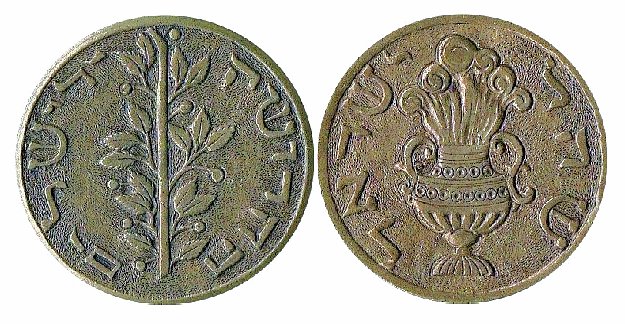
It's called a "false shekel". As you can tell from the name, it's not a real coin.
The design is (very loosely) based on a coin struck by the ancient Jews during the First Revolt, 66 - 70 AD. The original coin
looked like this one on Wildwinds and had the passover cup on one side and a sprig of pomegranates on the other. The cup has devolved into some kind of fancy urn or censer, with the Hebrew letters above the cup misinterpreted as smoke or steam. On the other side, the pomegranate branch has morphed into Aarons's Rod with almond leaves and buds. The writing style has also changed from ancient Hebrew to it's mediaeval Yiddish form. The text on the original coin said "shekel of Israel" on the cup side and "Jerusalem the Holy" on the other; the characters above the cup (misinterpreted as steam) indicates the year.
False shekels have a long and mysterious history. They were no doubt first made in Europe and the Near East back in the middle ages, sold to (gullible) pilgrims on their way to the Holy Land. The design was later used on "tokens" used in certain Jewish, Christian and Masonic fraternities. Ones that can be positively determined to be several hundred years old can be worth something to a collector of such things, but this one is modern - 20th century, by the styling. Check
this article on the American Israel Numismatic Association website for more info; your type is shown on page 4.
Do a CCF forum search for "false shekel" and you'll see they crop up on the forum here fairly often.
Don't say "infinitely" when you mean "very"; otherwise, you'll have no word left when you want to talk about something really infinite. - C. S. Lewis












 Posted 10/17/2009 5:57 pm


 Your knowledge saved me from placing a bid on this item. Gotta love this forum


