| Author |
 Replies: 15 / Views: 16,280 Replies: 15 / Views: 16,280 |
|
|
Pillar of the Community
Philippines
1156 Posts |
Would request your opinions on coin grade and also for any additional information about this coin. Thank you in advance 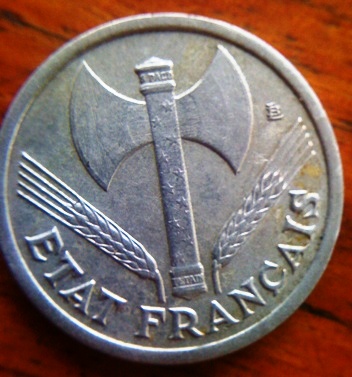 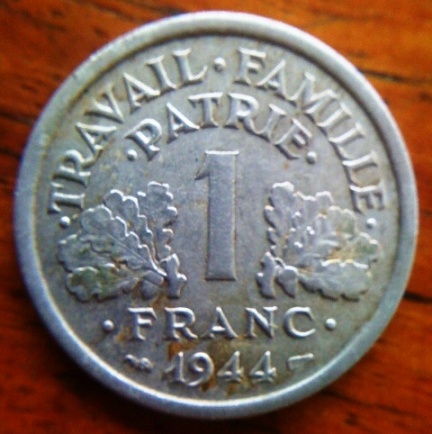 Moved to World Coin Grading forum - Sap Moved to World Coin Grading forum - Sap |
|
|
|
Pillar of the Community
Australia
2830 Posts |
G'day, as I understand it, "Etat Francais" and the fascist symbol; and on the reverse motto "Travail, Famille, Patrie" (work, family, fatherland), are associated with the Vichy Regime, which governed the so-called "Unoccupied Zone", in southern France. The Zone's administrative centre was at the town of Vichy. see: http://en.wikipedia.org/wiki/Vichy_FrancePeter in Oz |
|
Pillar of the Community
Belgium
651 Posts |
The letters LB right of the francisque (Frankish axe) are the designers initials and stand for Lucien Bazor.
|
|
Valued Member
United States
365 Posts |
Coupla tidbits to add:
- over 73 million made by the Paris mint (no mintmark)
- in the type, look for ones with a mintmark, the letter B or C to the left of the francisque. These are much rarer and represent much higher values.
- this one looks to be a VF grade at best--the stars on the axe look pretty good, but there is considerable wear and what appears to be corrosion (orangey splotches)--and the catalog I use doesn't list a value for anything below an XF. A top quality AU books at 3 euros, but I would think you'd need to have a true Unc to have something of value in this year and mint.
Finally, I'd temper Peter Thomas' remark that the francisque is a fascist symbol. It's a fascist emblem only by association or equation with Vichy--the real story of the symbol is more complicated, and more interesting, than if--like the Nazi Swastika on German coinage--the francisque had been a symbol of the extreme right in France before the Occupation (which it wasn't).
Bazor was chief engraver from 1931 to 1958, and is responsible for many franc designs before and after the 'dark years' of Occupation and collaboration. I know precious little about the circumstances surrounding the choice of the francisque--did top figures in the Vichy regime pick the design over other proposals?--or about the political leanings of Bazor himself, but I would suggest that the francisque is pretty ambiguous as a symbol and can be interpreted in more than one way. (Plus if Bazor had been much of a fascist he'd have been an easy target for punishment in the "Epuration", the purges of suspected collaborators and sympathizers after the war.)
The francisque is the only such warlike design on any modern French coin-- the rest are liberty busts, Marianne, the Sower, etc. I see the double-headed axe--though historically completely inaccurate, the Frankish axe had one head alone--as an evocation of the profound split of French society between Occupied France and Vichy France, a symbolic acknowledgment that France is divided, despite the (vain) hopes and declared intention of Petain to hold the country together. Further, it evokes the even deeper political split between the Left and Right in France that had existed for decades prior to the debacle of June 1940, but which everyone blamed for the disaster of that summer. Even though under the heel of the Germans, France continued to be very much torn between two extremes, and was going through a protracted, slow-burning civil war that wasn't truly brought to an end until 1945, with the often-violent postwar purges from which the Right took some time to recover.
Sorry for the lengthy post, but this thread has really gotten me thinking about the francisque. Hope my post adds to your sense of the value of the francisque franc!
-SCS
|
|
Pillar of the Community
 Philippines
1156 Posts |
Thanks all, that is one ton of serious information right there, thank you
I was quite curious why the axe and the wheat? and the other side appears to be Lettuce? at a time of war, 1944? Is the Francisque always represented together with wheat? thanks
|
|
Moderator
 Australia
17016 Posts |
The symbolism used on the Vichy State coins was deliberately different from that used on the Free French coins.
If you look closely at the "lettuce", you'll see acorns - those are oak leaves.
Don't say "infinitely" when you mean "very"; otherwise, you'll have no word left when you want to talk about something really infinite. - C. S. Lewis
|
|
Pillar of the Community
Australia
2830 Posts |
G'day, I didn't know that the Vichy axe was called a "francisque".
A quick search on Wikipedia only showed that "Francisque" has been used as a personal forename.
My understanding, as S-Ceres points out, is that axe was only used during the Vichy era.
And, it is reminiscent of one element of the Italian fascist symbol.
Hence, my inference that it was a fascist symbol.
Curiously, and I have no idea where this fits in to the overall picture, the coins of the early Third Republic, in the 1870s, feature an Angel - a device used much earlier, pre-Napoleon. But the 1870s Angel has a rooster in front of him, and something behind him that looks a lot like a Fasces. I'd be interested to know what it was, and what it symbolized back then.
Finally, back to the "francisque" - near the top and the bottom of the staff, or handle, there are devices which might be words: if so, what are those words, please ?
Monsieur BAZOR sounds like an interesting character: and one who didn't need a weatherman to tell him which way the wind was blowing.
Peter in Oz
|
|
Valued Member
United States
365 Posts |
Hi All!
Peter: I'm assuming you are referring to the angel on the purportedly luck-bearing gold coins of the Belle Epoque (3rd Republic). You're absolutely right, it is a Republican design, from the First Republic, the one that Napoleon "saved" from its enemies by, well, declaring himself First Consul and then a little later Emperor (ah, the irony...). The 3rd Republic was desperate to secure symbolic ties to the previous two short-lived French Republics and so they brought back Tiolier's Hercules design (used in both previous republics on the 5FF) and the bust of the Goddess Ceres (1 cte, 5 ctes, 10 ctes, 20 ctes, 50 ctes) as well as the Angel writing the republican constitution.
Ceres brings us back to your question, Nic, about the oak leaves and the ears of wheat. I take the wheat as a nod to the agrarian symbolism of many of the French coins. Ceres is the goddess of harvests, agriculture, and prosperity; France was still very much an agrarian society in the first half of the 20th century. (Note too the cornucopia on the reverse, an agricultural symbol, that had become the privy mark for the Paris mint.) The simple agricultural imagery is a real departure from the art-deco-inspired curves and lines of the Sower and the Mariannes of the 30s and 40s, and--much like the famous Petainist motto of work family and country--bespeaks a time in French history when it was best to keep your head down, keep your family fed as well as you could, and hope the storm would pass. Thankfully, a good number ignored this Petainist advice and caused some problems for the Vichy militias and the German occupiers.
The writing on the francisque is "S. Pacis" on the top and "Petain" on the bottom. Petain as hopeful guarantor of 'eternal peace'. It was Petain, after all who agreed to take "power"--though fairly little was to be had--and sign the Armistice ending hostilities with the Germans in 1940. This was indeed the only period where the French coinage feature the frankish axe.
I'm going to put some links up later on for you to sites discussing the francisque, and will also tell you what I can about the oak leaves, fasces and rooster.
-SCS
|
|
Pillar of the Community
Philippines
1156 Posts |
thank you for the info, truly detailed and coin relevant, specially the acorn leaves and letters on the francisque axe. It is very interesting to know that 'Petain' is a person's name, what is meant by 'S.Pacis', is it eternal peace?
On an opinion basis, just one more inquiry please... of what value.. more or less, would you say can be bought by 1 Franc in the year 1944?
|
|
Rest in Peace
United States
1729 Posts |
So ... the oak leaves ... symbolic of Germany "mixing" in with the agrarian population of France, symbolized by the ears of wheat?
|
|
Valued Member
United States
365 Posts |
Hello, back as promised! Nic: Great question! I did some googling and came up with a site that supplies values in euros for 1 French Franc from 1908 to 2001! Their source is the INSEE, a highly respected institute of statistics (they do amazing things) and so these values are pretty solid indicators. But this is just an indicator, it's difficult to grasp without developing a list of actual day-to-day prices for basic goods and services. During a war, of course, prices will fluctuate wildly, in addition to many, many things just simply disappearing from the market one day and reappearing another at many times their price. So one could find oneself in the situation of perhaps having a fair amount of francs on hand and nowhere to spend them on, say, butter. You'd then turn to the black market perhaps and find your franc value dropping by the second! So take a look: http://www.leparticulier.fr/jcms/c_...s-des-francsFrom these statistics, you'll be able to detect to some extent the effect of inflation on purchasing power. For instance, the silver Sower franc from before World War I, when France's economy was running very smoothly and seeing strong growth rates, one French franc was worth the equivalent of 3.6 euros (about USD 5.40 in 2009). That's a strong franc! It plummets as a result of the war, and like Europe's economies in general goes on a multi-decade slide and stagnation through the turmoil of the postwar, then Depression, then WWII, then the Algerian conflict, and Decolonization. By 1944 it's at the equivalent of .17 euro cents, or USD 25 cents (again, in 2009). What can anyone in America buy for a quarter these days? Used to be, it got you a lot of things. Now it's not so much! I couldn't resist looking up the equivalent in Philippine Pesos: a US quarter = 11.74 PHP. What can you buy with that, these days? That gives you an idea of the purchasing power of the francisque axe franc from 1944, the value of what a US quarter can buy in America today, what 17 euro cents buys you in the EU today, or 11.75 PHP in the Philippines! |
|
Valued Member
United States
365 Posts |
Part Deux: (<-- brazen Charlie Sheen film reference) Semper Pacis : Eternal/Always/Forever Peace. Petain was a top military commander, a "Marechal" of the French Army, and had distinguished himself in the course of the pivotal action around Verdun in 1916 (World War I) and endeared himself to many French of all political persuasions. In 1940 he was still a beloved hero, but he was a very old man too: 84 yrs old! Like most 'things Vichy' there is a certain amount of historical debate, but from my readings I've come to the conclusion that he stood up and signed the Armistice with the Germans in 1940, and agreed to serve as (figure)head of the Vichy State out of an altruistic belief that he was doing what France needed in a time of serious crisis. He saw himself like Batman at the end of "The Dark Knight": not the hero France wanted in 1940, but the one it needed. Whether right or wrong in his vision of things, that's a great point of debate. What is certain is that he was either ideologically blinded or just too weak to rein in the zealot right-wing extremists working in his government, and on his watch and in his name his functionaries committed atrocities and served as eager lackeys to the Nazis. NO OTHER NAZI-OCCUPIED NATION in Europe collaborated so eagerly as the French. That was certainly not what France needed! Now, politics aside, let's go back to the cultural symbols, the rooster, fasces and oak leaves. The rooster, 'coq' in France, became the national symbol of France way, waaaay before the 20th century or Mr. Bazor became head engraver. Like so much of what is delightful about the scrappy French, the symbol and term were born of a PUN that bemused the Romans: in Latin, what we call France went by the name Gaul, or Gallia, or Gallus (recall that the Romans controlled Gaul for centuries [I'll have you watch Gladiator for a quick education on how the Romans subjugated the populations of Gaul and Germania!]). It just so happens that the rooster--okay, certain kinds--was also called Gallus in Latin, so you could say "Check out that funny-looking Gallus over there!" and no one would know if you were referring to a Frenchman or a rooster. Centuries later, during the Middle Ages, enemies of French monarchs revived the pun to mock them, and, in their unstoppable spirit of contradiction, the French actually decided that they liked the association between themselves and the feisty, proud--and hey, let's face it, sexy--little animal! The French wikipedia reports--with sources--that the rooster became an enduring symbol for the French nation by the time of the Renaissance. It also traces out the battle of symbols that occurred throughout the long 19th century between Republican governments adopting the rooster for flags, signs, emblems, statues, you name it, and Imperial governments replacing the rooster with an eagle (Cf. Napoleon, who broke the mold with the eagle). By the 1950s, the rooster was a very familiar national icon, used throughout the Belle Epoque and pre-war period in advertising discourse. Hence the rooster's dominance on the last series of coins of the 4th Republic (10, 20, and 50 Franc coins). Aside perhaps from commemoratives I can't think of any 5th Republic coin bearing a rooster. The fasces is a symbol that takes us back to the Romans once again. In the good old days of the Ancient Roman Republic, you had a body of important citizens bearing various official titles and offices that constituted the justice system. These VIPs were escorted by, protected by, and saw certain decisions carried out and enforced by men known as lictors. These no-doubt savory characters walked around town carrying a fasces, or a set of rods bundled together with an axe (there's that axe again, Eugene!). The fasces is a pretty sophisticated device of 'law enforcement' and crowd control: the rods were for corporal punishment, sometimes people just needed a beating; the axe was for capital punishment, namely, beheadings. So one symbol, two meanings: discipline and punishment (pace Foucault!). It's a lovely pre-figuration of the very modern separation between those who have the power to judge you (judges, justices, etc) and those who get paid salaries to carry out those judgments upon your person (police, prison staff, executioners...). So if you're a Roman, you're walking around town and up comes a dude surrounded by men carrying fasces: you recognized immediately via the fasces (as a symbol) that here was a magistrate who had power over life and death. You might be advised to cross the street to walk on the other side... In French coins, it's the 1st Republic, the fledgling one with all the decapitations going on (irony...) that brought the symbol of the fasces back. The purpose of doing so is to develop an iconography of republicanism that is rooted in the Ancient Republic, thereby putting cultural weight and years on a political experiment that was extremely brand new to Western Europe, and, well, fledgling. They couldn't very well put a bunch of American Revolutionary symbols up, even though that experiment had already gotten started. No: they needed things that would connect with their audience, and in those days few things worked so well as iconography harvested from Antiquity. The Roman Republic was known to educate elites and idealized by those in favor of trying out a Republic as a form of government. Here's a link to a site that identifies all the French coins that bear the fasces symbol ( http://numis-media.fr/forum/viewtopic.php?t=577). My story of the fasces ends on a sad, ironic historical twist: what totalitarian political fantasy grounded its name in the term 'fasces'? Oh right-- fascism. Finally: oak leaves! It's an interesting hypothesis you have there, pls, I like that way of looking at it: wheat for French on one side of the coin, oak for German on the other. (Is it mixing, or saying "I'm right behind you!" "And armed!"?) ;) Only I'm not certain these plants identify so specifically with a nation, but this is just a hunch. I'm going to have to call upon one of the experts in Roman coins on this forum to to pitch in on this. But pending that... On many of the ecus of the 19th century you find a crown of oak leaves on the reverse, or oak leaves combined laurel. I think this was a legacy of Napoleon I's obsession with Ancient Rome. The Emperors of Rome made coinage with their bust on the obverse, and on the reverse a crown of oak leaves, which has an interesting history of its own in Ancient Roman culture. Originally, the crown of oak leaves had been the highest military honor one could earn. It was earned by saving the life of a Roman citizen during battle and was attributed by the Emperor himself, who, of course also had one. The prestige of this icon was such that it became an annual ritual for the Senate to give an oak leaf crown--made of gold--to Emperor Augustus. The gold oak-leaf crown made its way onto the reverse of Roman coinage under Augustus, and the tradition stuck. This feature of the reverse stuck through both Roman Empires and Republics. Now, not only did the oak-leaf crown feature on the reverse around the denomination of French Republican 5 Franc coins, but Napoleon also wears the oak leaves on his head on certain designs, as does Louis-Philippe, Napoleon III, as well as the goddess Ceres and Marianne. (The latter two are wearing wreaths consisting of several types of plants, not just oak leaves.) So Bazor's oak leaves on the Francisque 1 Franc are probably not as explicitly a nod to the German oak leaves as much as they constitute continuity with French coinage stretching across the 19th century to the 1st Republic. This link is to a nice page showing Roman coins with the crown of oak leaves: ( http://www.sacra-moneta.com/Numisma...maines.html)Here's a question: do we call "World Crowns" world crowns because of how often they have crowns of oak leaves/laurel/something else on their reverses? Anyway, thanks for reading another long ramble! -SCS Edited by SeriousCERES
10/26/2009 03:45 am
|
|
Pillar of the Community
Philippines
1156 Posts |
Hi seriousCeres, I just printed out your reply, gives me more time to absorb it. Thank you for that detailed information. 12pesos of 2009 = 25c USA 2009 = 1Franc of 1944 that is surprising. In answer to your question, 12 Pesos right now can buy...aha... One 250mL sealed plastic bottle of mineral water! and thats just about it, some candies? or one juice powder sachette for mixing to a liter of water. But if your a coin collector, that's 120 pieces of 10c coins! quite a lot of coins  . The link on the exchange rates was really good, thanks again |
|
Pillar of the Community
Australia
2830 Posts |
G'day, again ...
quote from SeriousCERES: "... so you could say "Check out that funny-looking Gallus over there!" ..."
- indeed ! Don't I wish I had a Franc, or a Euro, or a Razoo for each time I've heard that said ... but I digress.
Your reference to "Gallus" is more detailed than any I've previously read. This topic has arisen on CCF several times previously.
In one or other of the previous threads, a passage from Wikipedia was quoted to the effect that "the Rooster as a symbol pre-dated the arrival of the Romans". I found this interesting, but I can't think how one might ever get to the bottom of that one - a sort of "chicken & egg" conundrum ? Can't readily lay my hands on the Wikipedia reference, sorry.
P.
|
|
Rest in Peace
United States
1729 Posts |
Fabulous history lesson in this thread - thanks to all who contributed. I can now understand better why Hemingway and other artists were so well inspired during the time that they spent in Paris.
|
|
Pillar of the Community
Poland
3201 Posts |
Thanks for all the information.  |
| |
Replies: 15 / Views: 16,280 |
|
To participate in the forum you must log in or register.
Disclaimer: While a tremendous amount of effort goes into ensuring the accuracy of the information contained in this site, Coin Community assumes no liability for errors. Copyright 2005 - 2026 Coin Community Family- all rights reserved worldwide. Use of any images or content on this website without prior written permission of Coin Community or the original lender is strictly prohibited.
Contact Us | Advertise Here | Privacy Policy / Terms of Use
|
| Coin Community Forum |
© 2005 - 2026 Coin Community Forums |
| It took 0.47 seconds to rattle this change. |
 |
|




 Posted 10/23/2009 07:09 am





