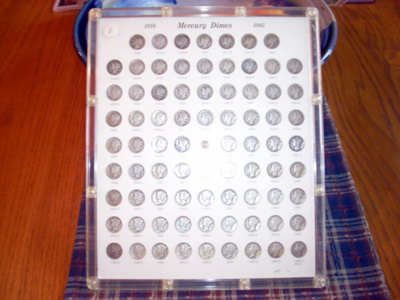
Posted 12/06/2009 5:45 pm


PVC in it's "natural" state is hard, brittle and translucent. It's also cheap, which is why people used it. But to make it soft, pliable and transparent (like you often find in cheap coin album pages) they have to add plasticizers. It's these plasticizers that degrade over time, leaving hydrochloric acid behind. This acid eats away at any coins placed inside them, creating the classic "PVC green slime film" you see on coins left in such albums for too long.
The green slime can be washed off with acetone, but the damage has been done - a lustrous or mirror-proof coin will appear hazed, a bright copper coin will darken, and so forth.
Plexiglass, also known as polymethylmethacrylate (PMMA), lucite, acrylic glass, and various other trade names, should be perfectly safe, at least for the short and medium term. PMMA, or a similar substance, is what the TPGs use when they slab coins.
The green slime can be washed off with acetone, but the damage has been done - a lustrous or mirror-proof coin will appear hazed, a bright copper coin will darken, and so forth.
Plexiglass, also known as polymethylmethacrylate (PMMA), lucite, acrylic glass, and various other trade names, should be perfectly safe, at least for the short and medium term. PMMA, or a similar substance, is what the TPGs use when they slab coins.
Don't say "infinitely" when you mean "very"; otherwise, you'll have no word left when you want to talk about something really infinite. - C. S. Lewis