| Author |
 Replies: 8 / Views: 2,160 Replies: 8 / Views: 2,160 |
|
|
Pillar of the Community
3660 Posts |
I bought a nice collection of over 200 older and first issue Thai notes about a month ago and in one of the albums was this Chinese note. Just wonder if it is worth keeping or is it trash? The paper is very thin, with stains and holes. You can read what I can read, but it means nothing to me. 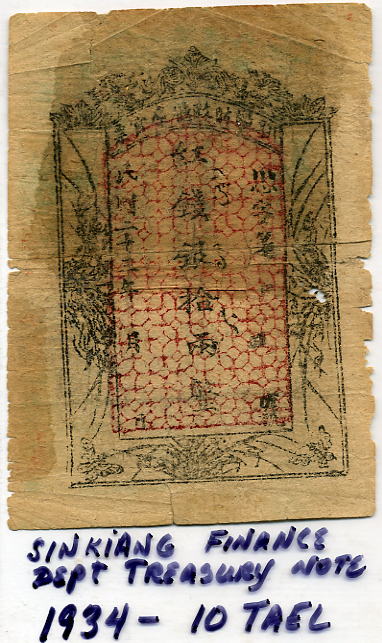 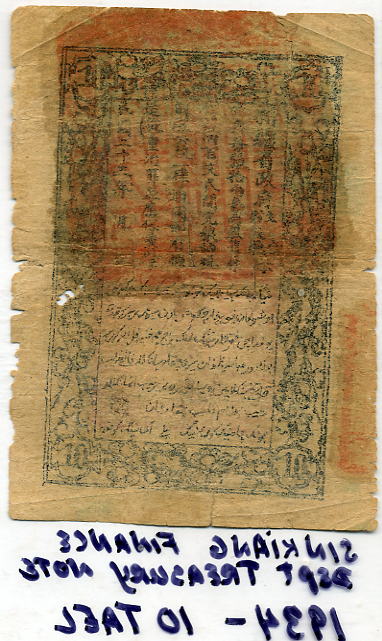 |
|
|
|
Pillar of the Community
Thailand
1509 Posts |
Hi zeewol
I'm sue you must realise by now that no note is ever 'trash'. Somebody, somewhere out there would more than likely love to have it just as an example, whatever its condition.
Anyway, can't help with that particular note but I was most intrigued by the 'nice collection of over 200 older and first issue Thai notes'.
Please tell me about the Thai notes (ages, denominations etc) or did you mean that there were a few first issue Thai notes. I've currently got about 140 notes (including various signatures on same 'type' notes) from Thailand but that's taken me 5 years to collect since moving here.
In eager anticipation
vic
|
|
Moderator
 Australia
17005 Posts |
It's a good thing it's already been identified, because I'd never have found it otherwise; the Chinese Provincial sections take up 100 pages in the Pick Volume 1 catalogue.
This note is listed, SP# 1881, M# H126.5-13 are the catalogue reference numbers but in the values column it merely says "reported, not confirmed". I don't know why it's "unconfirmed", especially given that there's a picture of that exact type right there in the catalogue. The 5 taels and 50 taels in the same series are worth $30 and $35 in Good condition, so assuming it's a genuine note, it probably isn't going to be worthless. But you may need to find yourself an actual expert in Chinese notes to find out what the story is with this one.
Don't say "infinitely" when you mean "very"; otherwise, you'll have no word left when you want to talk about something really infinite. - C. S. Lewis
|
|
Pillar of the Community
 3660 Posts |
Thanks again very much Sap. You are truly amazing. I hope you like doing what you are doing, I have lots of old (medieval, ancient type coins and a few old banknotes) lying around.
I will be more than happy to post some scans of whatever Thai note you would like to see Vic.
I have old, new, common, scarce, extremely rare, very circulated, uncirculated, errors, unserialized, you name it, I have it.
What I meant by 'first issue' is really first run. I'm sure that you are aware that each denomination was assigned a prefix letter and a series number in front of the serial number. Depending on the issue, these prefix letters changed, but for most of the older issues, one baht had a prefix of 'A1'. 5 baht= 'K1', 10 baht= 'N1' 20 baht= 'P1', 150 baht= 'O1', 100 baht= 'S1', and 1000 baht= 'T1'. About half of my notes are first run. The seller made a big point of this, I guess that it was important to him. The newer first run Thai notes have a prefix number and letter (like 0A), but I am sure that you know exactly what I am talking about.
|
|
Pillar of the Community
United States
5903 Posts |
I can read that is a department treasury note, but the year is 1923, and lacks the month and date indication. There's also the faded red cancel that no longer can I ever make out of from the scan, if its from Sinkiang.
|
|
Moderator
Australia
17005 Posts |
It says (in the column of characters down the left side of the top pic) "Year 23 of the Republic", which translates to 1934. There is no 1923 series of notes from this bank listed in Pick.
Don't say "infinitely" when you mean "very"; otherwise, you'll have no word left when you want to talk about something really infinite. - C. S. Lewis
|
|
Pillar of the Community
3660 Posts |
Thanks for clearing that up Sap; I was beginning to doubt you for a few tense moments. Everything is okay now though !
|
|
Pillar of the Community
United States
5903 Posts |
I better brush up on my history lesson! Thanks You too Sap!
|
|
New Member
United States
29 Posts |
I can read the Chinese on this note, but some of them are not clear enough.
It said "10 tael of red copper coin", which means you can exchange it into 10 strings of copper coins in Sinkiang.
the upper line says "Sinkiang Dept. of finance X X note". Issued 23rd year of ROC, which is 1934.
This note looks original to me. On the bottom of the back there are some local language in Sinkiang, like Arabic but actually not.
|
| |
Replies: 8 / Views: 2,160 |
|










 Posted 01/15/2010 08:52 am


