| Author |
 Replies: 11 / Views: 2,090 Replies: 11 / Views: 2,090 |
|
|
Pillar of the Community
3660 Posts |
I have more than just a few slabbed ancient coins, and I was wondering how can anyone grade such things? Without seeing the newly produced coin, how can comparisons be made? If you all don't mind, and think it may be interesting, I will post a few photos of some slabbed coins, to see if you can put a grade on them. I will follow with scans of the slabs showing the TPG's grades. Here is the first one. (I will determine by your responses or lack of, whether to continue with this sort of thing or not). ICG graded this one. It is labeled as Roman AD 321. 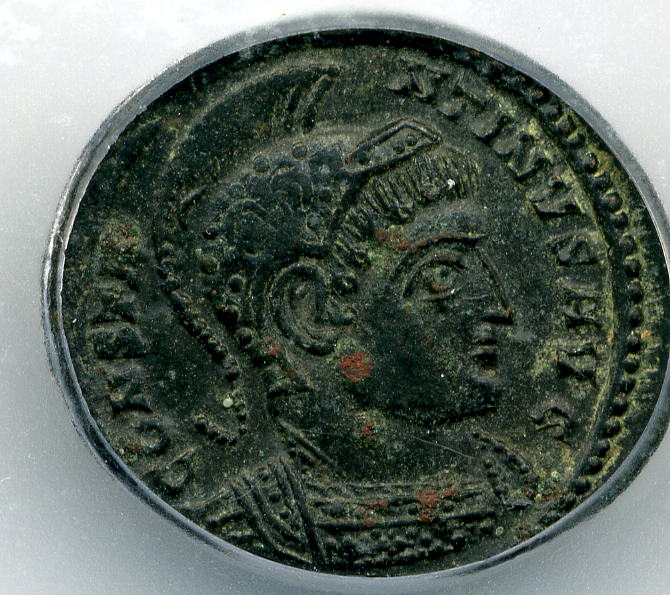 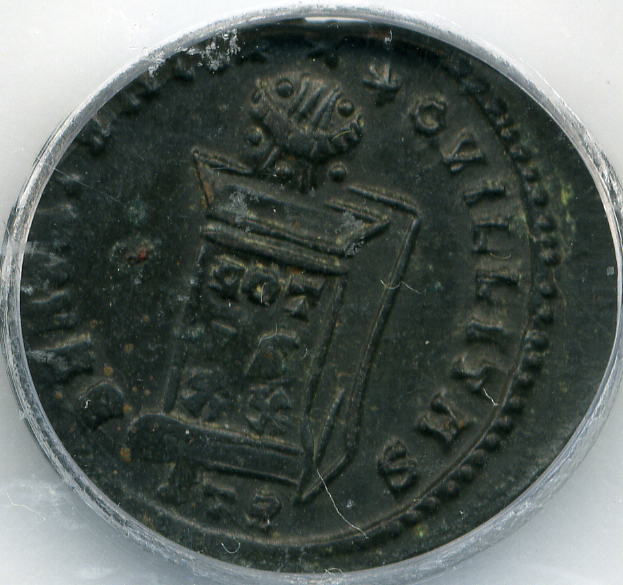 |
|
|
|
Moderator
 United States
23731 Posts |
Ancient coins are graded a little different the other types, only four grades are used, Good, Fine, Very Fine, and Extra Fine. There are an number of factors that are also used in the processing of grading this type, Corrosion, color, toning, centering, etc. From what I can see on this coin, I would grade it at VF- off center strike. Please feel free to post as many as you like.
|
|
Pillar of the Community
 3660 Posts |
Thanks for the info on the ancients echizento! It looks like it is just you and I on this subject, so I will throw up a couple more just for you. 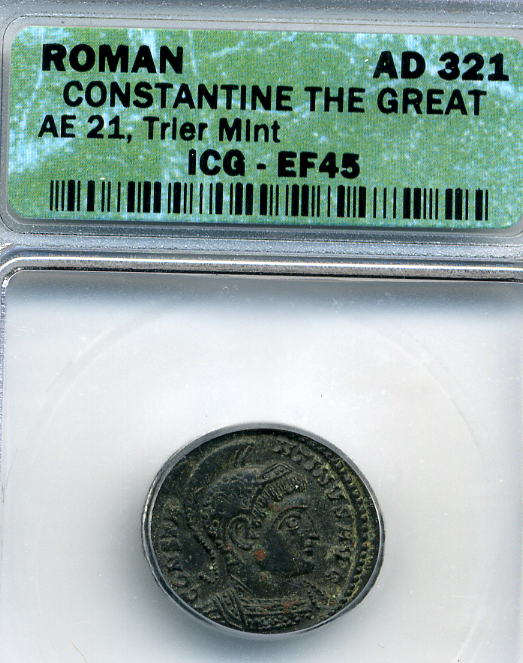 |
|
Moderator
Australia
17005 Posts |
I'd grade this one gVF; the wear looks EF detials, but it's a bit too off-centre and the corrosion spots on the reverse are too prominent for an EF grade.
Personally, I don't understand slabbing an ancient.
Don't say "infinitely" when you mean "very"; otherwise, you'll have no word left when you want to talk about something really infinite. - C. S. Lewis
|
|
Pillar of the Community
3660 Posts |
I too had wondered about the off center part of it all. I rather thought that the sharp strike is what may have garnered the EF at IGC.
|
|
Moderator
United States
16697 Posts |
Quote:
Personally, I don't understand slabbing an ancient.
Can I ask why Sap? Just curious since I was about to send ICG an ancient which is double-struck. I would like it protected by a "slab". swcoin.ecrater.com
|
|
Pillar of the Community
United Kingdom
2932 Posts |
I don't agree with slabbing ancients either.
There are just too many variables for it to be truely meaningful. If you take a milled coin, you know what the standard coin looks like and can determine a coins attractivenss as degrees away from that perfection - sort of.
With ancients, a coin could be partly off flan and still be more attractive and desirable than a perfectly centered one depending on wear, whats still on the flan and even die.
The labels VF, VG etc., really were designed to aid coin dealers when selling their coins to clients, back in the days when coin lists were typed up or handwritten - no photos to go by then.
Since photographing became so cheap and easy there is no excuse for a coin to be sold now adays (online) without an accompanying picture. That picture should say more about the coin than somebody elses opinion.
The slabbing thing is really an artificial form of rarity, deisgned to stimulate the buying and selling of coins as commodities rather than works of art (which ancients are).
I don't know the US system very well, but the differences between MS65 andMS66 is pretty minor and while some collectors will get excited about the financial variation between the two, to alot of people they will look pretty similar, and most people just want a nice coin, not an investment.
Certainly slabs will protect a coin, but then they are protecting the difference between MS65 and MS66, which is again a financial thing, not really a coin ching. With the exceptions of a very, very few "perfect" gold coins, most ancients would not really be affected by minor marks and scratches that occur from sitting in a tray.
Edited by Bacchus2
01/18/2010 07:24 am
|
|
Moderator
Australia
17005 Posts |
Quote:
Can I ask why Sap? Just curious since I was about to send ICG an ancient which is double-struck. I would like it protected by a "slab". As far as I can tell, slabs serve three purposes, none of which are really all that helpful for ancient coins. Protection - For the most part, ancients don't really need the help. An ancient coin has survived for a couple of thousand years without the help of a slab; I doubt a slab will be all that helpful in guaranteeing it sees another thousand or two. For the more fragile mediaeval coins I can see it being of some benefit, but ancients are typically much more robust. Further, ancient coins never come in "mint state" (even though some TPGs are in the habit of handing out MS or Unc grades) so they're never as vulnerable to serious accidental damage (like a fingerprint from careless handling) as a modern MS or Proof coin. Authentication - This is where slabbing is "least unhelpful", assuming thew slabbing company actually hires qualified experts that can tell genuine from bogus with reasonable accuracy. However, there are plenty of people, such as David Sear's ACCS, that authenticate without the need for slabbing. Sight-Unseen Trading - Slabbing has proved to be a boon for people who, for whatever reason, rely on Internet, mail-order, and other sight-unseen traders in coins - if you order a slabbed (modern) coin in the mail or off a website, you pretty much know what the coin is going to look like even if the pictures are poor, or absent. With an ancient coin, this will never be the case - complications such as off-centering, worn dies, a good or bad cleaning job, uneven strike, uneven wear; all this and more make summarizing an ancient with a single number difficult. If I ordered an "EF45" ancient without seeing it first, I have absolutely no idea what it would look like. Don't say "infinitely" when you mean "very"; otherwise, you'll have no word left when you want to talk about something really infinite. - C. S. Lewis
|
|
Moderator
United States
16697 Posts |
Thank you both for your response and expertise. I have 10 ancients (7 AE and 3 AR) and love them. I primarily collect U.S. coins but, am slowly finding a love for the ancients. In fact, my first coin purchase over 20 years ago was a small AR Greek ancient with Athena on the obverse and Medusa on the reverse. I have since sold that coin and really regret it. I have since added a few to my collection including a very interesting double-struck. I'll try to get pics up soon. Anyway, thanks again  Do you have a good book recommendation of Roman and Greek ancients? swcoin.ecrater.com
|
|
Moderator
Australia
17005 Posts |
The Sear catalogues are good general reference works, as well as a price guide. They're pretty expensive, though, so if accurate prices aren't necessary for you, I'd suggest you get second-hand ones from a couple of decades ago.
The Sayles books are also good for an "overview" of the different ancient coin series. The "Non-Classical" volume (VI) is especially useful for a generalist collector, outlining some of the ancient coinages that aren't covered by the Sear books.
Don't say "infinitely" when you mean "very"; otherwise, you'll have no word left when you want to talk about something really infinite. - C. S. Lewis
|
|
Pillar of the Community
United Kingdom
2932 Posts |
Even before you spend any money on books I'd have a look at some of the excellent websites there are around the place. Sap is right in that Sear or Vagi have some good background stuff in the books - though not significantly more than you would find on the right websites anyway.
The chances are if you invest in books - your interest will latch onto a specific area that isn't covered very well in them. Identification sites like Wildwinds show you what's possible and there is a plethora of specialised sites out there.
I have a couple of hundred denari and probably some 500 Roman Provincials in my specialised area. None are slabbed and I've never bought any in a slab either (I'd break it out if I did)
happy collecting
Edited by Bacchus2
01/25/2010 1:30 pm
|
|
Moderator
United States
16697 Posts |
Thank you.
swcoin.ecrater.com
|
| |
Replies: 11 / Views: 2,090 |
|







 Posted 01/15/2010 5:00 pm





