| Author |
 Replies: 32 / Views: 15,442 Replies: 32 / Views: 15,442 |
|
Moderator
 Australia
17035 Posts |
There've been several posts on cleaning/preserving coins, particularly Toast's thread on the use of olive oil to de-verdigrize coppers. Here's a penny Tasmanian tradesman token I recently picked up, which I will use as a test of this technique. You can see why: 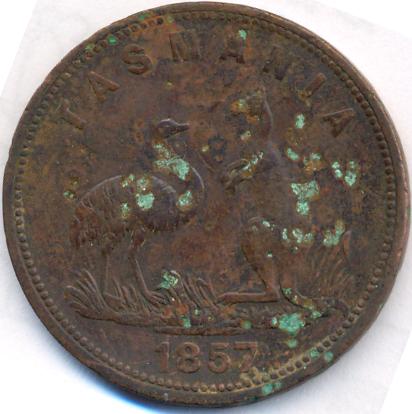 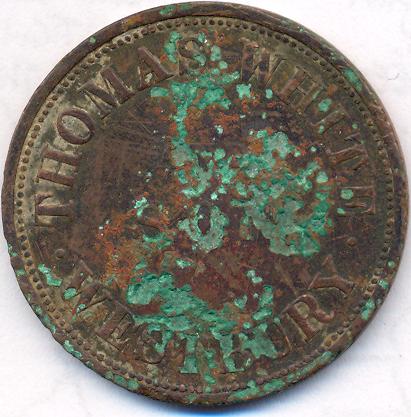 The green death has almost finished conquering the reverse, but you can just make out the name of the token issuer: Thomas White and Son, Westbury, Tasmania 1857. There's quite a lot of pitting on both sides, with evidence that a previous owner had attempted to remove the scourge. This is the "before" pic. I've just gone out and bought a bottle of cheap olive oil today, and started the soak. I'll post an update in a week or two. Don't say "infinitely" when you mean "very"; otherwise, you'll have no word left when you want to talk about something really infinite. - C. S. Lewis
|
|
|
|
Pillar of the Community
Australia
1092 Posts |
Wow, that is a challenge. This token has a lot more damage than the one I worked on. I'll be keeping an eye on this thread to see the results.
|
|
Pillar of the Community
United States
4589 Posts |
olive oil will work, the better the grade of olive oil and the longer the soak will work on some as well as distilled water- lacks the nutrients therfore eating away at the green and funk on coins (long time fram) is the key. but I would only use it on really cheap tokens coins and ancients that are very caked on. hot sauce will work to clean it however, it will make the the coin pinkish not good
|
|
Moderator
 Australia
17035 Posts |
Well, after a week-long soak the results were... disappointing. It didn't soften it up very much, though the oil did turn a slightly greener shade of olive. No point taking another pick - not much change. So I scraped at the green spots with a toothpick and put it back in some fresh oil for another soak.
Now I just have to find somewhere for this "coin jar" to sit for another week. It was a little precarious sitting here right next to the keyboard... but it has to be somewhere where I'll remember to find it in another week or two.
Don't say "infinitely" when you mean "very"; otherwise, you'll have no word left when you want to talk about something really infinite. - C. S. Lewis
|
|
Pillar of the Community
Australia
1092 Posts |
I used a oiled cotton bud to rub the coin and found the bud turned green. I did this many times with a clean bud and got alot of the green
off. But the coin I used wasn't as green as yours.
|
|
Moderator
Australia
17035 Posts |
Yeah, this one's gonna take time and effort. I'm thinking, "dental tools". [:p] Good experience for me, though. I've never tried this sort of "conservation" before, and if it has any benefit I have a couple of others I'd like to have a go at - like this ancient Roman one. Don't say "infinitely" when you mean "very"; otherwise, you'll have no word left when you want to talk about something really infinite. - C. S. Lewis
|
|
Moderator
Australia
17035 Posts |
OK, it's had two "treatments" of a nice long olive oil soak, then a serious scraping at with a toothpick (and a sewing needle for a couple of the tough spots). Finally a rinse in acetone to get the oil off. Here's the result: 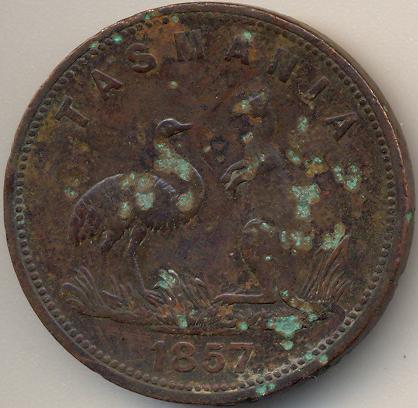 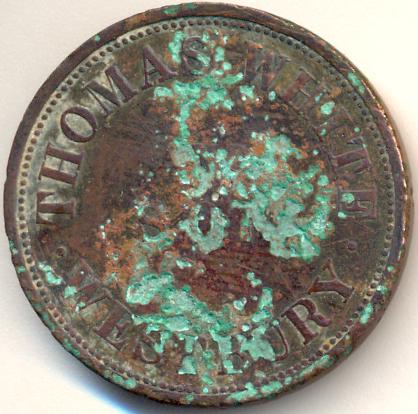 There is some slight improvement in some areas. Some tiny spots have become more obvious, but the oil generally hasn't damaged the non-verdigrised areas. Still, it's very slow going. Maybe it's the oil I'm using. One website I researched before trying this said to use any sort of olive oil and don't waste the expensive stuff on coin cleaning, so I bought cheap "home brand" stuff (we don't use it at all, food-wise, in our house). Other sites and forum threads I've seen since I've started have said, "better grade oil works better". Maybe I'll try the "potato method" next... Don't say "infinitely" when you mean "very"; otherwise, you'll have no word left when you want to talk about something really infinite. - C. S. Lewis
|
|
Moderator
Australia
17035 Posts |
OK, I tried the "potato method". For those unfamiliar with it, a quick precis - it's fairly simple: 1. Shove the coin into a raw potato. 2. Leave it there overnight. 3. Pull it apart next day; theoretically, most of the gunk should stick to the potato, leaving the coin gunk-free. 4. Coin is washed (I assume, for coppers, with acetone). Here are the results: 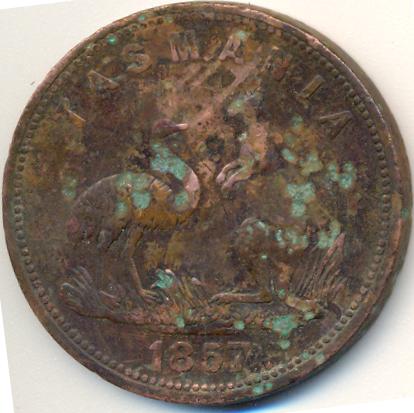 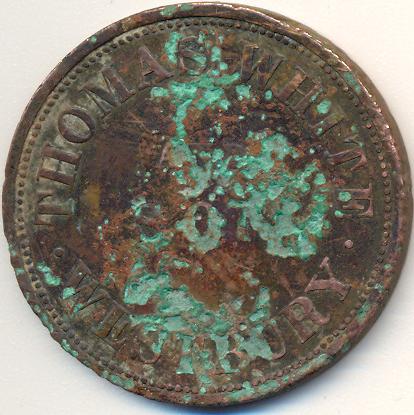 Ay yi yi! Just about the only thing it didn't affect is the verdigris! Definitely NOT an improvement, in my opinion! It's completely stripped away the brown oxide (which I was trying to preserve as much as possible), from parts of the reverse, most noticeably. That particular area of the potato may have dried out overnight, so keeping it moist (pop it in a tupperware box?) might help avoid this. I'll pop it back in olive oil for another go that way, and see if the green's grip has been loosed at all. Otherwise, I may just as well hit it with some nasty dip... The surface has been damaged anyway. Don't say "infinitely" when you mean "very"; otherwise, you'll have no word left when you want to talk about something really infinite. - C. S. Lewis
|
|
Pillar of the Community
United States
1454 Posts |
This is a very interesting topic. Have a few older lincoln cents with verdigris that I wouldn't mind trying these techiniques on.
Edited by Irishraider
07/23/2006 11:56 am
|
|
Pillar of the Community
United States
1454 Posts |
I found some info Sap. Not sure if it will help.
Verdigris is the common name for the chemical Cu(CH 3 COO) 2 , or copper(II) acetate. It commonly occurs by the action of acetic acid when copper, brass or bronze is weathered and exposed to air or seawater over a period of time. Its name comes from the Middle English vertegrez, from the Old French verte grez, an alteration of vert-de-Grice — verd (green), de (of), and Grice (Greece)— "green of Greece".
Copper(II) acetate is soluble in alcohol and water and slightly soluble in ether and glycerol. It melts at 115 degrees C and decomposes at 240 degrees C. It can be prepared by reacting copper(II) oxide, CuO, or copper(II) carbonate, CuCO 3 , with acetic acid, CH3COOH 2 . It is used industrially as a fungicide, a catalyst for organic reactions, and in dyeing.
|
|
Pillar of the Community
Australia
1262 Posts |
Sap, try the Alka Seltzer treatment next to see what happens.
|
|
Moderator
Australia
17035 Posts |
Irishraider: thanks for that  . I'd read something like that on Wikipedia some time ago. Curiously, the entry on "Verdigris" says "verdigris is the common name for copper acetate", but the entry on "copper acetate" says copper acetate is "speculated to be a component of verdigris". I suspect it's technically different meanings of the word "verdigris" that's confusing things. What we call "verdigris" on coins is actually going to be a complex mixture of copper compounds: acetates, chlorides, oxides, hydroxides, sulfides, sulfates - the exact mix depending on the environmental conditions the coin was subjected to: hot or cold, wet or dry, salt air or smog. BM: I might at that. I wonder what's actually in alka-seltzer? We don't have any here at home right now. Hmm... I wonder if "Aspro Clear" will do a similar job? [:p] Don't say "infinitely" when you mean "very"; otherwise, you'll have no word left when you want to talk about something really infinite. - C. S. Lewis
|
|
Pillar of the Community
Canada
1152 Posts |
WOW a veri interesting topic. I am thinking about trying it on some of my extra, verdegris covered pennies. Keep us posted Sap.
|
|
Moderator
Australia
17035 Posts |
Thanks, Pattiewhack. I was wondering about the ingredients of alka-seltzer. Good ol' Wikipedia. Bicarb soda, citric acid and aspirin, huh? I'll work on the assumption that the aspirin (acetylsalicylic acid) itself does little to clean coins, and the other two ingredients do the cleaning. We've got that stuff by the boxful at the lab where I work. I'll try to find time to give it a go in the next couple of days. Don't say "infinitely" when you mean "very"; otherwise, you'll have no word left when you want to talk about something really infinite. - C. S. Lewis
|
|
Pillar of the Community
Australia
1262 Posts |
I can hardly wait for your results either sap.
Keep us informed.
|
|
Moderator
Australia
17035 Posts |
OK, I had a quiet day at the lab yeaterday, so I thought I'd make me a batch of "synthetic alka-seltzer". Here's the recipe I used: To 100 mls of deionized water, add: 1 highly verdigrised Tasmanian token, 5 grams powdered sodium hydrogen carbonate (a.k.a. bicarb soda), 1 gram powdered citric acid. The mixture bubbles and fizzes the "alka-seltzer way", but not much seems to happen on the de-greening front. So I add some more citric acid, in half-gram spoonfuls (I'm not sure the exact recipe A-S uses) and see what happens. Still not much. Keep adding citric, eventually the fizzing stops as all the bicarbonate has turned to carbon dioxide. At which point the mixture starts to become acidic. At this point, some change starts to appear on the token - though once again not quite what I was hoping for: 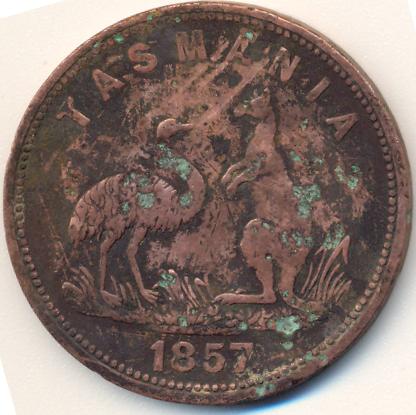 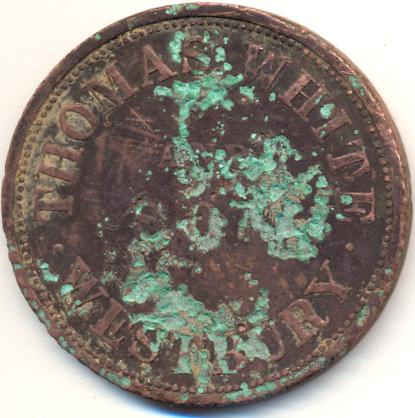 Aiee! [:0][:0][:0] It's gone pink! [:0][:0][:0] I suppose I should have expected it - I checked the pH of the cleaning solution; by the time I'd finished, the pH was around 3.5. Compare this to the pH of other, more familiar liquids: lemon juice (pH 2.5), Coca Cola (pH 2.6 or so), vinegar (pH 3), orange juice (pH 4.5) and beer (pH 5 or so). Acids will strip away copper oxide, leaving the bare metal. Still, it wasn't enough to kill the green. But it looks like it's weakening. [:p] Curiously, the "black stuff" was untouched too. Just out of morbid curiosity, I kept the cleaning solution (which is a pale blue colour from the dissolved copper) and hope to quantify just how much copper was stripped away by this little stunt. I have notice that some of the places where it "went pink" first (like in front of the 'roo's face) do show up as discolourations on the original pic. A closer look at the actual coin shows hairline scratches there - obviously a "weak point" in the oxide layer the acid found it easier to penetrate. Looks like (mild) acid doesn't work. I'll try the other way - googling "remove verdigris from copper" has a few hits which suggest a salt-ammonia solution; ammonia is a strong alkali - high pH, rather than low - the "chemical opposite" of acid. Sodium bicarbonate is a weak alkali. Looks like it's back to the lab again tomorrow... I saw the boss doing some experiments today on dissolving metal oxides, for a customer. Maybe he's got some ideas. Don't say "infinitely" when you mean "very"; otherwise, you'll have no word left when you want to talk about something really infinite. - C. S. Lewis
|
| |
Replies: 32 / Views: 15,442 |







 Posted 06/03/2006 6:55 pm


