











 Posted 01/29/2010 10:12 pm


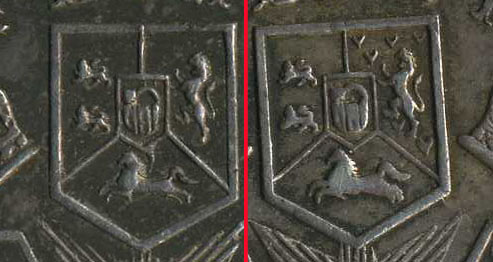
The hearts are there because they're supposed to be there. 
This particular coat of arms represents the Duchy of Brunswick-Luneberg, the German ancestral homeland of the Hanoverian dynasty that ruled Britain from the time of George I, and which George III still ruled as absentee Duke. The Coat of Arms of Brunswick-Luneberg featured two lions on the left, and a lion with hearts in the background to the right. The other symbols on this shield are the Leaping Horse of Hanover at the bottom (which all the branches of the House of Brunswick used as their family symbol) and in the centre, the Crown of Charlemagne, symbolizing the office of Arch-Treasurer and Elector of the Holy Roman Empire.
The shield with a blue lion and red hearts still features on the coat of arms of the city of Luneberg.
This particular coat of arms represents the Duchy of Brunswick-Luneberg, the German ancestral homeland of the Hanoverian dynasty that ruled Britain from the time of George I, and which George III still ruled as absentee Duke. The Coat of Arms of Brunswick-Luneberg featured two lions on the left, and a lion with hearts in the background to the right. The other symbols on this shield are the Leaping Horse of Hanover at the bottom (which all the branches of the House of Brunswick used as their family symbol) and in the centre, the Crown of Charlemagne, symbolizing the office of Arch-Treasurer and Elector of the Holy Roman Empire.
The shield with a blue lion and red hearts still features on the coat of arms of the city of Luneberg.
Don't say "infinitely" when you mean "very"; otherwise, you'll have no word left when you want to talk about something really infinite. - C. S. Lewis


 AHA (I see)


