| Author |
 Replies: 17 / Views: 3,859 Replies: 17 / Views: 3,859 |
|
Valued Member
United States
461 Posts |
if you were to run across a US Trade dollar with a weight that was 2 to 3 tenths of a gram more than the book calls for would that indicate a possible fake dollar?  |
|
|
|
Pillar of the Community
United States
8904 Posts |
More weight is probably good, but with Trade dollars particularly, ANYTHING out of the normal, I'd be suspicious. IMO. |
|
New Member
United States
5 Posts |
I don't know if more weight is good or not. Probably not ging to find it in a condition that doesn't have at least some bit of wear. Therefore it should weigh less correct. I don't trust those Trade dollars there are more fakes then real one's it seems like to me. |
|
Moderator
 United States
23731 Posts |
Trade dollars are an area of collecting I stay away from because of some many fakes. Less weight is more common than more. One thing you might want to check depending on the type of scale you are using is the calibration.
|
|
Pillar of the Community
United States
1055 Posts |
The best advice I can give you is "When in doubt don't break your wallet out" I would stay clear of raw Trade dollars unless you are an absolute expert, way too many fakes out there for me to even consider a raw Trade dollar. |
|
Valued Member
 United States
461 Posts |
yes, I did calibrate my scale, that was a good idea. I'm a bit leery about weighing coins as a test for authenticity. Maybe one of the more experienced numismatists on this forum can tell me whether or not weighing a coin is more accurate as just one test of authenticity for a classic coin versus a modern coin. I have been running an independent study on this issue and modern coins which I know to be authentic and with the same amount of ware or no ware at all weigh varying amounts than they should according to all of the books that I read and or studied over the years on the subject! I.e. Kennedy halves weights are all over the place within the same year and mint Mark of the same year. Anyone run into this issue? Additional information would be greatly appreciated on this subject as I know a lot of us here use weight as one method as an initial indicator of authenticity!    |
|
Bedrock of the Community
United States
12437 Posts |
Weight is one important part of authentication. As for being slightly overweight, if the coin is of a normal diameter and thickness, then the only possible way it could be fake is if it were made of lead as that is the only other practical metal with a density close to silver. It should be easy enough to tell a lead coin from a silver one in hand since the metals do not share the same qualities.
|
|
Moderator
United States
23522 Posts |
Weight is a critical factor in the production of coins, and the ability to measure weight with great accuracy has existed for centuries. Consider that early coinage issued by the US occasionally shows marks where the minted coin was filed to bring it to the correct weight. Morgan dollar planchets, for instance, were allowed +/- 1.5 grains around the standard weight of 412.5 grains. The Mint had equipment which could weigh 6,000 ounces at an accuracy of 5 grains (there are 5760 grains in one Troy ounce). By the turn of the century, they were weighing $1000 bags at 859.375 Troy ounces with a tolerance of no more than two hundredths of an ounce, after having calculated and combined planchets ranging all around the acceptable weight. I would immediately suspect a Trade dollar, or any coin, whose weight was 0.3 grams heavy. If I saw variation of more than 0.1 gram in a batch of Uncirculated Kennedy halves, I would immediately suspect my equipment rather than the coins. My scale is rated to an accuracy of 0.01 gram; I only consider it reliable to a tenth-gram. If your scale is only rated to a tenth of a gram, it shouldn't be used for weighing coins. |
|
Pillar of the Community
United States
2797 Posts |
Neal, Armed with a bit of knowledge on Trade dollars you can give yourself a great deal of protection against counterfeits. The weight issue has already been discussed. Most fakes weigh between 18~22 grams and are non-precious alloys (predominantly copper) that are "silver-washed" to appear silver looking. When performing a visual check, the first place I look on these is the dentils. Cheap fakes have dentils that fade in and out of the design, high and full in one spot and almost gone in others. The real deal dentils show uniformity. The next place I look is the motto. On genuine Trade dollars "IN GOD WE TRUST" will appear just about like you see it typed here ... you could place a straight edge across the top or bottom and it would line up perfectly. Counterfeiters just can't seem to straighten out the lettering on the motto. Sometimes they even mix fonts. If the coin is in hand or you have decent photos, look at the eagle's eye. Genuine coins have that eye half-open, fakes have it wide open. Hope these tips help you avoid a bad apple. |
|
Bedrock of the Community
United States
17884 Posts |
Since the Mints official tolerance on the Trade dollar was +/- .1 grams a coin that weighed .3 grams heavy should be viewed with suspicion. That does NOT mean that it can't still be real. It just means that further checks or tests should be made to confirm authenticity. |
|
Valued Member
United States
461 Posts |
Just received the coin in question. I'll let you folks comment! 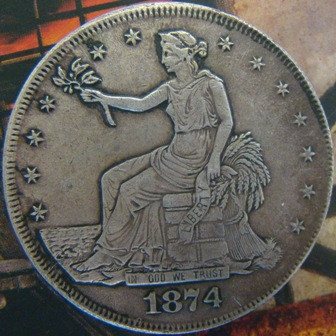 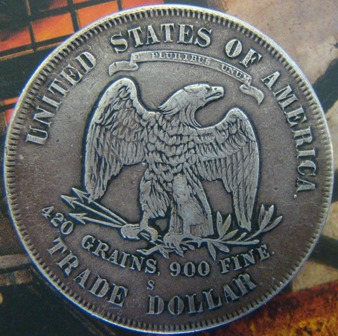 |
|
Pillar of the Community
United States
2797 Posts |
See my note on dentils ... hope you didn't pay too much.  |
|
Valued Member
United States
461 Posts |
when I originally purchased the coin the photograph was blurry and I inquired about the weight. The list told them that those were the best pictures he could take and it weighed Just a little bit of the amount required.I paid $175. However, I assured him that I would not keep the coin if it was not right. He has already issued a return number and is leaving reimbursing shipping both ways! You should see it in person it is one ugly coin.  I thought your post above was 100% dead on! |
|
Bedrock of the Community
United States
10045 Posts |
Since I know little about Trade $, I popped over to Heritage and looked at certified 1874-S. Something that caught my eye were the digits on the date. The 4 especially doesn't match certified examples--I'm sure there's more. So I'm betting the coin doesn't "ring" right either. Good luck on the return.   |
|
Bedrock of the Community
United States
14454 Posts |
Oh My, I want to tell you this is not a series to buy with blurry pictures and heck it really not a series to buy with good pictures unless you know who you are dealing with. It looks like you bought from a seller that at least had a return policy (as long as they follow through) but that coin definitely is a fake. Any coin with that much wear (trade or anything) and is over weight has something wrong
|
|
Valued Member
Canada
464 Posts |
I recently asked a seller about a suspicious looking Trade dollar, and was told it looked different because it was of a different variety! I laughed when I read the message..It was an obvious lie. Like you, I don't know much about Trade dollars, I'm glad you were able to work out a refund with the seller. Edited by gawd0wns
02/04/2010 4:09 pm
|
| |
Replies: 17 / Views: 3,859 |








 Posted 02/01/2010 9:17 pm


