| Author |
 Replies: 22 / Views: 42,582 Replies: 22 / Views: 42,582 |
|
New Member
United States
4 Posts |
Recently came across this coin and am having trouble identifying it. From what we can tell its israeli and have found several images of other israeli coins with like symbols but different text. Any help anyone can offer in identifying this coin would be greatly appreciated. thanks. 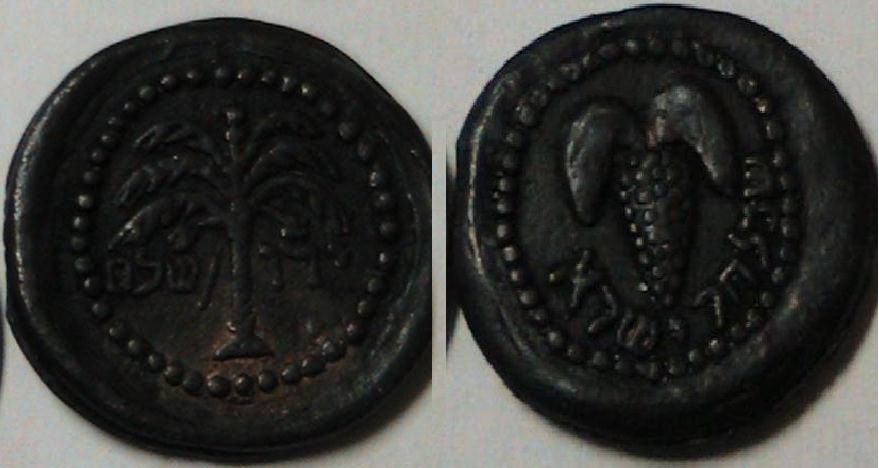 Identified - moved to Ancients forum - Sap Identified - moved to Ancients forum - Sap |
|
|
|
New Member
 United States
4 Posts |
*sigh* where's Sap when you need him, lol.  |
|
Pillar of the Community
Philippines
1156 Posts |
Hi eleven, just brightened up your image to see better. a banana tree and an ear of corn? I'm not sure those are usual items from Israel.... yep, let's wait for sap to chime in it's a very interesting coin...  |
|
New Member
United States
4 Posts |
yeah, thats what I originally thought untill I seen this; http://rosenblumcoins.com/files/img/37c/28458.jpgaside from that particular picture I've found many others almostly exactly the same though no real specific details on any of them, other than that some, (wich look older than mine) date back to the first and second revolt.. However most explain the symbols as a 7 or 8 layered palm tree and a grape bunch. I dunno. I've also found a couple with 6 leaves. Whatever the case there seems to be a wide variety of coins very simialar to this one, all with a tree and grapes, or corn with like text placed differently on the coin. is Sap is some kind of superhuman?  Edited by Eleven713
02/06/2010 8:30 pm
|
|
Moderator
 Australia
17005 Posts |
Quote:
is Sap is some kind of superhuman? No, despite certain scurrilous rumours to the contrary. I am, however, in Australia, so if you're in America or Europe, it usually means I'm awake when you're asleep, and vice versa. As for your coin: sad to say, it's a modern replica of the ancient coin posted in your above link. We've seen several of these here on the forum, and there are lots of them listed on the FORVM fake database. The biggest giveaway that these are fake is that the shape of the lettering is "modern" Hebrew or Yiddish in form; ancient Hebrew was written quite differently. Don't say "infinitely" when you mean "very"; otherwise, you'll have no word left when you want to talk about something really infinite. - C. S. Lewis
|
|
Pillar of the Community
Philippines
1156 Posts |
thanks sap, that got my curiosity going, looking closer at the trunk of that tree, its not a banana, it looks more like a date palm tree?
|
|
Moderator
Australia
17005 Posts |
Quote:
it looks more like a date palm tree? Yes, that's what it's supposed to be. The date palm was a standard symbol for "Judaea" on ancient coinage. In Roman times, Judaea and Egypt were the only places where dates were cultivated, and the Judaean dates were preferred; they were exported throughout the Empire. When the Arab-Islamic empire expanded in the middle ages, they took date cultivation with them and now dates are grown throughout the Middle East and North Africa. Not only did the Jews themselves use the date palm as a national symbol during both the First and Second Revolts, the Romans used it both on provincial coinage and the JVDAEA CAPTA coins in the Imperial series. Don't say "infinitely" when you mean "very"; otherwise, you'll have no word left when you want to talk about something really infinite. - C. S. Lewis
|
|
Pillar of the Community
United States
717 Posts |
As Sap say, it's a replica of an ancient Hebrew coin. The replica give-away is the use of modern Hebrew, Info here on the original: http://www.amuseum.org/book/page19.htmlOn the side with the date palm is the modern Hebrew letters spelling Hebrew word "Yerushalayim - Jerusalem." BTW, since Hebrew is written right to left (opposite to English's left to right, it may be confusing.) This coin is either from the first or send year of the Second Jewish revolt (132-135 CE) of the Jews led by Bar Kochba against the Roman Empire. On the other side with the grape cluster, there are 2 words. The second word (on the left) is "Yisrael - Israel" however it is misspelled. It leaves off the last letter Lamed - the "L." This is the further most letter which is on the extreme left side. The first word on the date palm side , on the right side, contains the remaining phrase. The first word letters are readable but to figure out the word intended is harder. The meaning is either an abbreviation or straight forward word which means: 1)"Year 1 [or Year 2] of the Freedom of [Israel]." or 2) "For the Freedom of [Israel]." Again, this is with the misspelled letter of Yisrael, missing its the last letter Lamed - the "L." |
|
New Member
United States
4 Posts |
hah! wonderful story. when my mother in law introduced this coin to me she was curtain she had struck oil. after reviewing it and others like it, I knew something was fishy about it. one thing was the condition of it. I couldnt imagine a 2000 year old coin found in a few inches of top soil near a tractor barn here in east texas could be in such great shape. second, although hebrew text looks like nothing more than chicken scribble to me I could see a difference between it and others like it.
i must say the knowledge between all of you on this forum is absolutely amazing, and I appreciate you taking the time to help me out. you cant imagine how many hours I spent rummaging through photos and pages of history trying to get an exact id on this thing.
although the coin drove me nuts for two days I must say its been very educating and very interesting. and although I'm relieved to know what it is, I must say I'm almost sad the quest is over, lol.
couple questions for curiousity...
How much was the face value of the coin?
How much would this be worth now, if it were the real thing?
And why would people go through the trouble of replicating such a thing, and in doing so why would they use modern hebrew versus ancient hebrew? I would think anyone who could read or write hebrew can tell the difference.. maybe the coin was meant to be identified as a replica?
anyways thanks again for the help and great history lesson, its actually been a lot of fun. now, time to go burst a bubble! :D
|
|
Moderator
Australia
17005 Posts |
Quote:
How much was the face value of the coin? The original coin this was based on was a small or medium-sized bronze coin of the second revolt. We don't know what the Jews themselves called these coins but they were made by overstriking a Roman or Roman provincial coin; the smaller ones were overstruck on a coin denominated an "as", the medium ones on a "dupondius". Quote:
How much would this be worth now, if it were the real thing? It's hard to say, because genuine ones don't usually come this "well preserved". This one sold for $410. Quote:
And why would people go through the trouble of replicating such a thing, and in doing so why would they use modern hebrew versus ancient hebrew? I would think anyone who could read or write hebrew can tell the difference.. maybe the coin was meant to be identified as a replica? I think so. They're not intended to fool an experienced collector of ancient coins, nor someone that actually knows ancient and modern Hebrew. I haven't been able to find out exactly where these came from, but they all seem to turn up in America, so I'm guessing they were either a giveaway in a "Reader's Digest" style promotion for a book on ancient/biblical things, or they're sold to tourists who visit Israel. In Israel, ancient coins are considered "antiquities" and buying and selling them is strictly controlled, but buying and selling fake ancient coins is quite legal. If these do actually come from Israel, the use of modern Hebrew might help the customs agents tell them apart from genuine coins. Don't say "infinitely" when you mean "very"; otherwise, you'll have no word left when you want to talk about something really infinite. - C. S. Lewis
|
|
Pillar of the Community
United States
717 Posts |
It's hard to pinpoint when the changeover took place between the written "ancient Hebrew" & "modern Hebrew."
But to clarify, "modern Hebrew" is not exactly "modern." It's about 2,300 years old, whereas "ancient Hebrew" as a written language is significantly older than the Torah & the Ten Commandments, which was over 3,300 years ago.
According to Jewish tradition, Hebrew was the very first language of mankind. Likewise, Hebrew is considered to be the one language spoken by the united mankind before the dispersion connected with the Tower of Babel, about 3,765 years ago.
This "ancient Hebrew" is "officially" called "Paleo-Hebrew." This lasted till about 1,875 years ago. This is around the time of the coin in question & is the script of the coin in question.
After this came the evolving into "Aramaic, " which lasted from about 3,000 years ago till about 1,600 years ago. Hence an overlap. Then came "modern" Hebrew, which came about 2,300 years ago until present times.
According to contemporary scholars, the Hebrew alphabet is a stylized form of the Aramaic alphabet, from which it descends and evolved from during the period around 2,300 years ago. Prior to this, Hebrew was written in the Paleo-Hebrew alphabet by the ancient Israelites,
If anyone wants to shed more light on this, feel free.
Edited by yechi7
02/08/2010 04:24 am
|
|
New Member
United States
1 Posts |
Hi. New guy here. I found this exact same coin in Kilgore, Texas 15 years ago on my job site. That's strange two of these coins were found in East Texas. I, too, thought I had stumbled upon a gem. I searched a few years back for its identity with no luck. I recently found the coin in storage and thought I'd try again and here I am. Disappointing but good info to know. I gather from what's been posted that these are novelty trinkets and do not belong in a coin collection. Too bad.
Thanks, guys for all the information.
|
|
New Member
United States
4 Posts |
so how much is this replica worth
|
|
Moderator
Australia
17005 Posts |
Not much - a coin dealer would probably sell you one for a dollar or two.
Don't say "infinitely" when you mean "very"; otherwise, you'll have no word left when you want to talk about something really infinite. - C. S. Lewis
|
|
New Member
United States
1 Posts |
I have a very similiar coin and would like to know where you found it and what you know about it if you don't mind.
Thanks
Bluecrab
|
|
New Member
United States
6 Posts |
I have one of these as well!
|
| |
Replies: 22 / Views: 42,582 |










 Posted 02/06/2010 7:32 pm


