| Author |
 Replies: 10 / Views: 1,377 Replies: 10 / Views: 1,377 |
|
|
Valued Member
United States
57 Posts |
Found this roll searching. Is this a repunched MM? 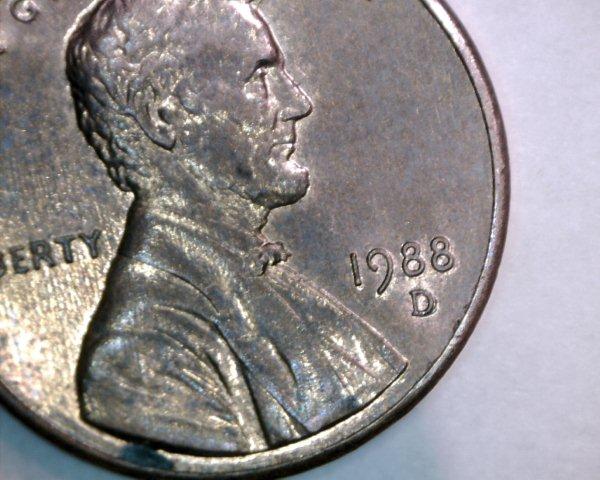 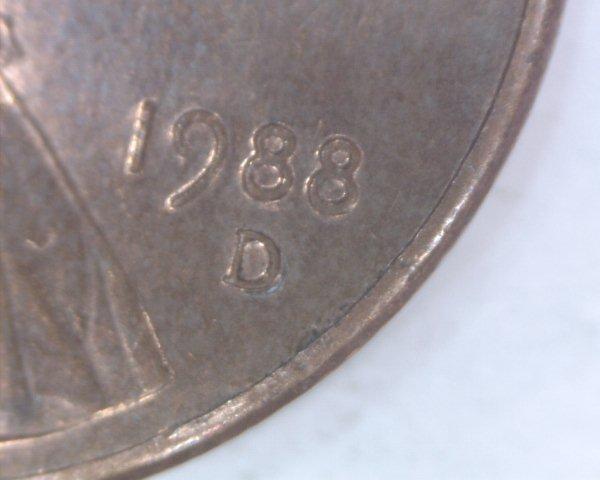 |
|
|
|
Moderator
 United States
56855 Posts |
Can't tell for sure by your photo but it looks like zinc rot by the mint mark not a RPM. Also you should have your post moved to the modern variety/error forum. John1  |
|
Moderator
United States
23522 Posts |
Quote:
Also you should have your post moved to the modern variety/error forum. I agree.  |
|
Pillar of the Community
United States
3507 Posts |
It's "rot" the zinc is corroding under the copper plating.
|
|
Bedrock of the Community
United States
12437 Posts |
Commonly referred to as split plating doubling. The striking force splits the copper plating giving the impression of doubling from an RPM or doubled die. The exposure of the zinc starts the corrosion process.
|
|
Bedrock of the Community
United States
62064 Posts |
Side thought: What causes the split on the lower part of the mint mark? The mint mark was applied by hand with a punch. After the striking a few times with the punch, the area becomes finned and the early strikes of the dies cause an edge on the die that cuts the plating. In later die states this wears off removing the finned area on the die.
|
|
Rest in Peace
United States
1943 Posts |
Coop, that is an interesting observation. Another thought might be that because dies are slightly higher in the center and not flat the striking pressure starts strong in the middle of the coin and radiates out toward the rim. This flow of pressure could cause the plating to split on the side of the feature closer to the rim.
|
|
Pillar of the Community
United States
2600 Posts |
I have noticed a tendency for copper splitting above the "Ts" in States though it appears most everywhere. This eliminates the idea of "cold flow" where material flows away from the initial impact of force to open voids. With the die being domed, in theory, the copper plating should be thinnest in the coin center and thicken toward the outer edge. So, one would expect to see more splitting toward the center and it does not seem to be so. As the splitting occurs typically at changes in flow direction (bends or angles) it makes me suspect annealing. I do not know if the planchets are annealed but I suspect so. Annealing makes metals more ductile, removing internal stress which presents itself as fracture points. Annealing makes the metal more suitable for cold working which is what they are doing when stamping coins. Not knowing the planchet manufacturing process this is only a guess.
Jim
|
|
Bedrock of the Community
United States
62064 Posts |
I don't think the Cents are annealed on the zinc ones. What is there to soften? Its just a zinc core plated with copper. Other planchets probably will be annealed, but I've never read of this process being used on cent zinc planchets.
|
|
Rest in Peace
United States
1943 Posts |
Coop, you are right. There was a thread on here over a year ago discussing this. I email the company supplying the plated blanks to the mint and received an email back confirming they don't anneal plated cent blanks.
Jim, in my experience I don't agree that the plating would split closer to the center of the coin. I think the plating stretches more as it wraps through features than it does as it goes across a flat field. As the froce goes through a feature and it stretches more it causes the plating to tear on the back side as it comes out of the feature. As you said, you notice splitting above the T's in states. This would be the side closest to the rim. But this is just from my observations as a machinist. I am not a metalurgist and can't really explain what is going on. It is interesting to hear different ideas on what might cause this.
|
|
Pillar of the Community
United States
2600 Posts |
Bob, thx for the info on no annealing, make me look elsewhere and your thoughts become more insightful.
Assuming that there is cold flow from the center outward, away from the initial point of contact, the flow would be stopped on the front side of the devise, or the side closest to the center. Then, the flow would start again on the outside of the devise and moving toward the coin rim. Being the case, the copper would be at it's thinnest, again, at the outside of the devise and the most likely place to break. As you pointed out that the "Ts" in States is breaking on the outside between the devise and the rim. This would support your theory and I think you are on to something.
Jim
|
| |
Replies: 10 / Views: 1,377 |
|







 Posted 02/20/2010 08:12 am





