| Author |
 Replies: 13 / Views: 1,506 Replies: 13 / Views: 1,506 |
|
|
Pillar of the Community
United States
577 Posts |
On the 1955 doubled die cent, the date was struck twice and rotated clockwise, but why didn't Lincoln's bust get repunched as well?
|
|
|
|
Valued Member
United States
69 Posts |
Unless it's a variety that I've never seen before...I'd have to say that it's counterfeit...do you have a picture?
|
|
Bedrock of the Community
United States
14454 Posts |
uhh I do and he is correct the date and everything else is doubled but lincoln isn't and I have often wondered the same thing Image Insert: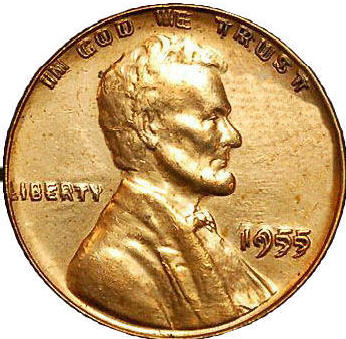 I had never seen one until a member on this forum was asking about one (they didnt know what it was either) and then low and behold I found one in a large collection my grandfather had given to me Edited by Bryan1315
06/14/2006 2:01 pm
|
|
Pillar of the Community
United States
2177 Posts |
 You lucky dog!! |
|
Pillar of the Community
Australia
1262 Posts |
|
|
Pillar of the Community
 United States
577 Posts |
thats the coin I'm talking about! Does anyone know why the bust wasn't doubled as well?
|
|
Valued Member
United States
69 Posts |
I'm sorry...i mis-understood the question. Now that the picture is available...OMG...I feel so novice not realizing what he was meaning. I have often wondered why Licoln isn't doubled as well.
And YES, Bryan...you are a lucky dog for being able to have one handed down!!!! Wish I could just hold one for a little while.
|
|
Pillar of the Community
United States
7629 Posts |
The entire design was hubbed into the die, not 'struck' or 'punched'. Aside from that, the entire bust is doubled...you just have to know what to look for. 1955P-1DO-001, the 'big' famous doubled die, is a class 1 rotated hub doubled die. What that means is that the die was rotated between hubbings causing the doubled design. The central axis of rotation was somewhere near the center of the design. Note that on LIBERTY the doubling on the L is much more pronounced than the doubling on the Y. The reason for this is simple. When you rotate a circle along a central axis, the distance a point travels along a ray extending from the center of the circle gets larger as you travel outward...it's much like the spokes of a bicycle wheel. All of the spokes are straight and point straight outward from the center of the wheel. Two neighboring spokes will be far closer to one another near the axle of the wheel than on the rim. It is because of this affect and the fact that the bust doesn't have a lot of well-defined hard edges that to the layman it does not appear to be doubled. Upon closer examination, however, you will find that the hair, eye, nose, bowtie, and lapel all show doubling, and the lower lapel shows very strong doubling (because it is close to the rim). If you would like to see close-up images of the doubling in the bust, please visit the following link located at my web site. It shows the doubling in the face very well... http://www.coppercoins.com/lincoln/...ie_state=edsI hope this explanation helps. Edited by coppercoins
06/17/2006 1:17 pm
|
|
Pillar of the Community
United States
7629 Posts |
|
|
Bedrock of the Community
United States
14454 Posts |
I got this from a website about the 55 DD Mint errors are all the rage these days. In recent months, the United States Mint has turned out a dizzying array of misstruck coins - some of them so unusual that they never had been encountered before in the Mint's more than 200-year history. These coins are bringing impressive prices as collectibles - sometimes in the tens of thousands of dollars. The jury is still out, though, on just how rare and valuable they are, and where their price levels eventually will settle in the marketplace. There is no such uncertainty regarding the 1955 doubled-die cent. This coin, one of the most dramatic U.S. mint errors of the 20th century, has established a solid track record over the years, and collectors now feel comfortable that they know how rare it is and how much it's worth. Most important, it has grown in stature from a novelty item to a legitimate rarity - one that is now among the most coveted and valuable components of the enormously popular Lincoln Cent series. Doubled-die coins result from mistakes in the making of dies for the coins, rather than in the striking of the coins themselves. With the 1955 doubled-die cents, it wasn't a case of each coin being struck more than once in shifted positions; rather, it was a matter of each defective coin being struck just once with a die on which the doubling already was stamped. This doubling, in turn, occurred when the die received multiple strikes from a hub in misaligned positions. Technicians apply more than one blow to a die in order to impart the design with sharp detail. Only the obverse (or "heads" side) of the 1955 mint error was affected; there was no doubling on the reverse. But the obverse doubling was obvious to the naked eye, especially in the date and inscriptions. According to knowledgeable sources, the mistake was discovered before the coins left the Philadelphia Mint. But because they had become interspersed with normal cents, it was decided to release them. By contrast, the Mint has acknowledged destroying thousands of coins following the recent discovery of the "mule" error combining the obverse of a statehood Washington quarter with the reverse of a Sacagawea dollar. At least a handful got out anyway. There's no way of knowing exactly how many 1955 doubled-die cents escaped, but the figure 30,000 is widely accepted. These coins turned up initially in the East, especially in New England, and their rarity and value weren't fully grasped in the beginning. As time went by, however, and only limited numbers were accounted for, the coins' market value rose steadily and significantly. Today, they're worth several hundred dollars even in worn condition, and thousands in pristine mint condition. That puts them high on the list of Lincoln Cent "keys," right up there with the 1909-S VDB and the 1914-D. Make no mistake, the 1955 doubled-die cent is a numismatic aristocrat now. It may not be novel any more, but it's definitely noble. Edited by Bryan1315
06/18/2006 5:29 pm
|
|
Pillar of the Community
United States
577 Posts |
Wow thanks Bryan, thats really interesting. Are there any significant reverse DDs? I have not heard or seen any.
|
|
Pillar of the Community
United States
7629 Posts |
quote:
Originally posted by madhandles761991
Wow thanks Bryan, thats really interesting. Are there any significant reverse DDs? I have not heard or seen any.
Just in the Memorial cents there would be three that come to mind immediately - 1964, 1968D, and 1983. There are actually hundreds (if not nearly a thousand) of them in the Lincoln Cent series as a whole, but because the general collector populace doesn't pay as much attention to the reverse doubled dies, they are far less known. |
|
Pillar of the Community
United States
577 Posts |
Would these reverse DDs be noticeable to the eye?
|
|
Pillar of the Community
United States
7629 Posts |
The three mentioned would be visible to the naked eye if you know what you're looking for, but a 5X grading loupe would make them unmistakable.
|
| |
Replies: 13 / Views: 1,506 |
|










 Posted 06/14/2006 1:54 pm


