| Author |
 Replies: 30 / Views: 6,854 Replies: 30 / Views: 6,854 |
|
|
|
Pillar of the Community
Canada
1248 Posts |
Coinsrfun
You hit the nail on the head with your reference to a donkey
|
|
Pillar of the Community
Canada
693 Posts |
The 1955 issue will be debated for ever.....first.....2000 coins special; ordered. Did they get better treatment than Circ coinage.....yup I think so....so PL IMO Now for Steve. The 1953 designation causes more arguements than the 55's....lol New dies.......etc ......PCGS guesses and ICCS flip flops...........I can not answer your question as I have never researched the 53 dilemma. I just listed a bunch of PL 65 dollars on ebay that will all (except 1) go 66 or 67 today. The term PL and what it means is still an unending debate. There are always exceptions, and I acknowledge that the 53 dollars do not fit in the rim and strike statement. Great thread. :-) |
|
Pillar of the Community
Canada
693 Posts |
|
|
Bedrock of the Community
United States
14454 Posts |
A MS coin is a business strike and proof are minted with specially prepared dies. A MS (business strike) can have PL or even DMPL fields but it doesn't make it a Proof coin. At least this is how US coins are graded. I did notice one thing on the label that is different, usually ANACS will put the PL designation beside the grade (like MS-63PL) and on this canadian coin its beside the country so maybe I am wrong on this. |
|
Pillar of the Community
Canada
1051 Posts |
Bryan, you are applying US terminology to Canadian coins. 1950's "proof like" Canadian coins had no actual corresponding "proof" issue, but some years had specimen coinage. PCGS and NGC both use the "MS PL" designation, and both are wrong for doing it. PCGS also uses the "proof" designation on a lot of Canadian dollars from 1967, again wrongly. There have always been specimens and MS coins. PL coins were introduced in the early 1950's or there about. True mirror/frost proof coins were not produced until 1981.
If we had called the PL coins "specimen-like", it might have been a better idea.
Again, I suspect with influence from the US, we adopted a term that did not really reflect reality. Our "proof like" coins resembled the superior traits of the US proof coins, though we had none of our own, save for the specimens which we do not call proofs.
Pretty clear now, right? Wait till we get started on "NBU" coins.
|
|
Pillar of the Community
Canada
1051 Posts |
"So PL 63 would be the correct grade....by Canadian Standards....or NBU as the donkey in Toronto calls it now."
No, no, no...PL's only stopped being PL's in 1977 (except for the one 1976 coin that ICCS decided to grade as NBU and not PL)....LOL
The whole thing is a train wreck IMO. What are early strike coins packaged in collector wrapping, but struck from an actual business strike die classified as? They are in NBU packaging, and sharper than average MS coins, but struck from the same MS dies. Ugh. I've already set the year 2000 as my upper limit of dates to collect, and all this headache is a good portion of the reason.
|
|
Pillar of the Community
 United States
2408 Posts |
Thank you all for your comments. I'll go with PL-63.
The problem with this grade is pricing. So here we go again.
PL-65 (with cameo) is at $550 Mine does have cameo, high? maybe not but still. No PL-63 to relate to.
MS-63 is at $70.
Suggestion?
Edited by canadian_coins
03/23/2010 9:42 pm
|
|
Valued Member
Canada
166 Posts |
Hello,
Because PL dollars came from sets and generally were not handled, PL63 is a low grade. The "average" grade on one of these would be just below PL65. In this case it is probably worth more than you have for MS63 ($70), but not much (perhaps $100-$120 in a real auction).
|
|
Pillar of the Community
United States
2408 Posts |
Steve,
Well... I estimated $60 actually. My reasoning is that for 1954, PL is valued significantly less than MS in grade 65 (as opposed to 1953!). I will report back once I liquidate... (soon)
|
|
Pillar of the Community
United States
2408 Posts |
I forgot... I posted this picture about the same coin in another thread a couple years ago. It has a die crack. Not sure if die cracks ever existed in PL. 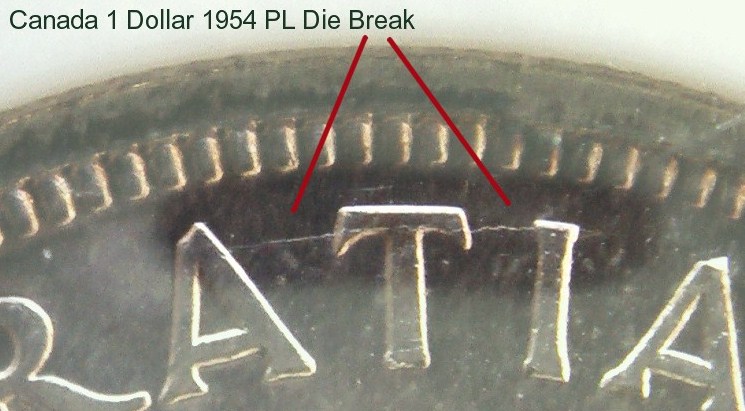 |
|
Bedrock of the Community
United States
14454 Posts |
Quote:
Pretty clear now, right? yep, clear as mud. nah I think I understand it sorry if I confused anyone with my responses above |
|
Valued Member
Canada
480 Posts |
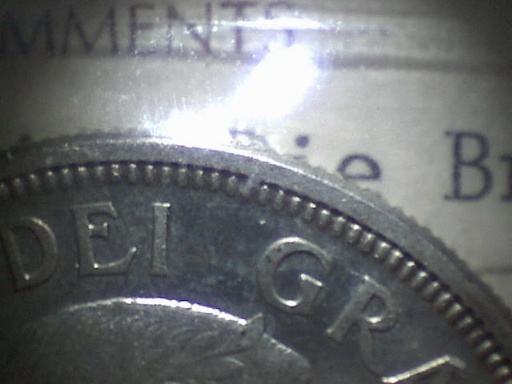
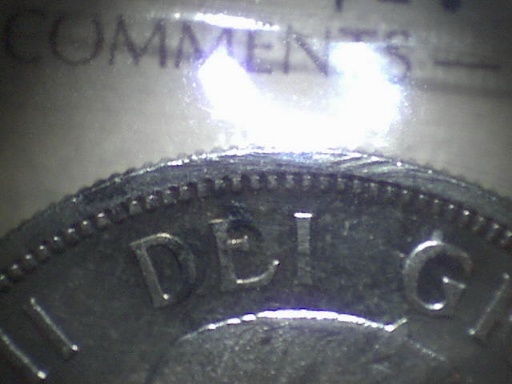
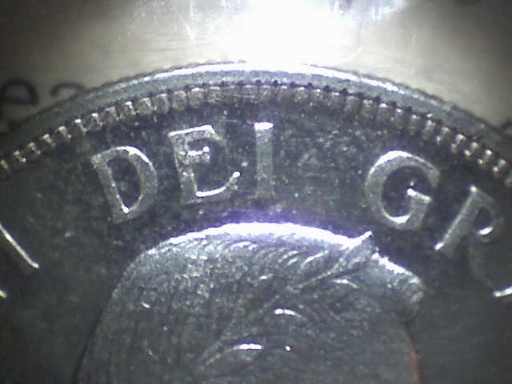
coin C has a nice die break through the E of DEI. The first PL Sets were issued with 1953 coins. I believe that the 1949 dollars and later coins may have pl strikings, as the new machinery was purchased for the 1949 NFLD dollars. There are 2 rim sizes for the 1953 (and 1954-55) varieties in several of the denominations, but I have not looked to see if that is true for the dollars.
Certainly, some of the nickel coins pl sets from 1968 had different finishes than the regularly circulating coins. The dimes seem to have a special finish on the sails and water, and I have seen many with varying degrees of frosting on design and letters (on the same coin)
I am still trying to research this, as well as the relatively large numbers of detached jewel coins (of many denominations) in PL sets from the 1979-1989 issues.
|
|
Pillar of the Community
Canada
4944 Posts |
I recently bought a coin with the same marking as the one first posted on this topic. My coin is a 1966 Canadian $1 MS-67.
I contacted ANACS about this, and attached a picture of my coin to the email so they knew what I was talking about and this is what they told me.
ME: "Business strike coin or a PL?"
ANACS: "Both. The coin is a business strike with proof like surfaces."
ME: "Being both, does that mean its not from a proof set, or it is from a proof set?"
ANACS: "It is NOT from a proof set as the coin is NOT proof. It's "proof-like". As in, "the coin is a business strike, but looks like a proof"."
Edited by Canadian-Banknotes
12/02/2010 6:34 pm
|
|
Pillar of the Community
Canada
4944 Posts |
This is what ANACS does if the coin is a proof. 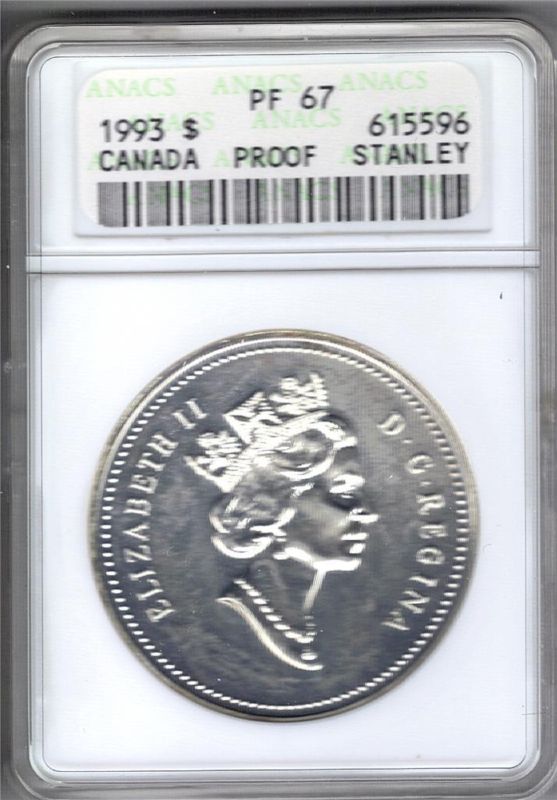 |
|
Pillar of the Community
 Canada
9901 Posts |
From the glossary on this site Prooflike-Term to designate a coin that has mirror-like surfaces......... . From the glossary on The Canadian Coin Reference Site Prooflike-Having a surface as flawless,and brilliant,or nearly so,as a proof but struck from working dies and sold to collectors as above average specimens.The term originates with and is generally applied to Canadian uncirculated mint-produced and mint-packaged sets..... . As you can see the American and Canadian definitions of PL differ . By the American definition a coin can be MS and PL at the same time.Thus American TPG's can and do grade Canadian coins MSxx PL. By the Canadian definition a PL coin must come from an uncirculated set,usually pre-1968.Canadian TPG's will not grade a coin as PL unless it comes from one of these sets.PL coins can be recognized by their virtually perfect rims,bright fields,strike,and absence of any bag marks. |
| |
Replies: 30 / Views: 6,854 |








 First Page

 Posted 03/22/2010 09:36 am