| Author |
 Replies: 6 / Views: 6,529 Replies: 6 / Views: 6,529 |
|
|
New Member
United States
1 Posts |
Hi. I am trying to determine where this coin is from. I'm not sure if it is actual currency or if it is just a token of some kind. The coin appears to be copper and is 25mm in diameter. There is a square hole in the center. I will post pictures to show both sides. Anyone have a clue? Image:  unknown coin side 1.jpg unknown coin side 1.jpg9.35 KB Image: unknown coin side 2.jpg8.89 KB |
|
|
|
Valued Member
United States
177 Posts |
Its slyle resebles a chinese anciant because of the four characters surounding the square hole on the obverse, and the two anamals, which usualy represent ying and yang, on the reverse. it was most likely minted between 1890 and 1940, but it could be older, and somewhat newer. it also mght be japanese, which tryed to copy the chinese as much as possible in the 1700's and before, and therefore resulted in the similarity between the two cultures. look at this comparison between your coin and a chinese coin.  |
|
Pillar of the Community
United States
986 Posts |
That's not a chinese coin. How do I know? Well, none of those characters are chinese for starters. Although that coin does look very familiar. I'll have to check my foreign coin box to see if I've got anything like it.
|
|
Rest in Peace
United States
3730 Posts |
First, welcome to the forum! It's a great forum, and the members are very helpful.
I have a similar coin in my foreign collection, so will join you in waiting for an answer to your question.
Edited by Gary Burke
06/24/2006 2:45 pm
|
|
Pillar of the Community
United States
604 Posts |
Well I seen one in a store and its a Mayalsian coin. sorry I can't get the year it was minted but I know it's mayaliasian
|
|
Moderator
 Australia
16989 Posts |
It may well have been made in Malaysia, but it's not an official coin, from Malaysia, China or anywhere else. The lettering is similar in style to ancient and mediaeval Chinese "seal script", but the coin itself is too "modern" - the perfect roundness of the rim indicates to me a machine-struck piece, whereas ancient Chinese cash coins were always cast; only a few "struck cash" were made in the early 1900's, by which time "seal script" was long out of fashion. Here is a "seal script" cash coin, from the Yuan Feng period of Song dynasty emperor Shen Zong (1078-1086 AD, Jen#251): 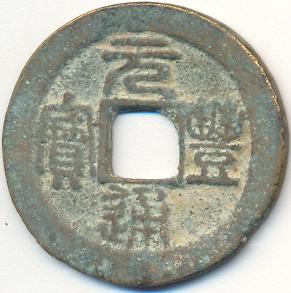 Chinese cash coins rarely had pictures of any sort on them; lettering only was the rule. I generally concur with FYI and say it's a 19th or 20th century amulet or charm, from somewhere in east Asia. I'm not certain, but the first picture (with the writing) might be upside down.  An expert in Chinese script might tell you what the legend is trying to say, though perhaps fengk is right and it's just "Chinese-looking" gibberish, designed to trick up gullible foreigners.  Don't say "infinitely" when you mean "very"; otherwise, you'll have no word left when you want to talk about something really infinite. - C. S. Lewis
|
|
Pillar of the Community
Australia
3841 Posts |
I am pointing towards the Thai-Chinese or Indochina community. The symbol of the reverse reminds me of the Thai royal crown, and hence my opinion.
My partial coin collection http://www.omnicoin.com/collection/gxseriesMy numismatics articles and collection: http://www.gxseries.com/numis/numis_index.htmRegularly updated at least once a month. |
| |
Replies: 6 / Views: 6,529 |
|









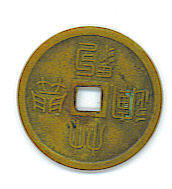 unknown coin side 1.jpg
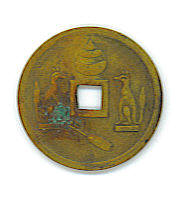 unknown coin side 2.jpg


 Posted 06/24/2006 2:26 pm


