| Author |
 Replies: 10 / Views: 2,116 Replies: 10 / Views: 2,116 |
|
|
Valued Member
United States
67 Posts |
I found two things among my coins that sort of look like coins, but maybe not. Can anyone shed any light on this one? This is both sides of one coin. It's 1 and 3/8 inches wide at the widest part. It looks to me as if it's made out of iron. The other one, which I'm not sending now, is similar but not the same dies, and it's curved on one face, which means it's thinner in the middle than at the sides. If anyone would have a clue on this thing, I think it would be the folks on this forum! 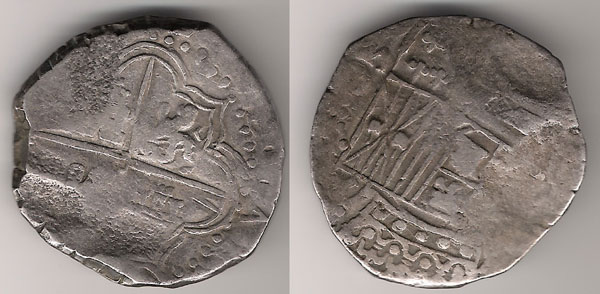 |
|
|
|
Pillar of the Community
Canada
1152 Posts |
It looks like an old hammered coin to me. Possibly British.
andrew
|
|
Pillar of the Community
United States
7123 Posts |
Yep its a coin !! But I'm not the one to help Identify it, Sap is pretty knowledgeable on ancient coins.
Rick
|
|
Pillar of the Community
United States
4589 Posts |
if we can get this moved to ancients etc it will get a better responce
|
|
Moderator
 United States
23522 Posts |
I'm going to throw a guess out there and suggest it might be an Ilkhanid issue of some sort. It sure looks Islamic to me.
|
|
Pillar of the Community
United States
577 Posts |
Wow thats very interesting, sorry I cant help you out - I'm interested to see what the others have to say.
|
|
Pillar of the Community
United States
5362 Posts |
The coin looks like a Spanish Cob coin. A rough cut hunk of silver that gets stamped roughly using hand hammered dies. It was typical for several Spanish and Spanish colonial mints. This is the "Real" piece of 8 first encountered in International trade.
The side shown at the left is oriented correctly. It is a quartered design with lions and castles in the quadrants. The legend runs around the fancy border.
The side on the right of your picture is not right side up. At about 7:00 o'lock is a row of "jewels" that run around the bottom the the crown. This is the TOP of the coin. The shield below identifies the royal family. It looks like Philip II or III which would date it to late 1500s or early 1600s. There were usually 3 or 4 dates on the dies - each date uses 2 or three digits. They always left off the 1 at the start and often the century. So a 1692 would read 92. There are no portions of the date visible here. The country of origin must in this case be determined by the pattern in use.
However, these are one of the most counterfeited coins in existance. That is because they are so easy to forge. You need to weigh the piece accurately and get a specific gravity if possible.
|
|
Pillar of the Community
Belgium
2078 Posts |
Better ask Aeteling  |
|
Moderator
United States
23522 Posts |
quote:
Originally posted by ageka
Better ask Aeteling
No need to after swamperbob's input - he's right. I was misled by the border into thinking Islamic. Here's a good place to start learning (as I am right now): http://www.coins.nd.edu/ColCoin/Col...s.intro.htmlEdited by SsuperDdave
06/30/2006 5:27 pm
|
|
Pillar of the Community
United States
5362 Posts |
|
|
Forum Kid
Kuwait
1523 Posts |
Pretty Neat looking coin, The difference between a 4 reale and a half real is really big, I have a Half Reale and it looks nothing alike.
|
| |
Replies: 10 / Views: 2,116 |
|










 Posted 06/30/2006 1:19 pm


