| Author |
 Replies: 25 / Views: 13,128 Replies: 25 / Views: 13,128 |
|
|
|
New Member
 United States
38 Posts |
Oohhhhh, so it is the die that is doubled and not a misalignment between die strikes. That makes much more sense, or in this case cents! (Sorry, couldn't resist) So could a misalignment between die strikes produce the Machine Doubling that we all love (or hate)? |
|
Pillar of the Community
United States
7629 Posts |
Yes. Machine Doubling is a simple process of a loose die that bounces on a coin when it strikes. The effect is slight shelf-like doubling. In some issues this happened very frequently - enough that nearly half the coins minted show Machine Doubling to some extent. Hub doubling is much more scarce because the doubling is on the die before the die is hung to make coins, and it is hand inspected with a loupe before it's hung for quality assurance. The doubling is supposed to be spotted and the die rejected prior to any coins being made. Obviously the inspectors miss some of them and they make coins. |
|
Pillar of the Community
United States
1882 Posts |
Quote:So could a misalignment between die strikes produce the Machine Doubling that we all love (or hate)? If you are asking if it is between two strikes on the same coin, then no. The bouncing Chuck is talking about happens on one strike of the coin. A coin (non-proof) that is double struck is a different error. |
|
New Member
United States
38 Posts |
Ok then, I guess I need to clear something up. Are circulation coins struck twice, and if they are, and the Machine Doubling is not caused by misalignment but by bouncing, then what does misaligned strikes look like, and/or what is it called? |
|
Pillar of the Community
United States
1882 Posts |
Business strike coins are struck one time. There's off center strikes where the planchet is not centered correctly between the dies: 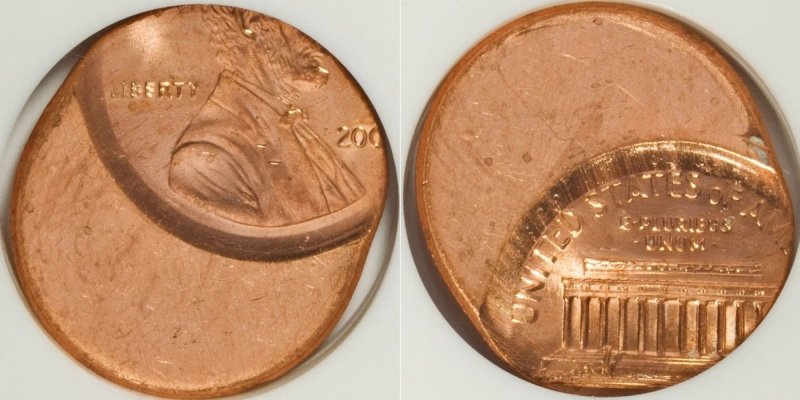 Then, there are misaligned dies, where the obverse and reverse dies are not lined up with each other: 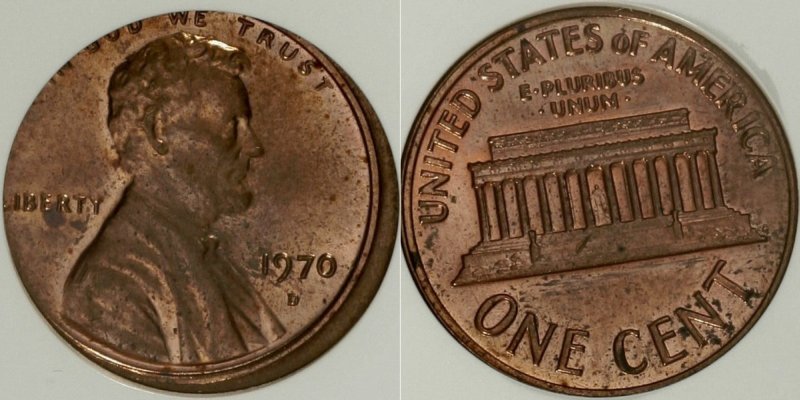 |
|
New Member
United States
38 Posts |
Cool, I think I have it figured out now. Mentioning the mis-strikes as it were, I haven't found any off-center strikes, but I do have an 11D that the reverse is about 30-45° off alignment. I always thought that was cool.
|
|
Pillar of the Community
United States
7629 Posts |
That's called a rotated die strike. Completely separate from all the aforementioned. Two things: 1. Circulation strike coins are only struck once (on purpose). If the die is loose and bounces, it causes Machine Doubling. 2. The difference between die varieties and errors is essentially in that the design is messed up on the die for die varieties before it is hung on the press to begin making coins, and errors cover just about everything else involving the strike of the coin. The third major category, 'varieties', covers mintmark shape and size difference, date size differences, etc. - all the things that were intended changes by the mint that were made so that collectors wouldn't necessarily notice them...but often do. These involve changes in the design hubbed into the die or the shape of the mintmark punch used. |
|
Valued Member
United States
373 Posts |
I have two 1989-D DDO's cents mainly in the "989". I guess these are common for that year, but not really mint errors. Too bad. And then I thought I had a 1982 cent that had two "D" mint marks spaced apart, but the second mark was just dirt. It almost had me convinced I had something special. Oh well....... I guess if I want an error coin I have to buy it specifically. |
|
Valued Member
United States
373 Posts |
I now have three 1989-D doubled "989"s. I guess these are unfortunately not worth anything. That figures.
I suppose there are thousands of these 1989-D doubled "989" coins around. It looks cool though.
|
|
Pillar of the Community
United States
4000 Posts |
Now that this thread has been resurrected from 9 months ago, it gives me an idea of how much I've learned since then. Amazing.
|
| |
Replies: 25 / Views: 13,128 |








 First Page


 Posted 04/23/2010 1:06 pm


