| Author |
 Replies: 13 / Views: 2,793 Replies: 13 / Views: 2,793 |
|
|
Moderator
 United States
16696 Posts |
What would be the safest, best way to remove earth from ancients? With the best results of course. Thanks for your help. Dave swcoin.ecrater.com
|
|
|
|
Pillar of the Community
United States
651 Posts |
Unless the coin is gold, not much. See my posting that I made sometime back in the forums.
|
|
Moderator
 United States
16696 Posts |
Thanks fcrazo.
swcoin.ecrater.com
|
|
Moderator
Australia
17002 Posts |
Gold coins don't require "cleaning" in the usual sense that ancient coin need; a quick wash with soapy water is usually sufficient.
Silver coins can be slightly corroded, especially if they're a low-silver alloy or they've been buried in salty soil, but they still usually come out of the ground looking like "coins". Mild acid (eg. vinegar or lemon juice), ammonia, or the baking-soda-and-aluminium foil technique usually do a good enough job on silver coins.
Bronze coins come out of the ground looking like rocks, and they will need cleaning. For these, the safest and best way is "very slowly". If you're short on patience (like me), then uncleaned bronzes aren't for you. Long soaks in deionized water or olive oil, followed by carefully picking and brushing away the dirt, then back into fresh water or oil for another month or two.
The important thing to do is not strip the coin right down to bare metal. 2000 years of slow corrosion has meant that most ancient bronze coins are essentially half-fossilized, with the original details of the coin preserved in the patina and not in the metal itself. Learning how to tell the difference between "patina" and "dirt" is the tricky part.
There are quick and easy shortcuts, but they rarely result in good-looking coins. For example, electrolysis, strong acids or alkalis can strip everything non-metallic off of an uncleaned ancient coin in seconds, but the end result is highly likely going to be a coin that looks like a corroded moonscape.
Be aware that not all ancient coins will clean up nicely; some will stay "slugs" no matter how slowly or expertly they are cleaned. Such coins were either already very well worn when they were originally lost and buried, or their burial conditions were damp, acidic or otherwise prone to accelerated corrosion.
Don't say "infinitely" when you mean "very"; otherwise, you'll have no word left when you want to talk about something really infinite. - C. S. Lewis
|
|
Moderator
United States
16696 Posts |
Thank you Sap! I have 7 that are pretty well encrusted with the white, chalky type material. Some of it is powdery so I am guessing there may be corrosion issues there. A couple look promising. I will start with a 2 month soak and go from there. I'll post the results as I go along here  swcoin.ecrater.com
Edited by vermontensium
05/09/2010 4:24 pm
|
|
Valued Member
Australia
155 Posts |
Don't despair if after 2 months of soaking you only brush of a little bit of dust.I've got coins that you'd swear were chipped out of concrete and will probably take a few years to get to the fine picking.And even then,like sap said,there might not be anything there.
That's all part of the fun in my opinion.
I'm waiting for a new batch at the moment,I've never bought them of this guy so I'm not to sure how the quality will be.I always hope for a few hard cleaners,i don't enjoy it as much when they clean up after one soak.Have fun mate and keep us posted!
|
|
Moderator
United States
16696 Posts |
Thanks! I have much patience and just enjoy seen them finally soaking! One is nicely off centered and on has a thick bearded emperor on it? We shall see and I will definitely keep you posted.
swcoin.ecrater.com
|
|
Valued Member
Australia
155 Posts |
Got my batch of five today.Some nice cleaners.I'm trying to get the missus into so these are hers. One looks like a constantius 2 vot xx wreath.Theres another wreath,a horseman and soldier,one I can see with a lone figure,and the last one ,which is pretty small with what looks like two ladies holding circular objects up to each other,havent got that one in my collection.Now they are of for a nice long bath.If you need any advice once yours have soaked hit me up mate. |
|
Valued Member
Australia
155 Posts |
How are they coming along verm?
|
|
Moderator
United States
16696 Posts |
Pretty good! You can start to see some detail. I changed the water and will just continue to let them soak I guess. Patience is what you have to have when doing this. Any further suggestions? One of the coins has a cool reverse of two standing figures facing each other.
swcoin.ecrater.com
|
|
Valued Member
Israel
423 Posts |
Here is a coin that I have had soaking in olive oil for the past eight months. It doesn't look look much but it is infinitely better that when I started. Perhaps another 2000 years and it will be a recognizable coin. 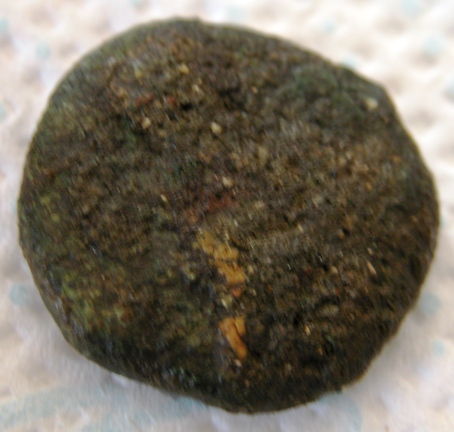 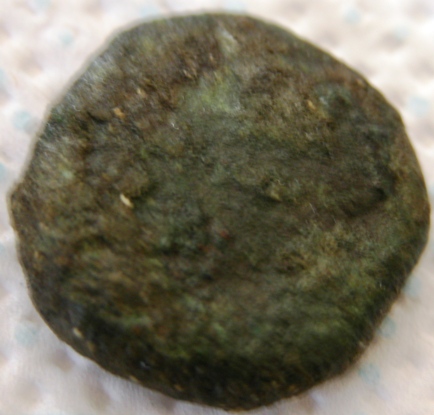 |
|
Moderator
United States
16696 Posts |
|
|
Bedrock of the Community
Australia
21792 Posts |
I don't clean ancient coins. Fortunately, most of the ancients that I have acquired have already been cleaned by professionals, any where from recently to perhaps hundreds of years ago.
I have searched the Net, and I have found a few sites that discuss the cleaning of ancients. It is up the the reader of this post to do the same if he / she wishes. Most of the people who clean ancients are most probably more skilled than myself.
The only point, other that what I have already said, is that of the ancient coin cleaning sites that I looked at, most have suggested the use of distilled water, not tap water, very soft brushing to physically remove dirt, and olive oil, which obviously acts as a cleaning and a preserving agent. It is noteworthy that all of the materials stated here, and used for cleaning, have been available for centuries.
|
|
New Member
United States
31 Posts |
Actually the olive oil is not a preserving agent. Once a coin is cleaned all olive oil has to be removed. Olive oil is slightly acidic. What the olive oil does for coin cleaning is very slowly eat away at the deposits, slowly being the key word. This way the cleaner can see what is happening and stop the process, while working with a safe "acid".
Distilled water is good since the water actually will absorb ions from the crust of the coin. It only works with repeated water changes, maybe every few days as the distilled water absorbs as many ions as possible.
|
| |
Replies: 13 / Views: 2,793 |
|






 Posted 05/01/2010 9:56 pm





