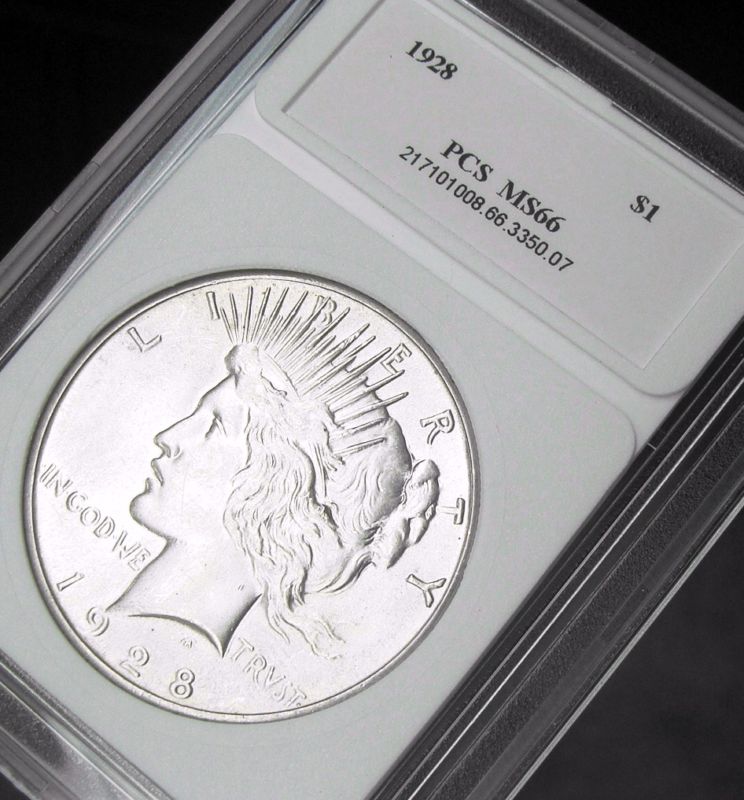
I was bidding on a 1921
Peace dollar being auctioned
by a firm HUBBY'SCOINS on
ebay today, May 30, 2013. I saw
it slabbed in a " PCS " holder with an MS65 grade,sequence
of digits. At 64, having collected coins since I was 10, I
was suspect of the listing over claiming the coin's status.
Assuming it's a business strike ( PCGS lists 1921,22 Proofs )
this coin's THE best I'd ever seen. It seemed as desirable
as Kate Upton, unless the reality is Kate Upton is a nun
like she was dressed in the latest 3 Stooges movie. Fate
can be cruel as human life on this earth is often amusement
for the Gods. I've read the 20 page expose a PCGS expert
wrote on
Peace dollars. That led into resolving what I saw.
I believe this PCS coin was THE king of the super sliders.
In a
Peace dollar grading page I saw in a Google search,(
where I saw this forum, decided to register as a community
member ), the highest points of a high relief dollar are on
the eagle's inner breast. PCGS notes that fewer than 1% of
the 1921's were well struck as they had extreme problems
with striking the high relief design. Dies would crack & break
often during the 5-20 day production of the De Francisi design
which forced Morgan to fill in dies, making the weak strikes
worse. This entire series had many problems with accurately
grading coins. I saw a 1935 at auction yesterday with an MS67
Obverse, an MS 63+ Reverse. But the design is sooooo special.
An easy set to assemble even in full gem grades, a challenge !
So many feathers on the breast were never well defined through
out the series, that even though the reverse side was the hammer
die, both sides have weak impressions unless first strikes. This
makes it tough to tell if the lack of feathers definition was due
to the weak strike of a worn out die, the filled in master die or
from very slight wear. Bona fide grading companies like PCGS, NGC
or IGS won't subtract from an MS
Peace dollar grade, knowing this.
I puzzled for hours seeking clues to resolve my question: Has this
" PCS " coin been handled even a little ? The basement slabbing amateur who passed it off as an MS65 failed to realize it would've graded higher than all known populations of PCGS, NGC, IGS, graded
Peace dollars, as an MS 69, at least to the unaided eye. Ie,if it didn't appear to have a slightly localized worn surface at the high point due to human handling.
Historicly, the 1921 was such a novelty with it's Medalion style
ultra high cameo high relief, many lined up at the Philadelphia
mint to obtain one, as they did in 1909 with Lincoln cents to get
one. Then they stashed it in drawers only to handle it privately though w/o care which resulted in extremely low wear on only the highest coin points. Wikepedia's history of the
Peace dollar is
a good read, explaining why many 1921s and 1928s were saved in
MS/AU, yet the 1934S wasn't. It was issued during the Depression.
Though this PCS coin looked MS-69, whatever guy was so lucky
as to get hold of it, was apparently so overwhelmed with it's
luster & mar free surfaces,so inexperienced with grading that
he overlooked what makes a coin MS 60 or AU58+++. A very small circumference, half the size of a dime, on the innermost breast
feathers showed no definition and no luster.I deduced that one
person handled the coin gotten from the Philadelphia mint,only
minimaly. He had the sense to keep it from exposure to the air.
But didn't understand that it's the light bouncing off the coin
surfaces' microfractures that causes the luster of a MS coin.
An AU super slider will have nearly perfect luster except in
the specific high points rubbed by thumb or fingers. Silver,
as Gold, is a very soft metal, so this evidence was telltale.
When the person who gets it submits it to PCGS, they'll put
it under a stereo microscope under a halogen lamp to check
for prints or oil film in the area dulled by human hand con
tact. If I hadn't noticed the small dulled area, I would be
the one submitting it to PCGS. But the bottom line is that
unless PCGS suddenly has a population of ( 1 ) MS 69 1921
Peace dollar in the 2nd half of 2013, my lengthy explanation
is probably correct. The guy likely paid $ 625 with grading
fees & shipping for a $200 coin. Though it was advertised as
" investment grade ". Caveat emptor.
This is what happens when a bogus company tries to hustle people
with the leverage of Smithsonian quality coins.I'm responding to
a fellow who commented about seeing PCS slabbed coins offered on
HUBBY'SCOINS
ebay lists. He claimed he'd get right back to us to answer the topic question: Is PCS a bona fide grading company ?
He posted in Spring 2010. But I didn't read his follow up. Coins touted for $20,000 don't sell for a pitance as another guy posted
on the 2 pages here I read. Anyway,I'm glad to be one of you folks.
I like the club motto a lot. As Alexander Dumas said: " One for
all,& all for one ! " That's what it is to be part of a community.







 First Page


 Is PCS usable or not? Looks like the "Ole Timer's" say no and the "newbies" say yes. Looks like it's a difinate maybe but only if you're lucky.


 Posted 08/06/2010 4:47 pm





 and also find this a little fishy.

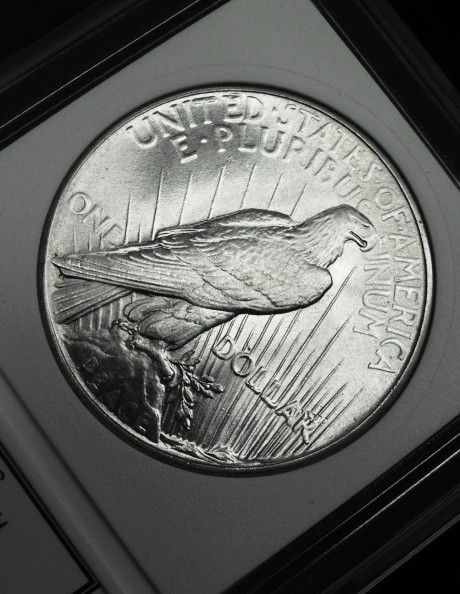 I'm not a dealer I'm a collector but its your kind that keeps these companies like pcgs ngc and the top three in bizz go ahead and buy the name I buy the coins not there holders have this coin submitted now will post results this coin in a pcgs holder is worth around $20,000 I paid $450 in pcs holder how can any company that sells also grade there own coins pcgs grades then sells to people like you that buy the name but that's good for people like me the I don't have any comp from people like you