| Author |
 Replies: 31 / Views: 14,283 Replies: 31 / Views: 14,283 |
|
Valued Member
Canada
287 Posts |
I cannot find this coin listed anywhere. Does anyone know if it comes from a special set, or is it an error. I received it from a friend who I believe received it in general circulation. I have taken pictures of it next to a normal loonie to show the difference in the lighting I have here (9pm, so not much natural sunlight available). 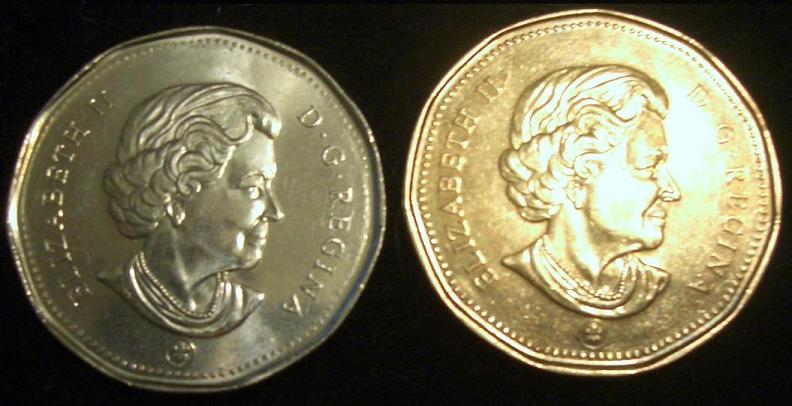 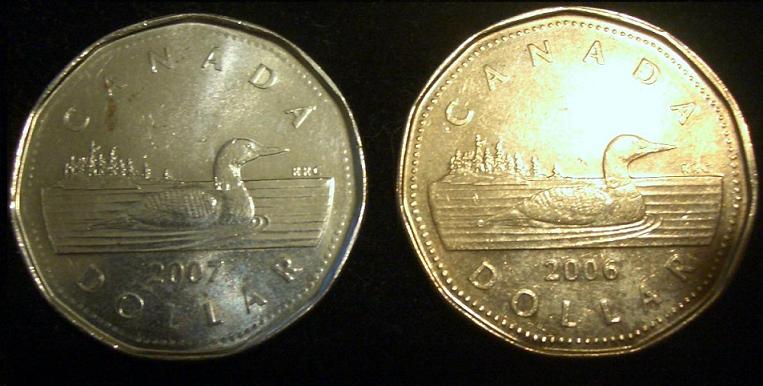 The reddish marks on the reverse actually are a copper colour when viewed up close. Edited by rikcando
05/07/2010 9:24 pm
|
|
|
|
Pillar of the Community
Canada
1733 Posts |
That's REALLY interesting... are those copper coloured marks actually rust? If so this planchet might have missed the nickel plating step in the plating process and the bronze plate won't stick to steel without it.
That looks like steel to me, a nickel strike plating layer would be very dull and grey in colour, not shiny on this type of process.
|
|
Valued Member
 Canada
287 Posts |
I am not sure about it being rust. It seems closer to a new copper penny in colour, and the spots look recessed, as if the outer coat is revealing something under it. Sound like rust. You may be right. The larger circles do have what looks like a pit mark in the center so it may be rust. I tried to scan it but it does not show very well. This is a picture through my 10x loupe. Time for a new camera. It definitely is rather shiny. 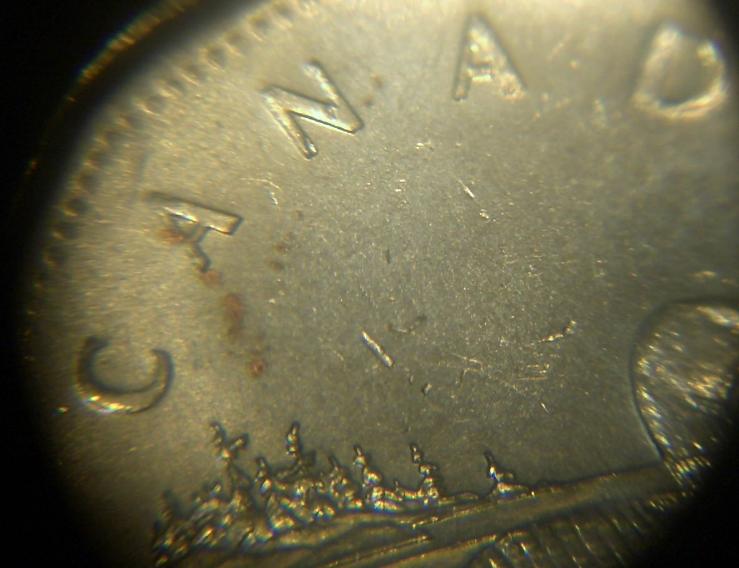 |
|
Pillar of the Community
Canada
1733 Posts |
Yeah that's steel in my opinion... I see remnants of the bronze plating too... definitely will not stick to steel without a quick flash of something else (that's why they nickel plate and then copper or bronze or put a finish nickel plate on etc...)
I have never seen this error before thank you for sharing it.
|
|
Valued Member
Canada
287 Posts |
Thank you for your helpful information. Here is a couple more pictures. They seem to confirm your comments. 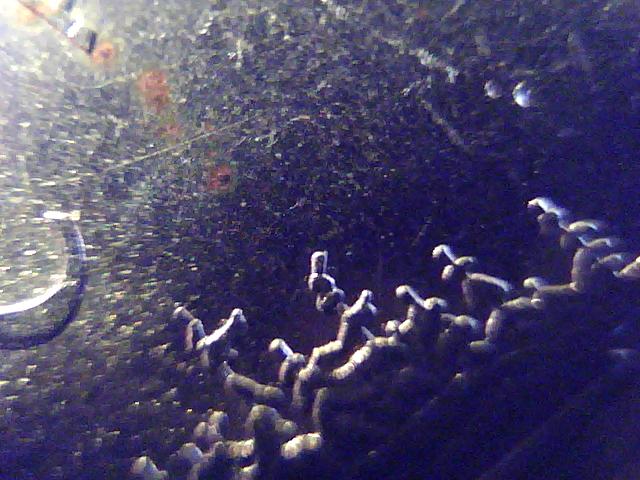 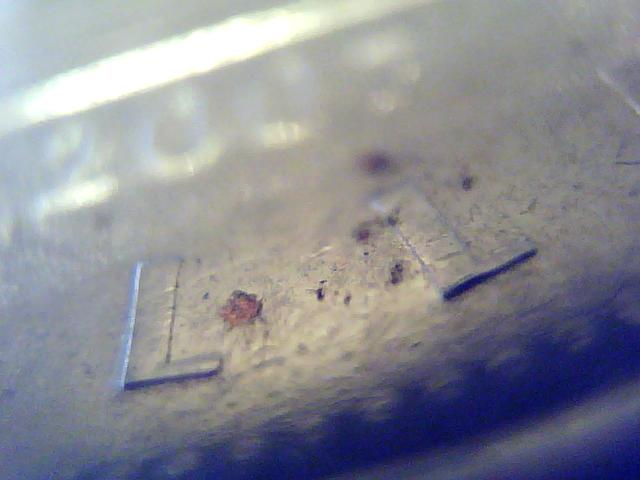 |
|
Pillar of the Community
Canada
3692 Posts |
Have you had the chance to weigh the coin yet?
|
|
Valued Member
Canada
287 Posts |
My scale only weighs in 1 gram increments, so I did not try it. I did weigh this morning and to my surprise there was a difference when compared to a regular loonie.
The regular loonie (2006) shows 7 grams, which make it between 6.5 grams and 7.4 grams.
This loonie weighed in at only 6 grams, meaning it is less than 6.5 grams.
|
|
Valued Member
Canada
287 Posts |
According to my book, the loonie is made from 91.5% nickel and .85% bronze. There is no mention of any steel within the composition. However, if this is true, neither of the coins should be attracted to a magnet, and they both are. Now I'm more confused. Could the world according to Charlton be incorrect ? Please tell me it isn't so.
Edit: Ok, I just checked a random nickel made from 100% nickel (1928) and the magnet picked it up. I was under the misunderstanding that nickel was non-ferrous and would not be affected by the magnet. Maybe I should just go back to bed and start over.
Edited by rikcando
05/08/2010 06:22 am
|
|
Pillar of the Community
United States
3098 Posts |
Nickel is actually one of the metals (including iron and germanium?) that are magnetic.
By the way, I heard or read that starting 2010 or 2011, the loonie and the toonie will also be made on multi-ply planchets, meaning that they will have the layers of plating. Is your loonie silver or more bronze-colored? Could this be struck on the wrong metal stock, say for quarters?...
........
|
|
Valued Member
Canada
287 Posts |
It is not as shiny as my new quarters, but a nicer finish than my toonies. It is not steel in appearance as is my 1954 nickel. It does not have that silver ting when dropped on glass.
My quarters only show a weight of 4 grams on my limited scale.
On my way out, I'll catch up later this evening.
|
|
Pillar of the Community
Canada
1733 Posts |
That's what makes this so interesting.
Nickel doesn't rust and pit. Yet steel loonies aren't supposed to be out there in this date year from what the book says.
|
|
Valued Member
Canada
287 Posts |
I just got back from Kitchner, went to a coin store there, and they had no idea either. The mystery continues.
I also tried to buy a better scale but it is special order. Guess that will have to wait.
|
|
Pillar of the Community
United States
3098 Posts |
Yeah... so could it be struck on a wrong stock? ie the multi-ply stock for nickels/dimes/quarters/halves?
|
|
Pillar of the Community
Canada
1733 Posts |
The planchet for the 50 cent piece is very nearly the same size, slightly thicker, made of steel, weighs 6.9 grams when finished. Also a possibility. subtract the copper and nickel from the fifty cent piece and you would get 6.43 grams, would round on your scale to six grams.....
|
|
Valued Member
Canada
287 Posts |
The math works. The science is sound. Now, what do I do with it?
I'll probably put it in a 2x2 and store it in my error book. Is there anywhere I could send it to have it confirmed? Or is this just a one of a kind oddity that is worth little more than face value at best and is destined to be just a cool conversation piece?
Where would one go for values on error pieces? Not that I'm planning on ever selling it, but it is nice to know when it come to valuating my collection. Actually, that question might make for a good topic.
|
|
Valued Member
Canada
287 Posts |
If it was the wrong planchet, would it not have still been completed with the proper plating and I would never have known? Could it be the wrong planchet AND skipped the plating process. Quite a coincidence for both errors to happen on the same coin.
|
| |
Replies: 31 / Views: 14,283 |










 Posted 05/07/2010 10:08 pm


