One of the problems I see all the time on
ebay are coins that are incorrectly described. I will often write to the sellers to tell them what they actually have (when I am positive that I actually know what it is). Most of the sellers are thankful and they correct the listing. I hope after doing their own research.
Some people selling forgeries or those involved in frauds obviously ignore me. Some people must write me off as some crackpot (I presume because no one has ever told me that - yet). But other will simply not believe me and will refuse to check out the facts - or worse still make up their own facts to contradict what I have told them.
Here we have one such auction where I wrote to the seller and he is either blind or just refuses to check the facts.
http://cgi.ebay.com/Mexico-8-Reales...ce_W0QQitemZ180004910453The description actually sounds good. Here is what he says ...
"
Mexico 8 Reales, Sinaloa,Zs Revolutionary Issue V Scarce!! Considered by some to be a contempory counterfeit, but all were actually sand cast unofficially. From an old Gypsy bracelet purchased many years ago and part of an Important Collection. No Reserve."
That description makes it sound like the seller has done the research and the facts should bear out that reasearch - RIGHT? Issue V sounds very precise.
My name must now be "some" because the statement about what some believe was added to the description when the seller relisted the coin after it failed to sell the first time. So he clearly heard what I was saying but rejects it by going on to state that "...but all were actually sand cast unofficially." That makes it appear that he did some checking.
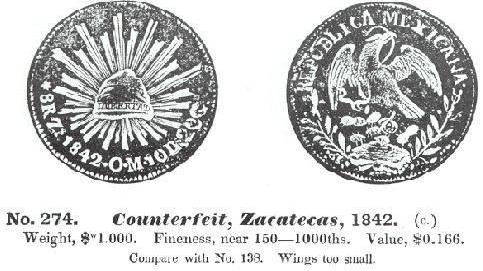
Here is what he actually has - the coin is not a Sinaloa casting - it is a contemporary counterfeit that used the eagle die listed in J.L. Riddell's book as # 274 paired with an unlisted cap die which is dated 1836 Zs OM. I know because I have examined dozens of copies and my collection includes 8 different eaxmples of this precise die marriage. My copies are all low grade silver forgeries that are struck from metal dies not cast copies. They do not vaguely resemble sand castings.
Please check this one out for yourselves.
The questions that need answers are:
Is his coin a Sand Casting?
Does it match the examples listed in Krause?
Is it silver?
Was it made at the right time?
To get the answers you first need to know what a Sinaloa coins is.
A Sinaloa casting was a coin made during the Mexican Revolution about 1910 or so. They were emergency issues and the manufacturers are uncertain. They were all made by pouring molten silver into a crude sand impression of an 8R or Peso coin. They were usually finished by filing the faces down to flatten the high spots (which improves the visibility of the design considerably). This step also allows correction of the weight as well. Because these coins were very crude - they are obvious targets for counterfeiting which is why I like the series. For pictures of originals, please see Krause "Standard Catalog of World Coins" KM numbers 765 to 770. There are many varieties, but I have never seen a Sinaloa made where the host coin used to make the sand impression was a COUNTERFEIT. All Sinaloa coins have a very similar grainy look. A simple comparison of any of the Krause pictures with the seller's coin will show that these are completely different issues made in totally different ways.
The Riddell 274 and it's two rematings 274A and 274B are all made from prepared metal dies - NOT SAND impressions. The details are simply too fine on the 274 for a sand impression. Also, the 274 is a coin made with 0.150 fine silver not 0.900 or anything near it. The counterfeit was made for circulation and the fact that it appears in Riddell's book means that they were made before 1845. The drill hole through the top is a typical period cancellation which would have prevented the coin from circulating any further. It may have been on a gypsy necklace or a head teller's counterfeit ring, but that adds no value to me personally.
One final fact, the design employed on the seller's coin is not an original Mexican design. That eagle and cap design have never in fact appeared on a real 8R. To be certain of this you need to review "Resplandores" by Mike Dunigan, but you can eliminate some of the 1400 different 8R cap and ray die pairs because the mint mark is Zs and the coin has a medallic rotation so you don't have to look past 1842.
Those are the very simple facts. Does anyone agree or disagree?










 Posted 07/08/2006 12:58 am