| Author |
 Replies: 11 / Views: 1,695 Replies: 11 / Views: 1,695 |
|
|
Pillar of the Community
United States
2365 Posts |
I have two coins that I have identified to be Chinese. I had identified the Dynasty at one time and ofcourse, now that I'm posting, I can't locate my notes. Can anyone assist me here? I'm looking for Dynasty, age and hopefully value. I'm still practicing my scanning of coins but, hopefully someone can identify these with the scans provided. Thank you! OBVERSE #1 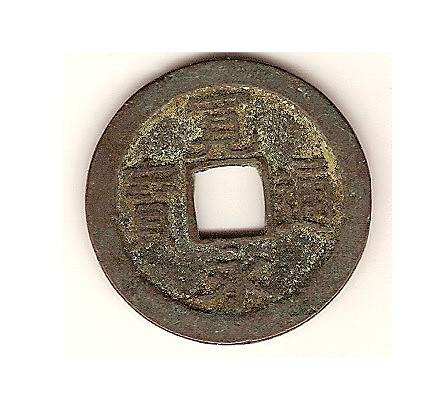 REVERSE #1 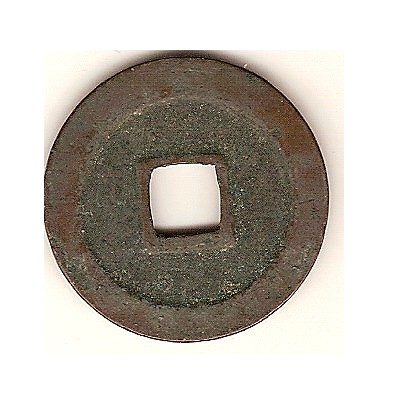 OBVERSE #2 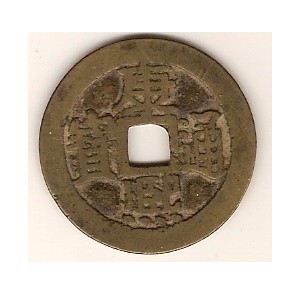 REVERSE #2 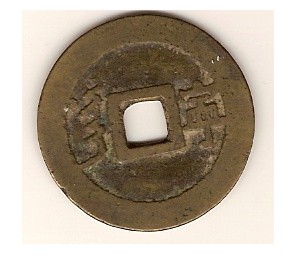 Edited by dsking
07/12/2006 12:20 pm
|
|
|
|
Moderator
 Australia
16982 Posts |
The top one looks like the "Kanei Tsuho" legend on Japanese coins. The reverse is plain, so it's a 1 mon. For further ID, we need to know if that one is copper or iron. Test it with a magnet - if it sticks, its iron.
The second one is Chinese, the Kang Xi emperor (sometimes spelled K'ang Hsi), reigned 1662-1723. The reverse mintmark is Ning Xia mint, Gansu province. Common enough; the price in Jen is $2.
(edited to add pricing)
Don't say "infinitely" when you mean "very"; otherwise, you'll have no word left when you want to talk about something really infinite. - C. S. Lewis
Edited by Sap
07/12/2006 7:55 pm
|
|
Pillar of the Community
 United States
2365 Posts |
A magnet doesn't attract either coin. I found my notes - finally and I had the second coin as top-Kang, rt-Tung, Bottom-Hsi and lt-Pao with the back Ning so the Kang Hsi Dynasty of Ching (Chien Lung period) is a match - yes?
I had also identified #1 as Lt-Pao and Rt-Tung and that's as far as I got with my ID'ing.
Does the fact that they are iron mean that they are ancients so to speak or new (also so to speak)?
Thanks Sap!
|
|
Moderator
Australia
16982 Posts |
Yes, number two is a match. Number one is Japanese, so you won't find it in your typical list of "Chinese cash coins". It looks similar because Chinese and Old Japanese are written with the same characters and the characters mean the same things, they're just pronounced differently. Japanese cash used this same legend for virtually the entire period 1626-1866. The Japanese listings in Krause are darned confusing, especially when you have to jump from volume to volume, but I don't have anything better to go on. I think yours might well be the older period (1636-1656, KM/C# 1.1, cat. value 50¢ in Fine). From my interpretation, copper, plain-reverse 1 mon coins tend to be older than iron ones. This website has some good basic info on the different types of Japanese cash. Don't say "infinitely" when you mean "very"; otherwise, you'll have no word left when you want to talk about something really infinite. - C. S. Lewis
|
|
Valued Member
China
117 Posts |
I must say SAP is an excellent expert on old coins.
On ancient Chinese coins, SAP is more knowledgeable than me though I am a Chinese. :-)
For the first one, I can not recognize it.
I trust SAP's judgement and it should be a Japanese coin.
For the second one, it is a coin under KangXi Emperor's reign. KangXi Emperor is the second emperor of Qing Dynasty.
I don't know much about the value of ancient Chinese coins. There are too many different coins and their values are quite different according to their age and quantity. KangXi Tongbao ( alphabetic spell of the 4 Chinese charactor on the obverse of the coin ) is not a rare item.
|
|
Pillar of the Community
United States
2365 Posts |
Thank you both so very, very much. The larger mystery is where in the World I got them? My Father was in the Phillipines during WWII and my Brother was overseas but, neither of them in Japan or China. Maybe I just picked them up somewhere but, for the life of me I am clueless as to where. In any case, it's wonderful to own two small pieces of Japanese and Chinese history. Thanks again to you both!
|
|
Moderator
Australia
16982 Posts |
Cash coins aren't just found in China. Both the Chinese "originals" and the "copies" made by surrounding nations, circulated throughout the far east (including the Philippines) right up to the beginning of the 20th century. And of course the "Chinese diaspora" took them with them wherever they went, as little reminders of home: California, Australia, New Zealand, Britain... you can find cash coins just about anywhere.
Don't say "infinitely" when you mean "very"; otherwise, you'll have no word left when you want to talk about something really infinite. - C. S. Lewis
|
|
Pillar of the Community
United States
2365 Posts |
Not that that narrows it down for me Sap (as my family members are all travelers) but, it does give me "clues". Where's Dr. Watson when I need him? Thank you very much Sap!!!!!!!!!!
|
|
Pillar of the Community
United States
4589 Posts |
dsking sap is right you can find cash coins in just about every dealers collections and or supplies, I have found one on the ground once here in America.. They are actually quite common to find and always really neat and a challenge to translate and attribute.. Did your father bring back any Phillipini money if you spell it that way sorry..
|
|
Pillar of the Community
United States
2365 Posts |
quote:
Originally posted by scoutjim99
dsking sap is right you can find cash coins in just about every dealers collections and or supplies, I have found one on the ground once here in America.. They are actually quite common to find and always really neat and a challenge to translate and attribute.. Did your father bring back any Phillipini money if you spell it that way sorry..
Thanks scoutjim...here I thought that I'd found something rare - duh, not that lucky! Yes, Dad did bring some loose change back from the Phil's. They are older than WWII and very unusual. They are all US occupied coins. I really love them! |
|
Valued Member
Canada
480 Posts |
IN Canada the cash were sometimes spread by the railway workers, and they were also imported to be used as bangles on clothing, because their brass content made a good sound when they hit each other. The top one is definately Japanese, Kanei Tsuho, but I cannot look up the variety, although there were many- starting with the way the feet of the top character join the horizontal line. The second one, according to Burger, is a counterfeit of the period 1662-1683 issues. The counterfeits were accepted if the weight of metal was close to the real coin. Check Kang Hsi Plate 13 row 2 coin 1- the way the manchu mint mark is wqritten is distinctive, with the big sideways v in the mark- this is Manchu, while the mark on the right is Chinese.
|
|
Pillar of the Community
United States
2365 Posts |
Thank you coinsnpaper! Very good information!
|
| |
Replies: 11 / Views: 1,695 |
|










 Posted 07/12/2006 8:05 pm


