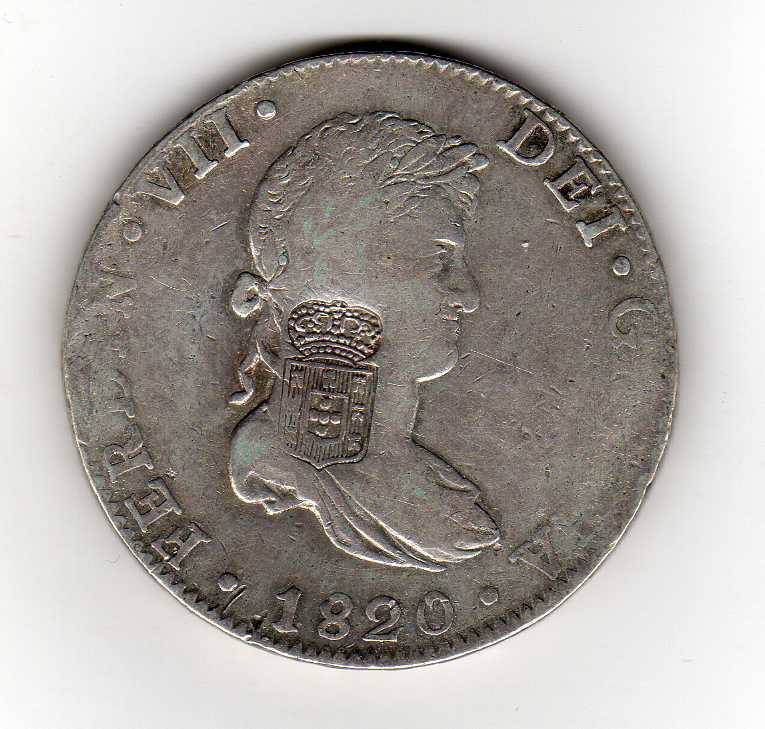
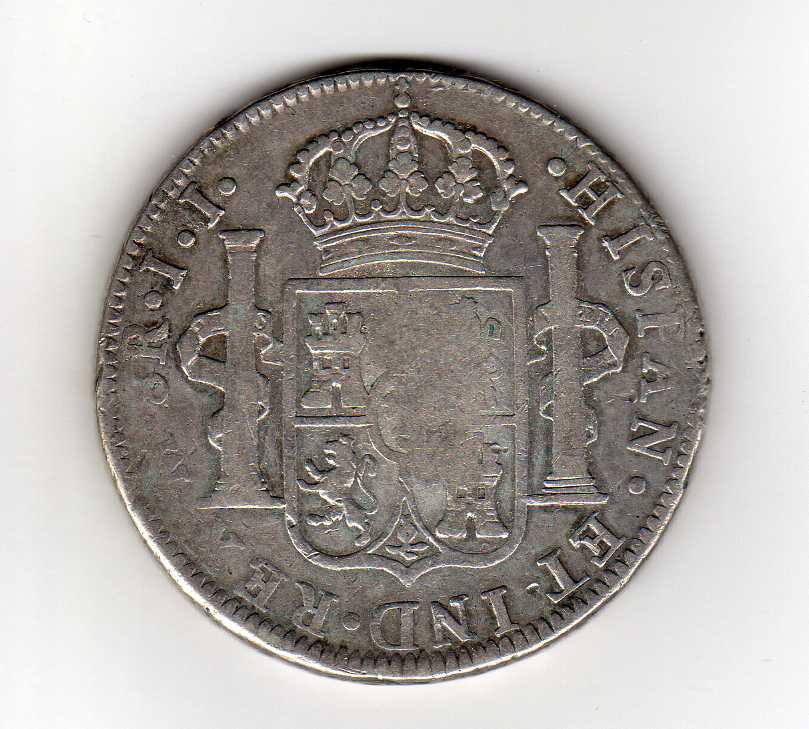
Usually when I spot a suspicious 8R on
ebay I write to the seller. In over half the cases, I get a positive reply. The average
ebay seller seems very understanding. Usually they have been scammed.
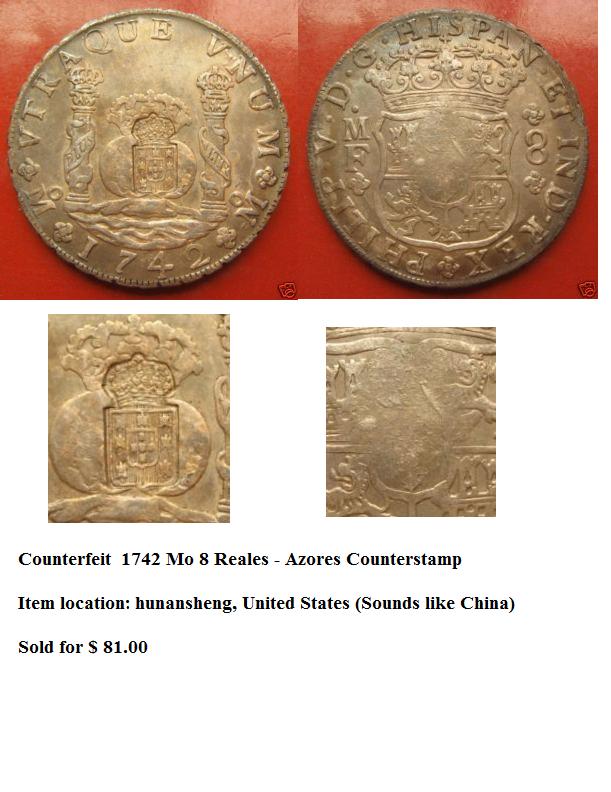
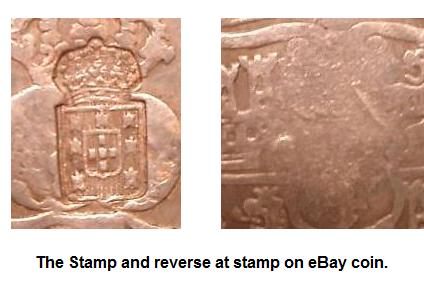
I have decided to document one such case involving a 1742 Mexico 8R with a Portuguese counterstamp.
The 1742 8R is one of those 8Rs which has been copied in Silver by the Chinese. The base coin is a nice VF EF. The counterstamp, also a Chinese target is near "Mint State". In theory it is a rare item in this grade.
But there are problems. Here is the listing:
http://cgi.ebay.com/Rare-Countersta...em1e5c529f93This date as I said above is one of the target dates forged by the Chinese. So a correct weight and Specific Gravity is in this case NO GUARANTEE of originality. So we have to turn to how the coin was made and the clues left on the surface.
Because it is a transfer impression made from a real coin, the design will be correct. That is the bad news - comparison to known originals will fail. But any transfer process has places where it falls short of making a perfect copy.
The dies look remarkably well done. The normal lumps and bumps seen on transfer dies are not visible in the pictures - that could be focus or the die could have been hand tooled. Pictures are not always clear enough to be certain. The edge photos provided look GOOD as well.
The only 1742 anomally I see in design is the 8 in the denomination. The separation of the left side of the upper loop is TOO WIDE. That could be a one die kind of thing and still be real - but in a transfer image operation fine details like that sometimes CHIP OUT or FILL IN. It is not conclusive - just suspicious.
The real problem I see is in the transition from the edge to the faces. The coins in 1742 were all struck on manual screw presses and the blanks were inserted between the moving dies by hand. That means position in the exact center was a goal but not a reality. Slightly off center strikes were the rule not the exception. To prevent filing of the corners of the edge by thieves, the dentils were ELONGATED so that a slightly off center positioning of the blank did not result in dentils that stopped SHORT of the edge of the coin. In this case the dentils end at a circular line segment. I believe the line is the edge of the transfer die impression. When you copy a real coin you only get what that coin had - in this case, the host coin used for the impression most likely lacked part of the denticles because that is where that particular coin ended. But this strike did not quite line up leaving a visible clue.
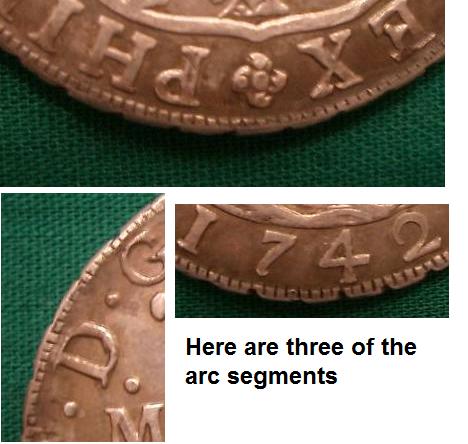
Now for skeptics who would like to believe that this coin is real - there is in fact a way that a somewhat similar line can be seen on a real 8R. This is how it could happen. If the coin was edged POST STRIKE (as it should have been in 1742). And if the blank cutter was worn allowing a "fin" of metal to be retained by the blank. And if that fin was not removed in the process of weighing or handling. And if the fin survived the strike. And if the edging mill rolled the fin OUTWARD onto the coin face obliterating the dentils along an arc. Then the normal wear could produce such an appearance.
I am not thrilled by the number of if's in this scenario.
I sent the following letter to the seller as a first step. The obvious problem here is that a Third Party Certified coin would sell for hundreds more than a raw coin (unless some trusting novice bidder shows up). I can never understand why anyone selling a RARE coin leaves it raw on
ebay where the bargain hunters and gamblers bid low. Why not certify the coin with a reputable
TPG and post it near retail?
So here is my letter sent this morning (Saturday at about 11 AM).
Quote:Hello, I was just looking at your 8R and I have concerns about the appearance of the dentils near the edge. There appears to be a small portion of the dentils missing nearest the rim. The coins were struck in an open sided screw press with elongated dentils on OVERSIZED dies - the "end" of the dentils should not be visible. Did you trace the origin of this coin? It appears to be a very recently made Chinese forgery. You should consider having it authenticated by NGC or another reputable
TPG. It would sell for much more IF it is real. Bob Gurney (Swamperbob22@aol.com)
I will post any and all replies.
The real problem here is that while I am certain this coin is a forgery - there is inadequate proof from an
ebay perspective (which is the CORRECT position). This is precisely where novice bidders get in trouble. They are too trusting and will bid a fraction of retail hoping for a bargain.









 Posted 06/05/2010 2:24 pm