| Author |
 Replies: 11 / Views: 6,090 Replies: 11 / Views: 6,090 |
|
|
New Member
Canada
23 Posts |
I have some 1965 PL cents, but how to tell the difference about Heavy Cameo or Cameo? Really appreciated if some pictures provided.
Thanks!
|
|
|
|
Pillar of the Community
Canada
1051 Posts |
sanong, I have a bucket (literally) of them still in mint plastic, I'll try to pick some good examples and post them up when I get a chance.
|
|
Pillar of the Community
Canada
1051 Posts |
The coin on the left is roughly HC, the one on the right just a cameo. The cameo coin has localized spots of frosting, most prominently on the queens face. The HC coin has much better coverage, covering nearly the whole portrait save for the usual suspects: top of the hair, neck/shoulder area weakness. When you look at it in hand, the strength of the cameo is apparent, but the areas of weakness are also easily seen.  The next one, I believe ICCS called an ultra heavy cameo. It displays excellent contrast between the reflective fields and frosted portrait, but there are small areas of breakage in the frosting, which by my standards means it HC and not UHC. I've gotten a few of these lately, and it just goes to show that even with the "pros", sometimes consistency is not that consistent. Assigning cameo contrast designations to coins is unfortunately subjective, just like numerically grading coins.  edit: the HC in the first scan didn't show up well due to the fairly non-mirrored planchet of that particular coin. This one has more mirrored fields, and shows up better on the scanner.  Edited by 1cent
06/14/2010 02:12 am
|
|
Pillar of the Community
Canada
636 Posts |
Intesting...are cameos and heavy cameos purposely struck this this way, or is this the end result of worn dies before a decision is made to replace them?
|
|
Pillar of the Community
Canada
1051 Posts |
I'd love to have some better answers to your questions D1948, as I'm kind of curious
about them myself. I know that the cameo contrast is created by "roughing up" the
device parts of the coin on a near-microscopic level. Modern proofs, I believe, do this with acid etching. In theory, the coins from the freshest dies should have the best cameo contrast. Were all the dies treated this way? I'm not sure. Were the coins with
no cameo just the result of dies where the "roughness" had worn down? I'm not sure,
and it goes back to the other question, but if this was true, the coins without cameo
should show the weakest strikes, which is in my experience not always true.
|
|
New Member
 Canada
23 Posts |
Thanks, 1cent! I posted two pics based on the digest of your post. Please feel free to correct if not right. Thanks again! 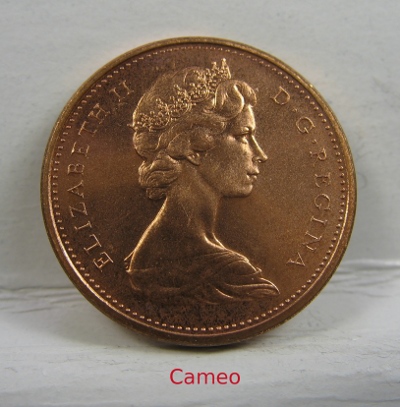 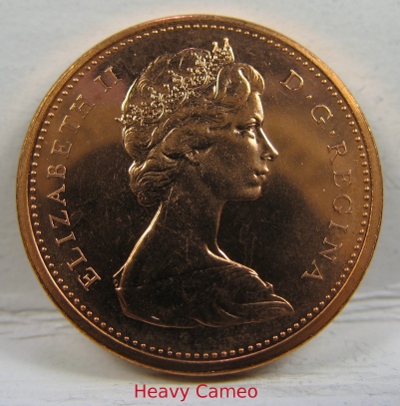 |
|
Pillar of the Community
Canada
1051 Posts |
I agree with your first one sanong, and I'd even say it's on the heavier end of the "cameo" designation. The second one I just don't see the frosting I'd expect on a HC (based on the picture). It could just be the angle/lighting of the photo though. I dug up a better coin and used the camera instead this time, and I think you'll find this picture to be a better example of a HC than the scans I posted.  |
|
Valued Member
Canada
480 Posts |
According to the people at the Royal Canadian Mint, the cameo affect is done by sandblasting, or selectively sandblasting, the surfaces of the dies. I am not really sure that this explains the effect on coins from new dies, or the differences shown on some coins where part of the design is heavy cameo, other parts of the design are cameo, and the background is brilliant, as I have seen on a number of the coins in the nickel pl sets. |
|
New Member
Canada
23 Posts |
Still little confused here! But, thanks, 1cent! Your last picture just show some points clearly!
|
|
Pillar of the Community
Canada
1051 Posts |
What are you remaining confused about sanong?
|
|
New Member
Canada
23 Posts |
The background, 1cent. Is it brilliant for HC? Can we tell the difference between HC and C from the background? I agree your last picture is a nice HC, but not sure the background. Thanks!
|
|
Pillar of the Community
Canada
1051 Posts |
Oh, I see. For general purposes, I wouldn't worry about the background too much.
In the Charlton guide I don't think it even mentions the background when listing definitions
for cameo coins, other than to specify that these coins have a "semi-mirror background". Obviously
differences do exist, and it's up to you to try and cherry pick the best ones, but
for assigning cameo levels I'd focus only on the level of frosting present on the devices.
I just posted the more mirrored coin because it was easier to see the frosting in the picture.
|
| |
Replies: 11 / Views: 6,090 |
|









 Posted 06/14/2010 01:50 am


