| Author |
 Replies: 26 / Views: 5,109 Replies: 26 / Views: 5,109 |
|
|
|
Pillar of the Community
United States
830 Posts |
That design is my favorite, too, Stu (as if you didn't know already) Here's mine ... 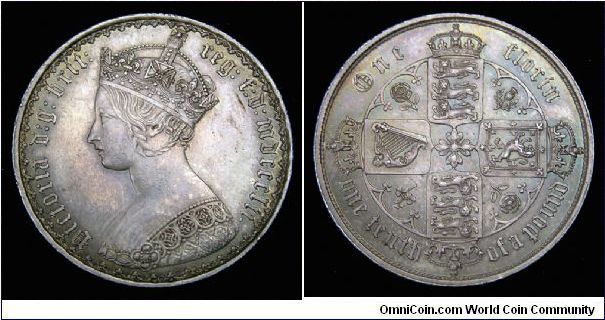 |
|
Valued Member
 United States
421 Posts |
|
|
Pillar of the Community
United States
980 Posts |
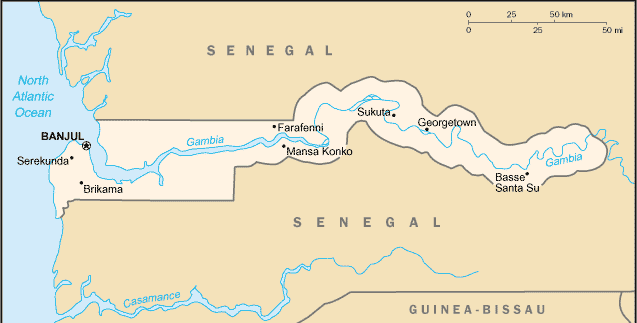
Stujoe, Love that Gambian 4 shilling! trivia Question-do you know why the Gambia has such odd, narrow yet serpentine borders?
Auldefarte-since you and Stu are posting these nifty Florins, can you give some of us a bit of history as ot how Australia came to have a coin named after an Italian city? Appreciated Stu's link, but still "in the woods" as to how Florins came into use in the UK, Oz etc.
Don
|
|
Valued Member
United Kingdom
188 Posts |
Back to the hazy and sunny days of the 14th century. There were several gold coin denominations already in production in the Italian cities at that time, Ducats, Florins etc.
Most northern European countries however had not had a gold coinage since a century or two after the disintegration of the Roman Empire. As Italy's trade links flourished this with the Crusades to the Holy Land had brought a supply of raided Islamic gold. Venice, Florence etc. got alot of this gold and decided to put it to good use in gold currency. One major reason for doing this one gold coin could replace several silver ones.
By the 14th century other countries such as France, England, Central Europe had begun to issue their own gold currency as none of them wanted to be left out.
England issued a new gold coin in the 1340s call the florin, issued at 6/8d (or 80 pence). Thus you could now have three large gold coins to make up £1 sterling, rather than having to send 240 silver pennies. Cheaper to ship, easier to conceal.
Unfortunately the weight of the gold used in the new English gold florins (name of which blatantly borrowed from the Florence coins), was over the face value, thus most got melted and the denomination was demonetised, and replaced by the slightly lighter but similarly designed gold noble also 80d face value (i.e 1/3rd of a £).
There the English florin died.
In 1849 it was decided that the UK should attempt it's first steps towards decimalisation and thus a new coin would be introduced worth 1/10th of a pound, (or two shillings). They were a bit stuck what to call this new coin, they had dabbled with the idea of going decimal and switching the name of the currency to the old favourite the Ducat, but in the end it was decided merely to introduce one new coin, call it a florin (since we had already had a coin called that, and it was a nice spare name going unused), the half crowns ceased production.
However by the 1880s any ideas of going decimal had diminished and the halfcrown was back in production alongside the florin.
|
|
Valued Member
United Kingdom
188 Posts |
So the new term got used in the UK and then got exported to Australia with the rest of the British coinage system.
|
|
Pillar of the Community
United States
980 Posts |
Thanks Aetheling! I wonder how those who were poor at math got along in predecimal days. I get confused trying to figure out the relative values of all these crowns, florins, guineas, farthings,etc. But I guess those poor at math didn't have to worry about how many farthings were in a guinea... And speaking of Africa (guinea), specifically the Gambia, source of Stujoe's coin, Download Attachment:  ga-map.gif ga-map.gif13.61 KB the smallest country in Africa, has it's peculiar shape because a British gunboat sailing the Gambia river had an effective firing range of 10 miles, enabling them to wrest that much terriotory and no more from the French who controlled most of West Africa and the surrounding territory of Senegal. I had a friend who worked as a Pediatric surgeon in the Gambia- has some amazing tales to tell. He's at UC-San Diego now- slightly more cush surroundings! Edited by SFDukie
06/22/2005 8:01 pm
|
|
Moderator
 United States
23796 Posts |
Stujoe
I am torn
Is that an Australian Croc
or
A Florida Gator
signed
a displaced Aussie living in Florida
rggoodie
aka Richard
"catch em doing something right"
|
|
Valued Member
United States
421 Posts |
I believe that is supposed to be a slender-snouted crocodile native to Central and West Africa. But, no matter what kind, I am more comfortabel with it on a coin than near when I live.
Not many crocs or gators in Illinois. ;)
Edited by Stujoe
06/22/2005 10:17 pm
|
|
Valued Member
United Kingdom
188 Posts |
quote:
Originally posted by SFDukie
Thanks Aetheling! I wonder how those who were poor at math got along in predecimal days. I get confused trying to figure out the relative values of all these crowns, florins, guineas, farthings,etc. But I guess those poor at math didn't have to worry about how many farthings were in a guinea...
That catches us all out from time to time. But if you think that's confusing be glad you didn't live in Europe in 1610. The coin values were all over the place, England and Scotland's more than most. Even I get confused looking in the catalogue, I mean here we are talking abouts coins actually changing their face value as gold dried up and a shortage arrived. |
|
Pillar of the Community
Belgium
2078 Posts |
My favourite is the american 20$ eagle probably because I got one when I was young
Of the later acquired coins it is the 100 Korona from Hungary
On the recent coins it is the obverse of my avatar
|
|
Rest in Peace
United States
3730 Posts |
My favorite is any, and all, of the silver, one ounce Britannia coins. Come to think of it, I guess the 2004 version is my favorite.
Edited by Gary Burke
09/20/2005 06:18 am
|
| |
Replies: 26 / Views: 5,109 |







 First Page


 Posted 06/20/2005 06:10 am




 ga-map.gif


