Coin Community Family of Web Sites Join Thousands of Coin, Bullion, & Money Collectors
Coin, Banknote and Medal Collectors's Online Mall Specializing in Modern Numismatics Royal Canadian Mint products, Canadian, Polish, American, and world coins and banknotes. Vancouvers #1 Coin and Paper Money Dealer Join Thousands of Coin, Bullion, & Money Collectors Royal Estate Auctions - $1 Coin Auctions300,000 items to help build your collection!


Username:
Password:
Save Password
Forgot your Password?


This page may contain links that result in small commissions to keep this free site up and running.

Welcome Guest! Registering and/or logging in will remove the anchor (bottom) ads. It's Free!

Star Trivia

To participate in the forum you must log in or register.
Author Previous TopicReplies: 5 / Views: 2,520Next Topic  
Pillar of the Community

3660 Posts
 Posted 06/25/2010  1:27 pm Show Profile   Bookmark this topic Add zeewool to your friends list Get a Link to this Message Number of Subscribers
Does anyone know why some stars replace the S/N letter suffix and other stars replace the S/N letter prefix?

Does anyone know why some stars have holes in their centers and other stars are solid?

Has anyone seen star serial numbered notes that are not actually replacement notes?

I would think that those here who take an interest in star notes would probably have the answers to all of the above. (I don't).
Moderator
Learn More...
rggoodie's Avatar
United States
23537 Posts
 Posted 06/25/2010  10:28 pm  Show Profile   Bookmark this reply Add rggoodie to your friends list Get a Link to this Reply
Star notes are used by the Bureau of Engraving and Printing to replace misprinted/damaged currency before it goes into circulation.
These replacement notes are printed like normal notes, except there is a star printed in the serial number.
On Federal Reserve Notes, the star is where the block letter normally is (the last letter of the serial number).

On Legal Tender notes and Silver Certificates, the star is where the prefix normally is (the first letter of the serial number).

Star notes are printed in what are called "runs." For the current printing systems used by the Bureau of Engraving and Printing, the maximum run size for star notes is 3.2 million notes (100,000 32-note sheets). Sometimes, this many notes are not needed, in which case less are printed. If a partial run is printed, the next run will start at the next closest multiple of 3.2 million. Star notes get their rarity from the quantity printed and released into circulation.

Hope this helps
Pillar of the Community
trdhrdr007's Avatar
United States
2335 Posts
 Posted 06/26/2010  07:08 am  Show Profile   Bookmark this reply Add trdhrdr007 to your friends list Get a Link to this Reply
I got a $100 star note the other day. I'm not a note collector. Are these things worth a premium over face value? No pictures, but mine is reasonably crisp. Unfortunately it has "300" written on it in ink.
Pillar of the Community
3660 Posts
 Posted 06/26/2010  09:57 am  Show Profile   Bookmark this reply Add zeewool to your friends list Get a Link to this Reply
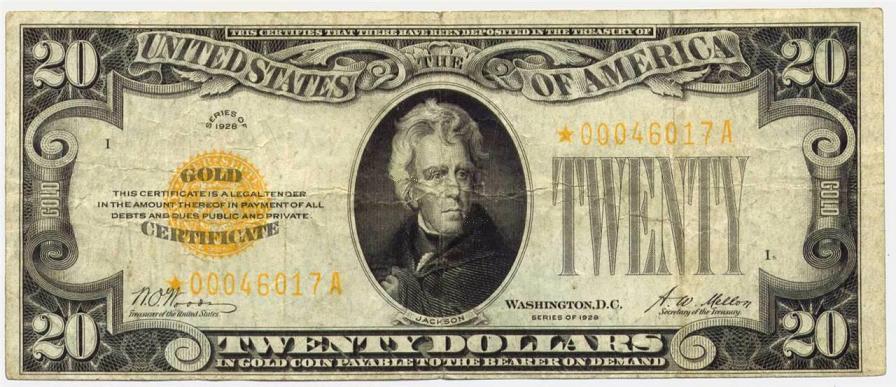
Right you are rggoodie, right you are. Add FRBN to the suffix replacement and Gold certificates to the prefix list as well.

I had read somewhere the rational behind the hollow star versus the solid star, but cannot remember the source (which is very abnormal for me), so it remains a topic that I want to learn more about.

The first replacement notes were printed in 1910, although stars were used as suffix characters on a few issues much earlier than that (ie USN of 1869, Treasury notes of 1890). Stars were not the only strange characters used as serial number prefixes and suffixes however.
There were several other shapes, neither numeric or phonetic, but more hieroglyphic in appearance, used on US currency, but not to signify replacement, but rather merely the beginning or end of that particular serial number.

I will refrain from showing examples of each of these various types of star notes as it is fairly clear that the consensus of forum subscribers are interested strictly in FRN.

It would not surprise me at all if my response to your question is balked at by other forum members trdhrdr007, but that is alright, we all have differing tastes and speculative views of futuristic value.

Star notes of earlier series (1899-1934) were not so much noticed or collected when they were in circulation, nor were they issued in huge numbers, and therefore, survivability of these early stars was relatively low, and today they are scarce.
Survivability of 1935-1957 silver certificates in star form is considerably higher due to the fact that silver certificates were printed in large quantities and backed by a silver exchange option.
When these notes were recalled for the final exchange to silver, many a speculator held onto their silver certificates in vast quantity in hopes that they would soon become collectible and worth more than the current silver exchange rate of that time. Smart idea, but too many folks had the 'same' idea. So much of this hoarding took place, that today, decades later, the collector market is flooded with silver certificates (including star notes).

FRNs (which I assume your note is) are a different story. They are not backed by anything other than the population's speculative faith in the notion that a dollar today will still be worth a dollar tomorrow.

FRNs are printed and issued in extremely high numbers. Star notes are avidly collected and hoarded on sight with notions that eventually they will be worth increasingly more. While this line of thought may hold some degree of merit, to me, it is reminiscent of the hoarding of the silver certificates (for the same reason).

While the BEP takes in and destroys FRNs on a recurring basis as they are returned from banks, collectors hoard the star notes.

What may be the result of this in decades to come? It would not surprise me to see that the collector market gives premium to non-stars as stars may turn out to be the predominant note available due to today's hoarding practices.

Is your $100 star note worth a premium? Not to me it isn't, but to many a person, it may well be, (depending on several factors such as condition, series, and serial number). To me, this star note below is desirable, but I realize that to most folks here, it is heavily circulated, it isn't an FRN or even a one dollar note, and therefore, uninteresting and undesirable. That's okay!




Star-Trivia
Pillar of the Community
Nickelman's Avatar
United States
1397 Posts
 Posted 06/26/2010  5:33 pm  Show Profile   Bookmark this reply Add Nickelman to your friends list Get a Link to this Reply
Well I for one hope star notes hold a higher value. I recently purchased a BEP banded pack of 100 uncirculated $2 star notes.

That reminds me, does anybody know if the BEP strap is different on this pack of bills BECAUSE they are all stars? BEP straps on my non star notes are solid green at the edges, and the ones on the star notes are green striped.
Pillar of the Community
3660 Posts
 Posted 06/26/2010  6:23 pm  Show Profile   Bookmark this reply Add zeewool to your friends list Get a Link to this Reply
Deja vu.
  Previous TopicReplies: 5 / Views: 2,520Next Topic  

To participate in the forum you must log in or register.


Disclaimer: While a tremendous amount of effort goes into ensuring the accuracy of the information contained in this site, Coin Community assumes no liability for errors. Copyright 2005 - 2026 Coin Community Family- all rights reserved worldwide. Use of any images or content on this website without prior written permission of Coin Community or the original lender is strictly prohibited.
Contact Us  |  Advertise Here  |  Privacy Policy / Terms of Use

Coin Community Forum © 2005 - 2026 Coin Community Forums
It took 0.34 seconds to rattle this change. Forums

