| Author |
 Replies: 35 / Views: 11,408 Replies: 35 / Views: 11,408 |
|
Valued Member
United States
120 Posts |
Serial Number:
BF19308510*
A few folds, no major creases, still a little crisp.
From a run of 640,000.
worth keeping?
Series 1999 Edited by twinsrule
07/02/2010 4:51 pm
|
|
|
|
Moderator
 United States
195404 Posts |
I am not sure what it is worth, but since it is only five dollars, you might want to keep it for a while.
I do not collect notes, but I have a few star notes I have kept over the years. I might eventually spend them at a coin show; they might make someone's day.
|
|
Moderator
United States
56855 Posts |
It's probably worth around $12-15. I myself would spend it.
John1 
|
|
Pillar of the Community
United States
1418 Posts |
|
|
Pillar of the Community
United States
4541 Posts |
|
|
Pillar of the Community
United States
1361 Posts |
Keep it! I mean, how often do you find 5 dollar star notes? By the way, that is a relatively small press run, I think... not for sure though...
|
|
Pillar of the Community
3660 Posts |
If you have to ask anyone else if it is worth keeping, then it isn't.
It is only worth keeping if you come to that conclusion on your own.
|
|
Valued Member
United States
420 Posts |
zeewool, I can't agree with you there... the knowledge of the members here, and their opinions mean a lot to people who post these questions back when the Presidential dollars came out, I had more than one roll of Washington's with no edge lettering.. 25 bucks was a LOT of money to me then.. I didn't think they were worth keeping- do you think the advice here would have been different? |
|
Pillar of the Community
3660 Posts |
I do understand what you are saying twincam, but I really don't know about the Presidential dollars thing , nor can I speculate on the potential opinions of others, nor am I aware of any notable errors specific to 1999 $5 notes. I do know though that star notes are hoarded by folks who speculate that they will increase in value. The BEP prints both regular notes and stars in absolutely huge numbers. Within 2-3 years, the vast majority of the regular notes are redeemed by the government and new notes are printed. Huge numbers of star notes are hoarded by collectors and 'investors' and are not available for redemption by the BEP. The outcome of the large scale hoarding of one type, and the large scale destruction of the other type should become apparent to these 'investors' eventually. Precedence can be correlated to the hoarding of 1935-57 Silver Certificates despite the final recall of these notes for their exchange to silver. The opinions of the investment speculators was that Silver Certificates would become high dollar collectors items as the new FRNS had now replaced the SCs as the prominent note in circulation. The hoarding of star notes is a fairly recent phenomena, so if this $5 note were series 1928 rather than 1999, I would have a different response. I do see that there are differences in opinion here on whether to keep or spend a 1999 $5 star note. If I were to keep a 1999 $5 bill as an investment, I would choose one without the star (but that is just 'my' opinion). 640.000 is a huge number, and even bigger when considered that a large chunk of that is hoarded by 'collectors'. I am curious as to what this figure of 640,000 relates to. Is it the total number of star notes 'printed' by the BEP for the FRB at SF? Is it the total number of star notes 'issued' to the FRB at SF by the BEP, or is it the total number of star notes 'released' by that FRB to the public? |
|
Valued Member
United States
72 Posts |
I was never a fan of the star note either zeewool and for the exact reasons you give. But I've since loosened up on that. Not that I think that they are something extra special like most people tend to. I don't. Instead I now view them as a second A block run and as such would like to keep an example of that. But I know exactly what you're saying. The star note that is always the easy find and the A block is tough yet most of the time it's the stars that are priced higher. So I do keep stars but for different reasons than most.
|
|
Pillar of the Community
3660 Posts |
Yes, we ll have our own reasons for the things that we consider worthy of our unique collections.
Do you have the capability to post pictures? Maybe we can swap some photos of what we like.
|
|
Valued Member
United States
420 Posts |
zeewool, your logic is completely sound and reasonable with your explanation.
it does make sense that the regular issues are circulated and wear out, therefor they would be destroyed and replaced, while many stars are hoarded and never seen in banks or the BEP again
thank you for taking the time to post again, this is the type of info that some forum users can take into consideration when deciding about star notes- and it's also exactly what I was talking about in my post above- your knowledge and logic on the subject enlightened me on the real rarity of regular issues in good condition vs. stars
|
|
Pillar of the Community
3660 Posts |
You are embarrassing me twincam. My earlier statements are merely my own opinions. I would think though, that a set of notes (one from each FRB including a star from each) would be a fun thing to do for each series. I don't have the time or patience for it though. My attention span is very low usually. Some folks may even attempt to tackle block sets. Either way, my main point was actually more of a slap at those people who buy countless bricks of star notes as investments for the future. I would think that taking that money and buying certified rare bank notes or coins (or even just building up their bank account) would be a far more sensible investment. Earlier star notes (pre-1935) I do consider to be investments over time however. These notes were released in far fewer numbers and hoarding of star notes was not on anyone's agenda when they circulated. There are census populations on these early notes and early stars. A note with a population of less than 200 known gives a collector a special feeling to own one. I personally would rather own one of these than 100 star notes of current series (despite condition). Track and Price is a census service that lists a fairly accurate (in my opinion) population for all large size and many small size notes. Its figures are consistently higher than other censuses. I like to post pictures (up to a certain point), and like to look at pictures that others here like to collect. I'd really like to see some pictures, not as a contest, but out of curiosity and learning for me. Here is one (or two) of those star notes that is covered in the T & P census: 1928 $1 Silver Certificate - 102 known notes. I don't know why one looks bigger than the other, they are really the same size. I am not a computer whiz, so I think that I must have had my scanner settings off on one of them.  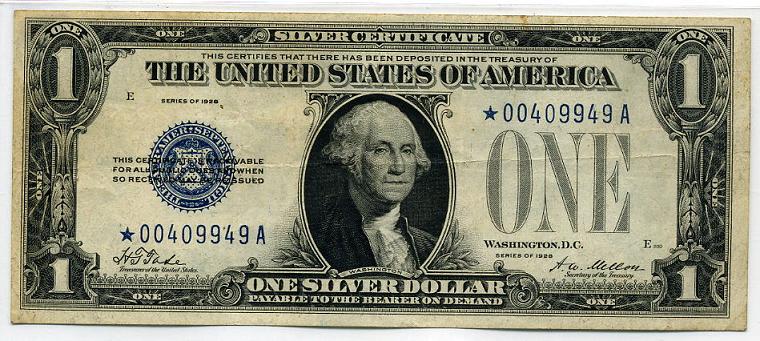 Edit---there were approximately 7,000,000 star notes printed for the 1928 Silver Certificate, yet only around 100 now exist, illustrating the point that these things were not hoarded back then. Edited by zeewool
07/10/2010 10:19 pm
|
|
Pillar of the Community
United States
1397 Posts |
zeewool don't laugh too hard when you see this... it's my only old star note. I got it in circulation so I (thankfully) only had to shell out a dollar for it.  I went to a coin/currency show today and couldn't help but notice how much everyone seemed to think THEIR star notes were worth. I didn't buy any, but I did buy 10 1963 $1 Cu notes, and 2 1963A $1 CU notes. I have decided to start putting together some district sets. After getting all 12 I will probably add star notes to it to complete the sets. *edit* I just noticed something about this note I missed before. The serial number is G, the plate letter is G, and the series is G... hmmm. Edited by Nickelman
07/10/2010 10:26 pm
|
|
Pillar of the Community
3660 Posts |
I was really hoping that someone would post some pictures Nickelman. Does your note have the In God We Trust motto on the reverse? A most special note, with the triple G effect and finding it in circulation. Special to you I trust. I am one person who will never laugh at notes of another. Did you know that there are many a collector who dabble in lowball notes (just as some folks do with coins)? I saw an 1896 $1 Silver Certificate yesterday in a TPG holder graded at Poor-1. The note was amazing, and it took me a minute of hard looking just to identify it. Most of the notes that I own are graded VG to VF. I have only a couple of Uncirculated notes and a few that are only Good. No laughing here. I don't even own any 1935 or 1957 notes of any series. Yes, as someone else pointed out, folks will ask high prices for common notes, and they do so because every once in a while, someone will be willing to pay. I like your idea of the district set. 1963 is an excellent place to start too, since it is the beginning of the $1 notes. Did you know that the 'first' $1 FRN left the BEP on the 'same day' in 1963 that the 'last' $1 Silver Certificates were printed? Neat bit of trivia 'eh? |
|
Valued Member
United States
420 Posts |
there's that knowledge kicking in again, lol
thanks zeewool
|
| |
Replies: 35 / Views: 11,408 |







 Posted 07/02/2010 9:25 pm





