Jeffreyice, you took offense to their reply to this quote from you:
Quote:
OK these are my recent Morgans! Any VAMS?
These are the words of someone who doesn't know what a
VAM is, and they were giving the standard "Introduction to
VAM's" spiel one or the other of us gives to every new VAMmer. In addition, your use of the term "rating" instead of the universally-used term "grade" further supports the idea of a brand-new collector whose education needs to start at a rather basic level.
That's the perception, true or not, and that's the level at which people began talking to you.
We occasionally get members whose disposition keeps them from playing well with others - they refuse to listen to reason, preferring to argue every point even though they don't know what they're talking about. That was the impression you left me last night, and it's unwritten policy (at least with me) to drive such a person from our midst immediately, as they will only disrupt the place.
Your unfailing cheerfulness in the face of what I handed you last night proves that you don't belong in that category. There's a lesson for me in there.
Enough of the metadiscussion. On to the coins.
First words: Scans are, IMO, better for strict technical grading than all but the very best photographs. Lighting plays tricks, highlighting some scratches while hiding others, masking wear and unfairly representing the quality of the surfaces. A good scan does none of these things (and yours are
very good scans indeed). It requires a bit of a learning curve to interpret what a scan means in terms of the real-world appearance of the coin; once one has made that leap, grading from scans becomes easy with the understanding that it's still not possible to make the distinction between AU58 and Uncirculated, should there be any doubt.
Of these, the only coins which leave me any doubt whatsoever are the 1881-S and 1886. Dark on a scan means bright in real life, and the cheek of the 1881-S is a little darker than the others. All the same, the reverse is of sufficient quality to get me past the doubt. The 1886 I'll go into with more detail below.
Besides that, these are all Mint State coins. None of them are "outstanding"
VAM's, the term being used to describe obvious features which make attribution easy. It's therefore necessary to hit the grunt-work level with them (possibly excepting the 1887, which we'll discuss in a minute). The trouble with this level of study is, one
must have the ability to look at the coins at a microscopic level - minimum of 40x magnification - to identify the features which will nail the attribution. We'll talk about this more at the end of my post. This is part of why helping folks attribute
VAM's is so frustrating - often they don't have the tools to give us as much detail as we need to make an accurate determination. So, in my review of each coin below, I will in most cases just direct you to the features which need to be studied in greater detail. Hopefully you'll have the equipment to see, if not photograph, these details.
1881-S: Based on the obverse, this is what they'd call a "slider." Could be AU58, could be MS63. The obverse shows wear - the hair is a little mushy, the cotton bolls aren't fully-formed, the cheek is a little bright.
Then we look at the reverse, and our opinion changes. Still not as strongly-struck as one would expect from an early San Francisco Morgan, but note that only the highest tips of the eagle's breast feathers show any darkness (meaning brightness in a scan, remember). One 4" slide over a slightly-abrasive cloth surface will remove that much mint frost from a Morgan. For this issue, I will start considering strike quality at a much lower grade than, for instance, a New Orleans Morgan; for that reason, this one is limited to MS63.
There is insufficient information available, either about this specific coin or in the varying online infosources, to easily attribute this coin. With 1881-S, the vast majority of varieties start and end with the date, and secondarily the mint mark. It is necessary to study this one at high magnification in both places, looking for doubling and filling. Some 1881-S
VAM's have a small "spike" inside the top loop of the first 8, at roughly 11:00 and pointing southeast. The presence of this spike would help narrow the field. On your coin, I see what could very well be this spike, at the proper location, but the scan isn't detailed enough to be sure.
1884-O: Frosty and pretty well-struck for New Orleans. A little scratchy, even considering the scans; I don't think I'd go over MS62 but might change my mind in-hand.
Attributing this issue is about 3 things - date location, mint mark placement/doubling and, to a lesser extent, date doubling. Each must be studied in detail.
1885-O: Frosty! Big strike for New Orleans. Very deceptive obverse - I think the scan is overstating the marks because of bright/dark contrast. Much of this is, in my opinion, breaks in the frost rather than scratches on the coin. Like most Morgans, the grade is obverse-limited but I'll hazard a guess at MS64.
As with the other we've discussed, there are no really outstanding
VAM's in this year, and details of each individual variety are scarce. There is one feature which struck me, as outlined in the pic below:
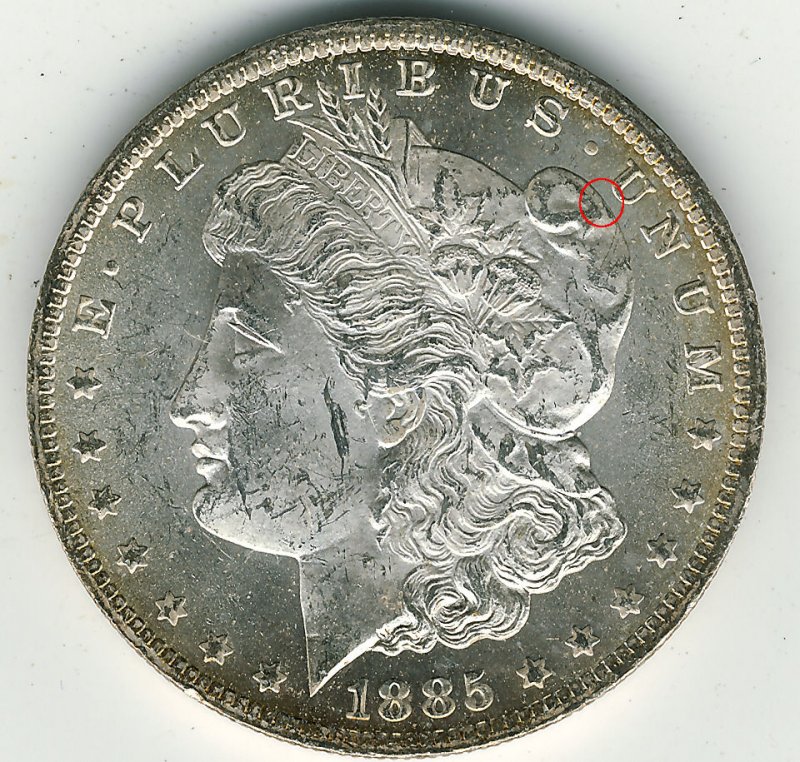
Not what looks like a little chip in the center of the red circle. If correct, this would be the hallmark of VAM-22. I think. The available information isn't conclusive. See what a frustration this is?
First, check the arrow feathers for doubling downwards - this is present in VAM-22 and might help, although it's also found on other
VAM's of this year. That feature, and doubling in the date, are pretty much the only help you'll get for 1885-O.
1886: I'm having a hard time with this one. It's weakly-struck, but the areas where a weak strike shows are also wear areas, and I can't quite get myself over the high_AU hump with this one. AU55-58.
Although there are a couple of more easily-attributed
VAM's for this date, none of those cry out to me from the photos. Study should include the date, with strong emphasis on the 6, which factors into a few of the known
VAM's.
1887: MS63. I've seen the "speckling" and "noise" on the lower cheek on 1887-P's before, as well as the die crumbling around the designer's initial.
I'm inclined to agree with the attribution of VAM-13, but only because of what I found at Heritage, not anything from VAMworld:

This is an ANACS-attributed example, and the die cracks look very close. It's important to know, though - the die cracks must be
exact. Morgan die cracking is very common, and dies tended to fail in the same areas. "Close" isn't enough.
Detailed study of the first two stars right of the date should confirm VAM-13.
1904-O: This issue has benefited from some pretty serious research; it's going to be one of the first issues "completed." It's not, yet, though. Your coin shows a typical mega-weak New Orleans strike. The twin scratches on the cheek, IMO, barely keep it from MS64.
The tilted mint mark will help narrow the search down for this one. The date seems a bit "far," which might help. Additional places to look will be date and profile doubling (down the nose, and at and under the chin).
Now. As I type this, it's just after Noon. I've been sitting at this keyboard for two hours, and this post is the only thing I've done in that time. Yet, I've been able to offer no conclusive attributions. That should be an indicator of just how difficult attribution actually is - all I've been able to come up with are places you should look closer.
It ain't easy, but this is the level of dedication required to successfully attribute
VAM's. Then, having done all that, you have to pray that the information is out there in sufficient detail to make the attribution conclusive. That's only true in maybe a third of the cases; for the rest, you've got to find the individual who has a conclusively-attributed example to compare to yours.
In a large percentage of cases,
VAM attribution is speculative. That's all there is to it.
A note on micro-imaging: You're going to need magnification of 40-60x to reveal some of the features we've discussed, and you're probably going to have to look at each feature from all 4 corners of the compass in order to come up with images which might possibly be conclusive. One set of doubling might need an entirely different orientation from the next, to reveal itself.







 1886 Reverse


 Posted 07/05/2010 11:40 pm





