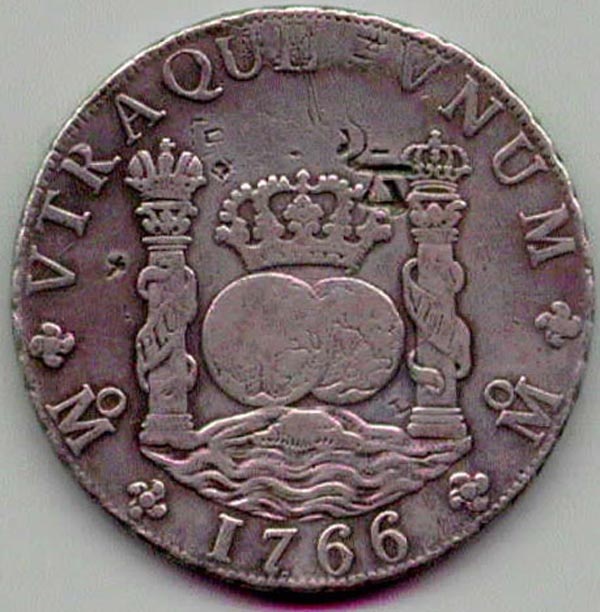
The anomaly you point out is something that troubled me for years. It was not until I studied this effect for a long time that I finally came to a conclusion that satisfied me.
I first encountered this anomaly over 30 years ago on an average grade 1836 Zs OM 8R - a very common coin. The look was identical. The curious raised area extended from the denticals - through the lettering and leaves into and around the lower half of the eagle's left wing. About 25% of the coin surface was effected. I thought it
MUST BE a forgery effect caused in the transfer step by some mechanism I didn't quite understand.
But after examining a large number of similar coins, I came to a far different conclusion.
I no longer have the coin that originally gained my interest but I have encountered many others including one that was submitted to me for authentication just TODAY. This last submission (by coincidence) is also a Pillar dollar dated 1788 from Mexico City.
Here is a picture of the anomaly on that 1788 Mo coin.
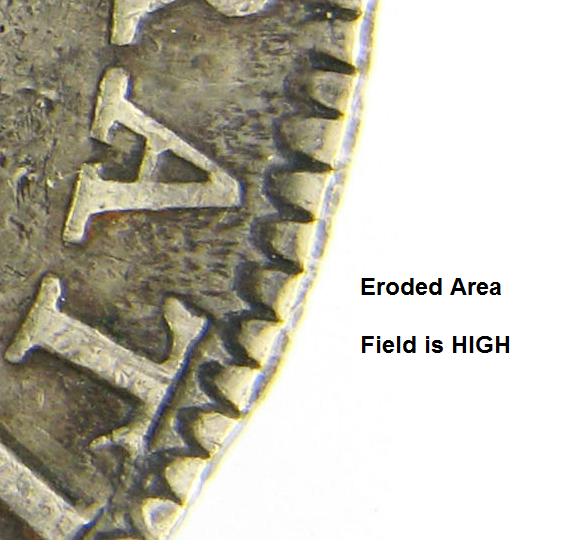
This is a feature that since I first encountered it - I have observed on many coins struck in open sided presses - originals and forgeries alike. I have over the years come to the conclusion that it is a function NOT OF THE PRESS but instead is related to the degradation of the steel used for making the dies themselves. It seems to occur when substandard steel is employed in die making or when the dies are improperly hardened before use.
My reasoning is a bit more complex and I hope more well thought out than the simple conclusion stated above and it came as a net result of many conversations with other collectors versed in early Mexican issues. I am particularly indebted to the late Dave Sunderland whose training in the metal sciences exceeded my own and who spent many hours discussing this precise anomaly with me.
As I have noted above this effect happens on both counterfeit and original coins although I have noted more examples on forgeries than originals.
Here is a summary of the final thought process that leads to the conclusion.
If you examine one of these coins in hand, it is obvious that the raised area is composed of normal planchet metal. There is no added material that has entered the coining chamber and there are no distortions of the coin caused post strike. It is coin metal that has simply flowed into an area of the die that for whatever reason is DEEPER than it should be.
So we are looking at a die feature. But what caused it?
The other striking features seen on all copies of this anomaly are first a curious outlining of the normal die features (edges of letters, denticles, feathers and leaves) all appear as outlines only. Since this is a die feature it means that on the die these outlines STAND ABOVE the field of the die itself. Second in virtually every case there are PITS located within the perimeter of the raised portion of the coin. These pits never occur on the other portions of the coin and they resemble the surface seen on modern coining dies as they approach terminal state. Once again a pit on the coin means a RAISED element on the die.
These PITS were actually the key to discovering the theoretical process at work here.
NOTE in particular that the shape and orientation of the pits is always the same. They are ALWAYS oriented RADIALLY. Secondly, they are always DEEPER and or WIDER at the end closest to the center of the coin. This means they are thicker and wider on the die at the point closest to the center of the die.
Here is an edited version of one of the pictures posted by re_lee who posed the question. I have added a few RED arrows to show the orientation of the pits. You can also clearly see on a couple pits that the end nearest the center is deeper and wider.
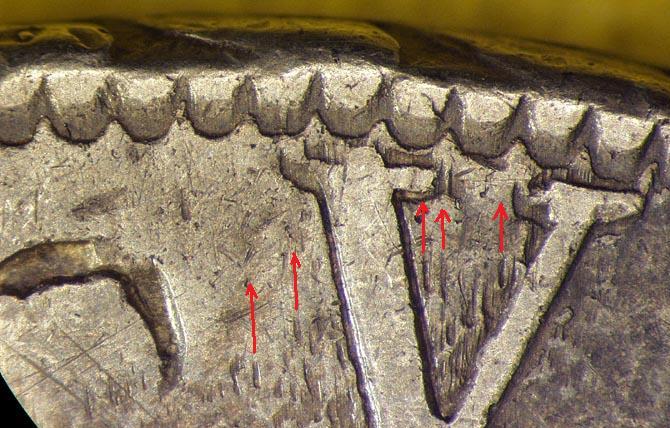
The conclusion is that die surface has RAISED dimple like marks on it which are like little hills ORIENTED along the axis of surface stress.
Surface stress and metal flow on any die flows from the center outward along radial lines - like the spokes of a wheel.
The PITS become HILLS on the die and that brought to mind the hills seen on glacial outwash plains. In geologic terms these hills give the direction of flow of a glacier and they are built by stress and flow.
In a like fashion, I explored whether or not such an erosion pattern could be expected on the surface of a die. The answer is YES provided that there is a difference in the material strength of the die. A poorly hardened die has similar hard and soft spots that would/could erode in this pattern. Dave Sunderland came up with the principle of stress hardening as the reason for the outlines.
When any metal is struck - the pressure of the strike can harden the metal. For proof you can look at a coin - it is always harder than the planchet. Dave had been studying this phenomenon in connection with the recoining of 8R's by the Brazilian government to make 960R coins. Dave had discovered books which indicated Brazil had experienced die life problems until they HEATED the 8Rs to soften them BEFORE recoining. The 8Rs had been hardened by the strike.
This strike hardening of metal also occurs in DIES. The highest points of stress in the process of creating a die hardens the die surface.
This hardening effect is particularly strong at the edges of deep features - like dentils or letters. This small area of strike hardened metal then WEARS slower than the metal around it leaving a raised line on the die.
It is a process similar to the ghost second images that result on well worn dies. A second image forms in the die steel adjacent to the primary feature because of stress hardening in the die.
This anomaly appears on counterfeit dies because the forgers do not have access to the best quality steel for their dies. I have seen it occur on molds used to cast forgeries where the mold material is eroded by the liquid silver. It occurs quickest on die/molds made of the softest materials.
I hope that is clear.










 Posted 08/02/2010 02:36 am