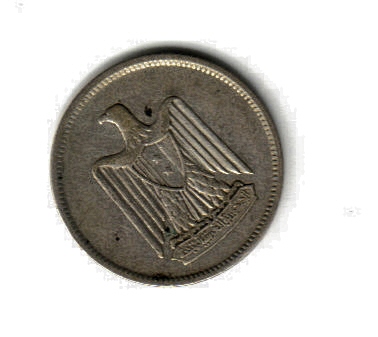
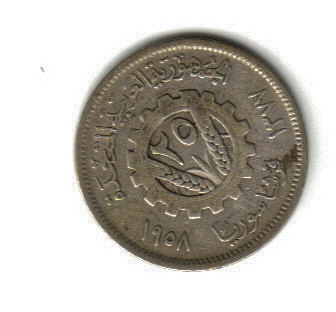
Litotes I agree with you 100% - the 50 Piastre should weigh twice what a 25 Piastre did. So in this case we have a solution.
ALMOST.
If I read the original post correctly the coin is now OVERWEIGHT by 0.2 grams which is 8% heavy. Better but still out of range "technically".
The first issue to address is accuracy of the weight stated. Provided the scale is accurate we have an 8% overweight condition, but if the scale is accurate only to =/- 1/10th gram the error could evaporate to 4% and the coin is within standard. The coin should be weighed to 1/100th of a gram minimum when discussing over/under weights on such a light weight coin - a range of =/- 1/10th gram is not adequate.
The standards of operation at the Royal mints do apparently allow for a 4% overweight coin struck in debased silver. In another post an Australian silver coin was significantly overweight but a quote from an expert on the mint indicated a wide parameter was in place. So perhaps other
Royal Mint facilities were also operating under relaxed standards. After all in 1958 2/10ths of a gram of 60% silver was NOT WORTH MUCH (about 6 cents today and under 1 cent US in 1958).
I would also like to address another tendency of many collectors regarding weight of a coin - especially one that is light weight. There is a tendency ONCE A COLLECTOR OWNS A COIN to defend it. They look for any reason to cling to a belief it is real BEFORE looking at other possibilities. Admittedly this applies to generally older coins (1800 to 1850), but the tendency remains. Always check for alteration. When silver was far more valuable than 1958 - people often shaved silver from original coins for resale. They had many ways of doing that which didn't show.
The simplest was edge filing or clipping. Simply filing the coin all the way around was easy but the governments added edge decorations to stop the practice. An arc shaped or straight cut out of the perimeter could be a mint error but it could be a thief as well. That is why you always check for the reflected weakness on the opposite edge of a collar struck coin. Do not assume this kind of error to be real. Check it out.
There were many forms of mining employed. One easy method involved drilling into the side of a coin. A good machinist could make several tunnels (radial) using ONE entry point. The holes and the edge were filled with some metal to cover the spot. A rim knock was often applied to conceal the entry point. The end result is an off weight coin - sometimes HEAVY if lead was used.
Another simple method of removing silver was cutting a coin from edge to edge with a fine saw and then gluing the two pieces back together. The process removed a few % of total weight. It makes a seam all the way around (which any collector should be looking for) but in circulation it is not noticed. If you do 10 or 12 coins you get the weight of silver in one coin and you still pass the original coins at face value.
A more skilled machinist would make a cut very close to one face of the coin making a very thin layer. The thicker piece was then placed on a lathe and up to 75% of the silver was removed. The hollow was filled with white metal plug and the three pieces were soldered together. These can be made to weigh very close to correct amounts and were difficult to spot. They are often referred to as smuggler coins but they are the result of silver theft from the coin itself. They were common in China.
So my caution is to check weight ACCURATELY - the cost of a good scale is not that great and in any off weight situation check the coin for alterations first. The selection of an off metal planchet as the cause should be well down on your list of likely possibilities in any coin that circulated before Token coinages were widely used.




 Posted 08/10/2010 10:34 am