| Author |
 Replies: 7 / Views: 2,838 Replies: 7 / Views: 2,838 |
|
|
New Member
Czech Republic
16 Posts |
Dear friends, help me please to identify my new coins: 1. Unknown, 4,14 g, 18-19 mm 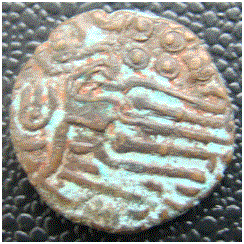 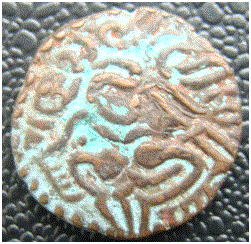 2. Bhutan, 3,33 g, 19 mm. My friend from India sent me this coin as Bhutan km#7 1 Ma-tam (1835-1910), but it seems to me like km#8.1, 1/2 Rupee because of X above crescent. Am I right? 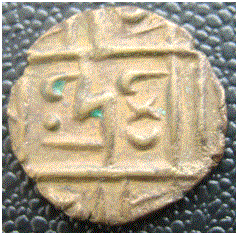 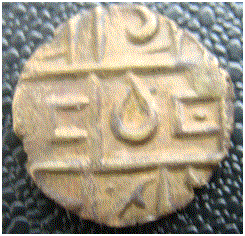 3. India, 2,86 g, 22 mm. I suppose it is India - Princely State of Gwalior km#178.1 1/4 Anna VS1999 (1942). Again, please help me. 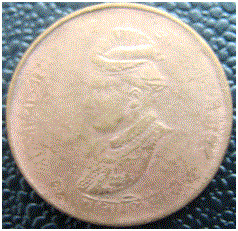 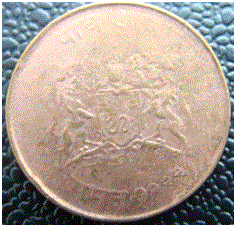 Thank you very much. Josef Identified - moved to World Coins forum - Sap |
|
|
|
Moderator
 Australia
16961 Posts |
The top one is either a copper kahavanu of mediaeval South Indian from the Chola Empire or a copper massa of mediaeval Sri Lanka in imitation of the old Chola type. If I had to guess, I'd say this one was Chola, like this one. I agree with your assessments on the two bottom ones, Bhutan KM# 8.1 and Gwalior KM#178.1. Unfortunately, there's an error in my edition of Krause (33rd edition), the pics of KM 178.1 and 178.2 are actually identical and of 178.2; 178.1 has "two facing cobras below bust" like this coin, which I believe I can see on your coin. Don't say "infinitely" when you mean "very"; otherwise, you'll have no word left when you want to talk about something really infinite. - C. S. Lewis
|
|
New Member
 Czech Republic
16 Posts |
Thank you very much Sap. May I have one more Q? Could you explaine to me what is the difference between India - Princely State of Tonk km#29a 1 Pice (1934)and India - Princely State of Tonk km#29 1 Pice (Paisa) AH1350/1932?
|
|
Moderator
Australia
16961 Posts |
If the pictures in my edition of Krause can be trusted (and that's by no means guaranteed), the difference is in the size. KM/Y# 29 is 25mm across, 29a is only 20mm across.
Don't say "infinitely" when you mean "very"; otherwise, you'll have no word left when you want to talk about something really infinite. - C. S. Lewis
|
|
New Member
Czech Republic
16 Posts |
Many thanks.  |
|
Pillar of the Community
India
1996 Posts |
coin number one is a chola copper coin of "Raja Raja Chola" who rules south India between 985 and 1015 AD
|
|
Pillar of the Community
India
1996 Posts |
The third one is a copper coin of the Indian princely state "Gwalior"
|
|
Pillar of the Community
India
1996 Posts |
Details of the third coin can be had from the "Standard catalogue of South Indian coins and paper money" publishers, Krause Publications.
|
| |
Replies: 7 / Views: 2,838 |
|










 Posted 08/17/2010 10:03 am


