| Author |
 Replies: 16 / Views: 4,226 Replies: 16 / Views: 4,226 |
|
Valued Member
China
106 Posts |
I recently purchased this extremely rare peru 1804 8r from Germany. I say it extremely rare beacause it had an unly apprearence with mint struck error. On obervese it was stucked twice with reverse pattern,REX lima mint 8R JPand the pillar of the shield. On the reverse side it was double strucked with the lengend from the obervse,the DEI.GRATIA. So all in all it is a monster of lima peru,I have only see a pillar can be strucked with this extremely wrong pattern. How do you guys evalue it? I need you comments on it 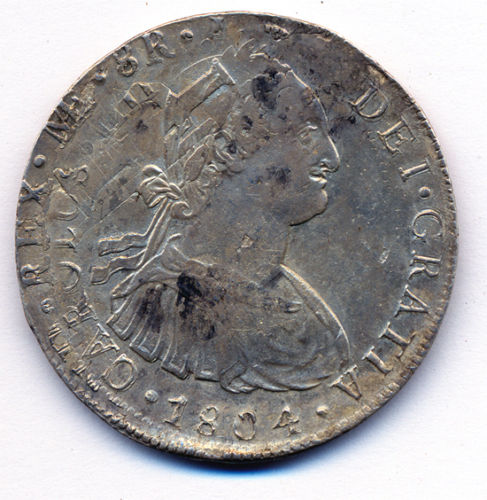 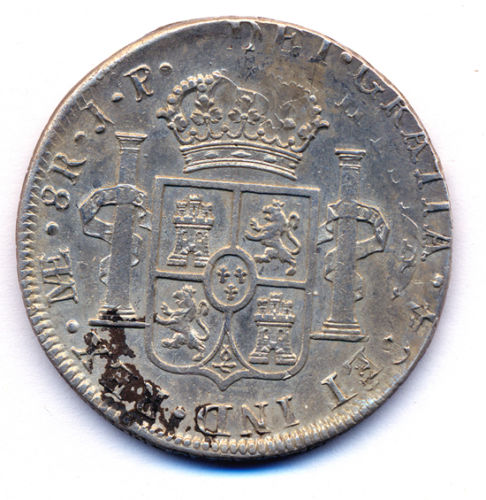 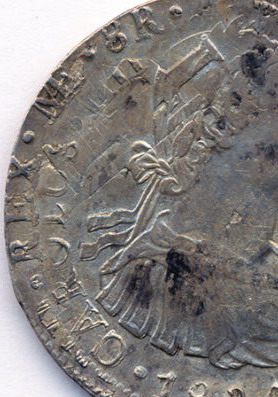 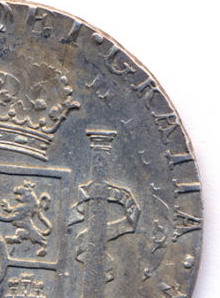 |
|
|
|
Pillar of the Community
United States
1801 Posts |
That is an amazing coin! I can't tell from the picture but I am assuming the pillar image on the obverse is "raised" off the surface and not incuse into the surface? (Looks like one of the mint workers chewed a little too much coca leaf on lunch break) errors like those are rare on Spanish Colonial coins, they had pretty good quality control in place.
|
|
Valued Member
 China
106 Posts |
jfransch
yeah£¡ The pillar on obverse is "raised" off indeed.
Can you estimate a market value of this coin for me?
|
|
Pillar of the Community
United States
1801 Posts |
No guess from me for value. The coin has great appeal to an error collector but is only a curiosity piece to most 8 reales collectors. I would pay a premium over the price of a normal strike but nothing on par with a true rarity. Remember the golden rule of coin values, scarcity PLUS DEMAND = value. Your coin is a "one off" error and as such lacks the demand feature where "everyone has to have it". No offense to your coin, it's an amazing coin, just not a high dollar coin in my humble opinion. If I had a choice between a high grade 1772 MoMF and your coin for comparable price I would take the 1772, it has a known demand factor. So I guess you could say I would value it at less than any of the key dates in the Portrait series. If you want to sell it, assign a value to it that you are comfortable with and market it to both 8 collectors and error collectors and see if you get a bite.
|
|
Pillar of the Community
United States
689 Posts |
Awesome looking error, especially on such an old coin. congrats!
|
|
Pillar of the Community
United States
5362 Posts |
nicolashsing I agree totally with jfransch on the issue of value. This is such a rare error for a Spanish Colonial mint that it may have no established market. The purist 8R collectors see double strikes, strike doubles and off center strikes as detrimental to the coin. The purist looks for the rare perfectly centered and fully struck coin. To appreciate the error in the strike you need the interests of an error collector and they are usually less than enamoured with the earlier more primitive mints where errors abound.
So the premium may not be too high for a coin like this because there is no market and the rarity is unknown.
Also, whenever I see one of these VERY RARE minting errors I get very suspicious that the error was a made to order item - a modern fabrication. I start from that viewpoint and have to convince myself that the coin is real and that the error was possible on the open screw press. Some common errors seen today could not occur on an open sided screw press.
This coin purports to be a flip over double strike (error 1) with EACH strike significantly off center (error 2). The coin also shows clear evidence that the two dies were not in fact properly mounted so that there was excessive pressure along one edge of the coin while the other edge is weakly struck (error 3). This third error can not be attributed to a tapered planchet because it alternately effects the two edges. So the coin purports to be a combination of three different errors EACH of which is scarce, Rare or unheard of - by itself. The combination sounds impossible at the outset.
Double strikes in the series are rather common. The dies moved constantly and quickly. If there was inadequate time to safely remove the struck coin and insert a blank - the operators would have opted to double strike a coin INSTEAD of clashing the dies with no planchet in between. A clash could damage one or both dies. Now we all know how common clashes were so I would opt for the theory that double struck coins occurred more often than clashes.
But how do you account for a flip over double strike?
One way (the most plausible) is to presume that a previously struck coin finds its way into the unstruck planchet basket and it is positioned for striking before the operator notices. I see that as possible yet unlikely - they were paid by the number of coins struck.
The other way it could happen is an intentional placement. It could have been done to see what happens. But in the days of manual planchet placement a flip over double is RARE. These errors are common today because of the closed coining chamber and automatic planchet placement.
The flip over really bothers me. Perhaps because I have only seen ONE authentic flip over double struck 8R in 50 years. I own that one. I bought it as a forgery 12 years ago, because I had never encountered one before. But after every test I can think of it checks out completely, so I am forced to accept it is real. Others may exist but I have never run into any. Also on my coin both strikes are centered and striking pressure was consistent over the entire coin face. The result was the nearly complete suppression of the first strike image. It more clearly resembles a Bank of England Dollar where the second strike obliterates the first image almost entirely.
Remember, in a double strike situation it is rare to find complete details of the first strike visible and the second strike loses detail where the features of the first strike rob coin metal to flow into the die recesses of the second. The SKIPS in lettering caused by overlapping design elements is very typical.
The second thing that really makes me VERY suspicious is the out of alignment dies. The first step in die mounting is the alignment. Until dies were properly aligned - PRODUCTION DID NOT BEGIN. That was very critical at a time when die steel was EXTREMELY hard to get. And in Lima especially, good die steel was in very short supply according to Gilboy.
A full pressure strike of misaligned dies CAN FRACTURE THE DIE on the very first strike. Heads would roll.
There are three critical items in the process of die alignment. Both dies have to be mounted concentrically so that the centers and edges align. Dies that are not concentric will develop fractures at the opposite edges where one die passes the other.
The second alignment consideration is rotation to make sure that the dies match top to top. This alignment is NOT critical to die life and as a result you see this error with great regularity.
But the THIRD and VERY critical step is to align the faces of the dies PARALLEL to one another. If a die pair does not meet face to face at the same time - at all points - it is a nearly certain way to fracture both dies along the one side that meets first. All of the force of the strike concentrates at the first point of contact and the die or dies fail. I have NEVER actually seen this error on a real 8R of the period. I do not believe it happened in reality.
On your coin I see a deeply struck REX, LMAE, 8R and Pillar on both sides. This feature is in fact the clearest remaining portion of the first strike. The opposite side 180 degrees away - the HISPAN portion of the legend is weak on both strikes and missing from the first strike. This can only happen when the die faces are not parallel. If the planchet were tapered the weakness would move side to side when the planchet was flipped for the second strike - but that didn't happen in this case. The opposite edges show both strong and weak strike evidence at the same time.
Look for the dentils of the second strike on the coin's (portrait side) - why are they missing where the REX LIMAE 8R text appears? The only way they can be missing is for there to be no pressure along that edge on the second strike. Otherwise there would be evidence in a skipping pattern at least where the letter metal of the first strike filled the dentils of the second. Once again planchet thickness is not the cause. The only way to get the image I see is for the left side of the portrait die to be further from the planchet than the right side.
So how do you get the die faces OUT OF PARALLEL alignment. There are two possibilities I can think of. One, the dies were not ground perpendicular to the long axis of the die rod. The second is if the die itself rotated in the chuck after it was aligned. The first possibility would have been disclosed in the alignment step and the die or dies that were not properly made would have been discarded. The mint operators would not risk both dies by mounting a bad die.
That leaves die rotation in the chuck after alignment as the only possibility.
That (die rotation in the chuck) is a problem only when very shallow depth dies are used in the press. Those are the types that forgers typically use. The screw press used by Spanish colonial mints had a long die which was chucked into position and the ONLY WAY to get a significantly out of parallel strike was for one die to have been made incorrectly. This type of slippage simply did not occur in reality.
So be VERY cautious when examining a coin like this. Look extra closely for any hint that it is a modern fabrication.
I hope it is real. But, in my opinion, the only way that might be possible is for this to be an alignment test strike piece. The degree of misalignment here is so significant that in my opinion early retirement of the error die was an absolute certainty.
|
|
Valued Member
China
106 Posts |
I was confused by your comments on this coin.So I want to know your exact poin of view,do you intend to confirm it as a genuine one or a modern fabrication?
|
|
Pillar of the Community
United States
1801 Posts |
Thank you Swamper for another great lesson in how coins were made and how to go about thinking through the coining process when looking at a "special" coin. I, for one, now understand why die clashes on 8s are scarce and have a new appreciation for the few coins I have with evidence of significant clashing.
|
|
Pillar of the Community
United States
5362 Posts |
nicolashsing - My opinion is that the coin is "most likely" a Modern Fabrication. However, I can be proven wrong by tests which would support authenticity. The problem is that it is impossible to be sure from a photo.
The one flip over double strike that I own - sat in my suspect box for over two years before I accepted that it was real.
I tend NOT TO BELIEVE that errors like this are real until full proof is provided:
1. Detailed die examination for errors of a modern nature - particularly traces of any known image transfer process.
2. Detailed examination of strike characteristics - was it made correctly on an open screw press?
3. Exact weight confirmation. Is it within normal range?
4. Specific gravity test. Is the alloy density within range?
5. Detailed examination of the edge dies - Does the pattern match known originals and are there proper overlaps.
6. XRF test to verify micro-impurities.
If all the tests point to no forgery and if expected trace contaminants are present and provided no Modern Contaminants are found - then and ONLY THEN would I personally accept this coin as real.
In my first summary statement - I pointed out the one way it could be real - it could be a die test for alignment. But if the test results lead to that conclusion add question 7. If it is a die test strike the die pair would have to be PRISTINE - straight out of the die shop and all of the features of an initial strike would be visible on the surfaces.
It is a tough bunch of tests - but I would at the successful conclusion of all 7 call the coin UNIQUE.
|
|
Pillar of the Community
United States
5362 Posts |
jfransch I have been doing authentications for many years for quite a few dealers and I am always surprised at how most coin collectors remain unaware of how coins are made. Most forgeries can be detected because the coins are simply made wrong. There is an error or a series of errors.
I hope I can spread what I know so that perhaps the average collector can become aware for himself. The best method is to read. Then visit a working metal shop - a place that actually makes medals is great.
I have a background in Structural Civil Engineering and I have always enjoyed metal analysis and fabrication since I was very young. I really loved metal shop in school and worked on a Graduate level for a group testing deep water metal fatigue the summer before I joined the Navy. But as a kid I really loved hanging around metal working shops and mills. My uncle was a die cutter and machinist (also a part time forger of coins with underworld connections). But I didn't know he was a forger or about his shady past until after his death so I missed a great opportunity to learn the how to's from him. But I did get to meet other admitted forgers through my God-father (another uncle) who was a coin collector. I only wish I was older when I met those old men. I would have been able to ask better questions.
My mother used to say that I shouldn't get involved with my uncles and their work. Perhaps if I had been older at the time, I would now be working on the OTHER SIDE trying to perfect the manufacture of forged coins to fool collectors.
|
|
Valued Member
United States
357 Posts |
WOW Swamperbob....That was a great educational post/reply. I wish there were more posts like yours. Here is a idea your may want to look into..Doing a weekly or biweekly educational forum by topic so you can share your vast knowledge about coins and the story about your family was very interesting as well.
Thanks again
|
|
Valued Member
China
106 Posts |
swamperbob
So can I say so that you are in Dilemma to identify the authenticity of this coin,or we can say this coin is not a definately fake at one glance.
The actual weight of this coin is 26.55g,this coin also has a planchet flaws,I'll take detailed photo for you including the edge,yesterday I examine this coin carfully and I found there also shallow "CARO"of carolus above IND which can not seen from these pics.
So I think if this coin was not deliberately made for cheating,then you concluson "this to be an alignment test strike piece" is reasonable.
|
|
Pillar of the Community
United States
5362 Posts |
I simply do not have enough facts to say for sure - but until it is PROVEN REAL (as a test strike for example) - I would personally consider it to be a forgery or a suspect. A coin that raises too many questions has to be treated that way. You can submit the coin to a TPG and you may get it slabbed. They certify coins I would not but all to often they slab counterfeits. I do not have enough of the answers to my questions to make such a final decision. Even in my own collection I have many coins that I place in a similar status.  Any coin that I can not be completely certain about goes into a group of "suspicious" coins. I do not have enough data yet to be certain because the testing needed is COSTLY and time consuming. Until all the testing including XRF technology becomes more available I am stuck with this "suspicious" group. Anyone who cares to can simply donate about a $250,000 to the cause so I can buy my own lab set up for XRF testing? A complete lab set up to do every potentially required test could be done for say $500,000.  By the way for those who might be interested in my suspicious categorization - as of this this morning I have 3,729 8R coins in my collection (8 new counterfeits arrived in yesterday's mail and they are in the process of review) but of the 3,729 coin total, I have 282 that fall in the "suspicious" category.  That is about 7.5% of my collection. But I know that if I spent the time and money to resolve those few I could make a final decision in all but a handful of cases.  |
|
Pillar of the Community
United States
1962 Posts |
Perhaps its brother from another mother? I've seen several Lima 1800-08 Char IIII 8R with at least some doubling (though not like these)... even owned one for a few days (returned it b/c the coin it was partnered with in the lot was a skunk).  |
|
Pillar of the Community
United States
1962 Posts |
Update to that piece I posted a few weeks ago... ended up hammering for just over $500 incl. the BP.
|
|
Valued Member
China
106 Posts |
i recently acquired the one that realeswatcher montined from stack's.And this coin also has the same features as double strucked.I want to reasearch on this coin and see if the coin I post above is a genuine one.But I have the confidence that this coin was not a forgery.I can figure out 2 reasons to support my point. First also the double strucked pillar seems to be extremely wired,the same mint feature also on other pillar which the same year and the Lima mint.Secondly,until now I don't find the excatly same copy as mine,if this one is a forgery one then there must be another one exactly the same.cause it costs too much to produce only one copy. 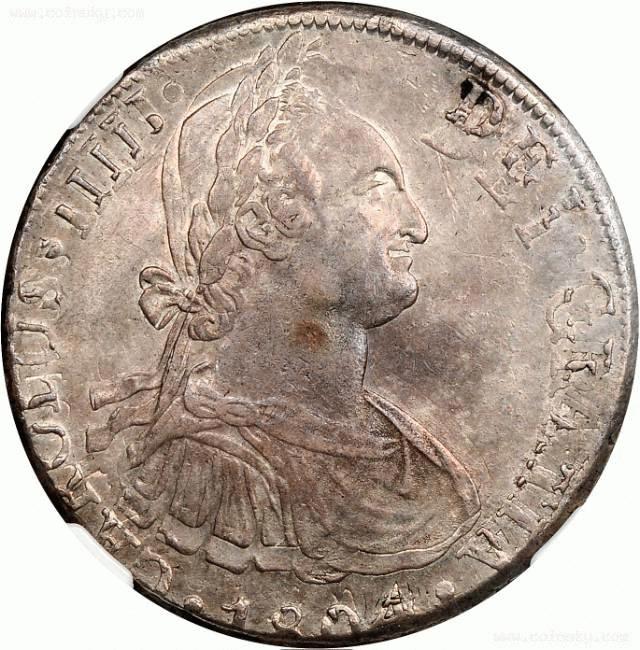 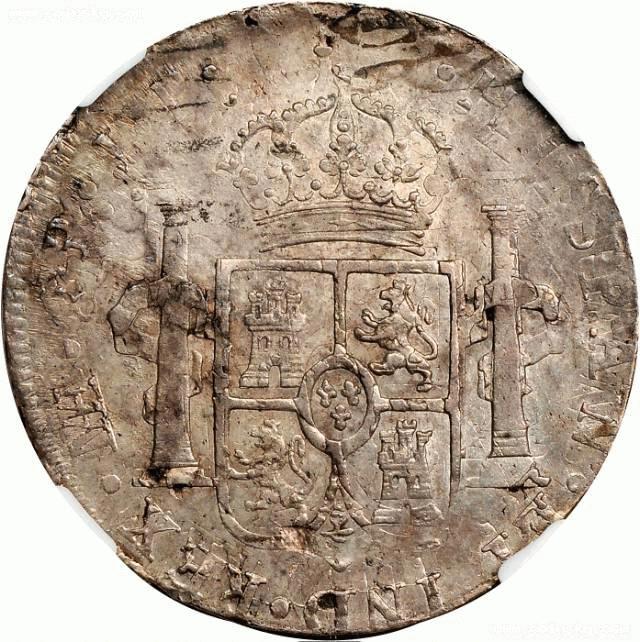 |
| |
Replies: 16 / Views: 4,226 |








 Posted 08/21/2010 1:19 pm


