| Author |
 Replies: 27 / Views: 13,502 Replies: 27 / Views: 13,502 |
|
Valued Member
United States
476 Posts |
Don't know if you've ever heard of them or not, but I think I've found one. It seems a number of 1958 and 1959 Jefferson nickels were struck on planchets that were improperly annealed. The annealing process is where the unstruck planchets are heated before striking. These improperly annealed planchets are assumed to have been inadvertantly run through multiple cycles in the annealing oven resulting in a "burnt" look to the coins leaving them with a black color, thus the "Black Beauty" label. The coins generally will show a lot of luster. A Google search finds that the Home Shopping Network (known for great deals on coins  ) has sold 1969 MS64 certified coins for the bargain price of $249. There also appears to be a good bit of discussion on the PCGS board regarding what exactly causes the dark color, there is speculation that a copper powder bonds to the coins resulting in their black color - this is also known as "sintering", thus some will call them "Sintered Planchets". The coin in my photos was pulled from a bank roll last week. I'd grade it AU58 (or maybe MS58  ). I don't think the photos capture the dark tone as well as I'd like, but regardless...without further a-do...adioux...ado...delay here it is!  This photo is next to a 1966 SMS coin pulled from the same box for comparison purposes:      |
|
|
|
Pillar of the Community
United States
4212 Posts |
Very nice! I have about 60 rolls of those dates to cull this week. We'll see if I get as lucky.
|
|
Valued Member
United States
314 Posts |
Nice find if it is legitimate. I find it most interesting that we can still find coins that are 59 years old or older in circulation. A lot of folks overlook the fact that you can still find Jefferson nickles with 1940's dates commonly in circulation. Is this a great hobby or what? |
|
Pillar of the Community
United States
4212 Posts |
Went through rolls and ran across this. I'm still not convinced. 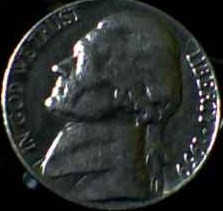 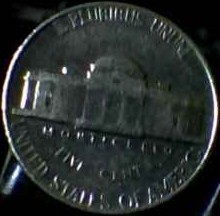 |
|
Valued Member
 United States
476 Posts |
I'd say if mine is...yours is. Looks pretty similar.
|
|
Moderator
 United States
15921 Posts |
Interesting thread .... Quote:
Don't know if you've ever heard of them or not This is news to me ...... the '58 and '59 planchet annealing idea and resulting black coins. I find a lot of black Jefferson during my roll searches ...... but have always attributed them to environmental damage. I'll be following this thread to see what other knowledge is offered up. BTW ..... two things ... If that reverse photo is your 'black beauty' ...... then I humbly submit the wear on the pillars/dome grade this coin at EF-40 or so. And ...... any luck yet on that 55-P? Saw your post on the five (5) 55-D. Have my fingers crossed for you ...... looking forward to the big dancing fruit celebration when your set is done. Thanks for sharing ... David |
|
Valued Member
United States
476 Posts |
You may be right on the grade, but my key grading point is the triangle at the top of monticello, and it doesn't show much wear on the right corner, which makes it AUish in my book. I don't know if it'd be reasonable to assume these planchets would be harder than typical from the multiple heat cycles resulting in what would look like a weaker strike. The dealer I showed it to yesterday (who was also unfamiliar with the black beauties) said he'd say high AU for a grade. And I think he's generally pretty conservative.
No 55-P yet...but am currently without a box, so may have to swing by that Wells Fargo branch on my way home and stock up.
|
|
Bedrock of the Community
United States
12437 Posts |
Unless a "black beauty" is in lustrous uncirculated condition, odds are high that it is just environmental damage or toning. The effect can be imitated but only to the detriment of luster so be wary of circulated pretenders. Striking a coin is what imparts luster and the planchets are annealed/darkened prior to striking. Quote:
I don't know if it'd be reasonable to assume these planchets would be harder than typical from the multiple heat cycles resulting in what would look like a weaker strike Just the opposite, planchets are annealed to soften them in preparation for striking. Multiple annealing cycles should result in a slightly softer than normal planchet. |
|
Valued Member
United States
476 Posts |
Thanks for the input Bio. The coin is rather lustrous, although not uncirculated. Some of the high points have lost some of the color; although it doesn't show enough wear to have reached normal CuNi coloring. I could research your comment about the annealling process softening the planchets, but it's easier this morning to just discuss it off the cuff (I don't mind being wrong) so I'm going to stir the pot a bit.  Are planchets normally struck when they are "warm" from the annealing process? I assume not, but my instinct is that the multiple heat cycles would harden, not soften the metal. Of course I'm not the "kemist" either.  |
|
Pillar of the Community
United States
3592 Posts |
I sent in one of these 1959 nickels to ANACS and although I specified this variation,the email I received has them grading it as an MS63 but no mention of the variety. I haven't received the actual coin back so I'm wondering why they wouldn't aknowledge the variety.I would think if were tampered with they would note it as a problem coin at least.Anybody have any ideas ?
|
|
Valued Member
United States
476 Posts |
 to the playground. Interesting that they don't note the variety on the order info. Guess you'll find out soon enough. On a side note since the post was revived. I was at a show this weekend and showed it to Alan Herbert (author of the Official Price Guide to Error Coins) and he indicated that they've determined the reason for the black beauty's is that the ore mixture contained a high amount of silicon, which melted and darkened in the process. He indicated he couldn't determine if mine was authentic without a microscope which he didn't have available. Unfortunately, I was not familiar with Mr. Herbert's work, or I would have spent more time visiting with him, he was manning the ANA table at a show in Sioux Falls, SD. I did however buy a copy of his book for $10 and got it autographed, he was liquidating the old edition as the new one is due out very soon. Edited by DylansDad
09/15/2010 09:30 am
|
|
Bedrock of the Community
United States
20043 Posts |
Quote:
Unless a "black beauty" is in lustrous uncirculated condition, odds are high that it is just environmental damage or toning. The effect can be imitated but only to the detriment of luster so be wary of circulated pretenders. Striking a coin is what imparts luster and the planchets are annealed/darkened prior to striking.
Agreed. Who knows what happens once it's been circulated? |
|
Pillar of the Community
United States
3592 Posts |
I got two of them from my soda machine one day and I didn't suspect tampering because of the uncirculated condition...usually when I get several good coins in the machine,it means somebody was going through dad's stuff.I'm just puzzled because of the MS63 condition but no note of tampering or environmental damage...they are definitely black....guess I just need to wait and see what the holders say....then go from there.I would post pictures but the 90 kb size limit will have me puzzled for a while.
|
|
Valued Member
United States
476 Posts |
Most of us use an off-site photo hosting site such as photobucket to host our pictures.
|
|
Pillar of the Community
United States
3592 Posts |
Thanks, I'll work on that when I get time.I couldn't get any smaller than 800 kb with my pc.
|
|
Bedrock of the Community
United States
17884 Posts |
Quote:
I assume not, but my instinct is that the multiple heat cycles would harden, not soften the metal. What confuses people is that both annealing to soften the metal and hadenin of metal are accomplished by heating the metal. What creates the difference in the final hardness is how hot the metal is heated to, how long it is held at that temperature, and most importantly how rapidly the metal is cooled back down. To anneal the metal, after heating you cool it very slowly. In general the longer it takes to cool the softer it will be. To harden it you want to cool it VERY rapidly, so it is typically quenched in liquid (water, oil, different chemical solutions), and the choice of liquid to quench it in can also result in differences in the hardness. So repeated annealing will not result in a harder planchet unless the metal is cooled more rapidly than normal. |
| |
Replies: 27 / Views: 13,502 |









 Posted 08/31/2010 09:29 am


