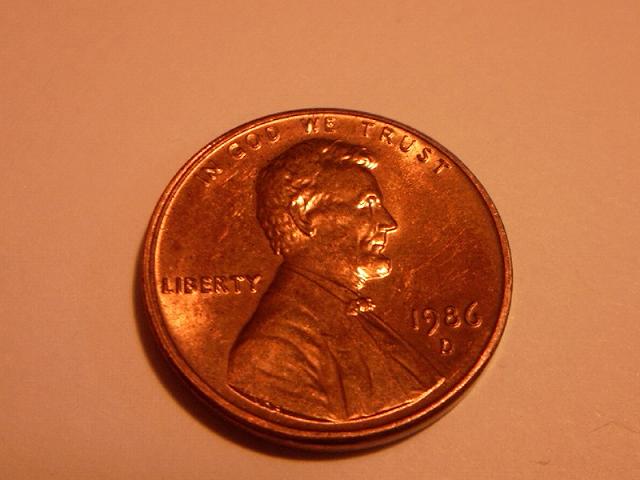
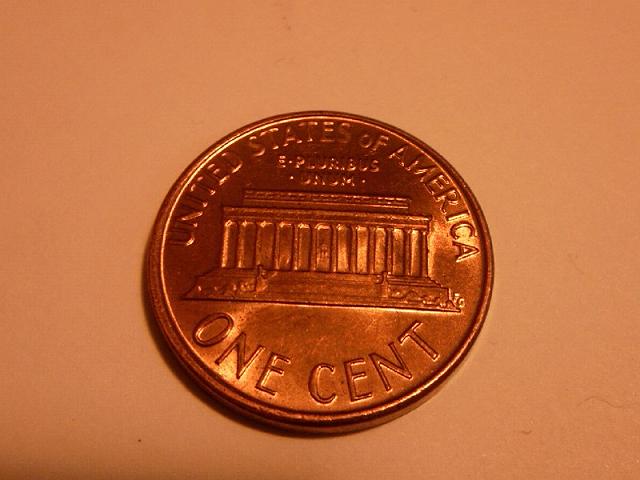
A few things to point out to clear this matter...
1. Wear will not make some parts of a design nearly disappear while other parts are very strong. Wear is normally even all across the design on both sides of the coin. This coin is a very typical and common weak strike.
2. 1986 cents are known to be struck weakly enough to not fill all reverse devices - as are all 1983-1988 cents.
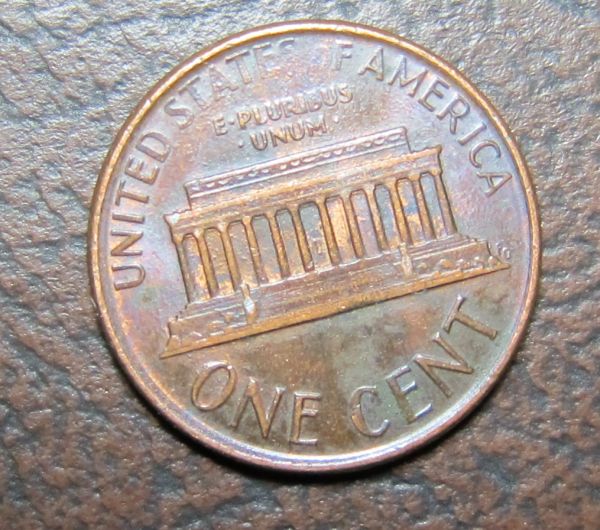
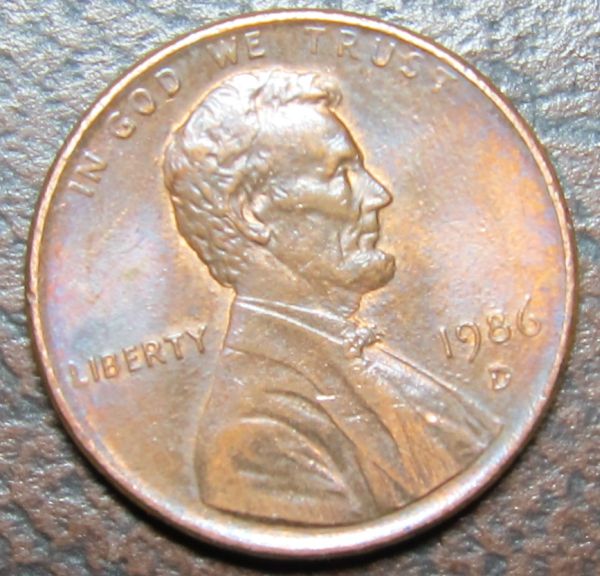
3. The reason the lettering is weak at the top of the reverse on many of these coins is because this area is exactly opposite the highest relief area on the obverse - the shoulder. If the strike is not absolutely complete and strong, the lettering on the reverse suffers and does not strike up completely.
4. The second 1986D cent shown is not an "early die stage" example. It is mid-die state and is struck completely - nothing more than that.
5. The term "early die stage" is not numismatically correct...there is no such thing. I will explain...
stage - used to determine progression in the use of a die by pointing out markers visible on the coins a die struck through its life. Stages are pointed out by using a letter, i.e., stage A, stage B, etc.
die state - used to point out the approximate age of (number of coins struck by) a given die. Synonym - die wear. When a die begins striking coins it is automatically in very early die state. As it strikes coins, it moves through early die state to mid die state, to late die state, then eventually to very late die state if it lasts that long.
A hypothetical example to illustrate the two different terms and why they are very different and are NOT interchangeable.
stage A - very early die state.
stage B - die clash forms. early die state.
stage C - die clash polished away. early die state.
stage D - die scratches from polishing worn away, die crack develops. mid die state.
stage E - die crack rim to rim. late die state.
stage F - die breaks leaving a
Cud. late die state.
Note that each stage points out a different marker, and the die state repeats from stage to stage if necessary. Like I said, stage and state are unrelated to one another in a direct fashion. In other words, because you move from stage D to stage E does not necessarily mean you have to move from mid to late die state.









 Posted 09/09/2010 03:40 am