| Author |
 Replies: 56 / Views: 3,988 Replies: 56 / Views: 3,988 |
|
|
|
Pillar of the Community
United States
1703 Posts |
quote:
Originally posted by texasmick
Don't trust the color, TLS, they're silver colored, not bronze like the photos would suggest.
No more popsicle sticks for me, I bought a scale. It's a Fuzion Nitro (NTR 400) and it cost $30+tax. It's small (100 x 75 x 15 mm), digital, and weighs in g, oz, grains, and carats. No more calling gun shops asking for powder scales. 
At the coin shop, I had them measured as well as weighed. Here are their vitals:
Coin__________diameter (mm)__________weight (g)
Authentic__________38.1_________________26.73
1878______________37.5_________________20.1
1886______________37.5_________________19.1
1922______________37.3_________________19.6
I repeat my call for visible defects.
Mick, Its not the color itself I'm speaking of but the discolor around the edges of the features in the coin itself.Also can you explain the "question mark ?" next to the neck on the 1878? On the 1886 I can see what look like bubbles in the denticles.For example just straight up and a little to the left of the left wing tip on the reverse.Also straight above the "UR" in PLURIBUS on the obverse. If these are in fact bubbles in the metal.Then it would mean the coin was poured and not stamped as all U.S.Mint coins are.Very hard to tell without being in hand though.Or microscopic pics. |
|
Pillar of the Community
 United States
751 Posts |
Ah, the discoloration, thanks for clarifying. The ? mark looks like just a coincidence to me. Image Insert: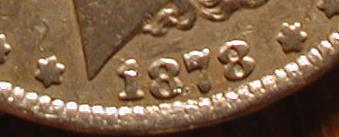 Here are full res pics of the areas you mentioned. Image Insert: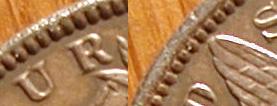 Unfortunately, my camera doesn't have a particularly good macro mode. It seems that it's minimum focal distance is about six inches. |
|
Pillar of the Community
United States
1703 Posts |
Mick,
What do those areas look like in hand? Do you have a 5X or 10X loupe to check out the denticles? Still cannot tell from the pics.The deformed "E" on the obverse of the 1878 is another area I would be checking. Also I see tiny black dots on the surface of the 86 Morgan especially on the stars. This would be typical of slag bubbles if in fact that what I'm seeing.Sorry,I have to disagree with most of the others and say these are copies.I'm no expert but that my opinion without holding the coins.
|
|
Pillar of the Community
United States
5362 Posts |
I just saw the thread on the Morgans - looks to me like you have some decent counterfeits. The key to possible value is when were they made? There are visual defects that would make me suspicious - but weight and Specific Gravity would appear to be conclusive. The weights listed are simply TOO LOW for natural wear. At 20 grams you would not have much left to identify the coins and yet these all look like they should weigh 26 grams or so. The diameters are also low and should mean that hardly a trace of the reeding remains. I would check the reeding to see if it is correct or if it was applied with a ring die. Look for an OVERLAP - there should be NONE. Look for hollow top reeds - there should be none - look for split tail reeds - NONE of those either. One clear physical defect was noted by longnine009. Good work! That defect in the rim below the date on the 1886 is a dead give away that the coin is most likely a cast copy. It happens when the mold is not preheated and the molten metal cools too fast during the pour. There tend to be these "fold lines" at the perimeter - especially near the vent hole. But starting at the top - look at the 1878. I like it. It is not a counterfeited date that you see very often. The coin appears to be a casting and I suspect a high Zinc white metal based on the way it darkens on the points of contact. It may have been tinned to make it pass. There are also some tiny lumps visible. Look in the upper loop of the second 8 in the date. Look at the lump next to the lower loop of the first date. Check the dentils in the area below the date - why so rough (indistinct)? The dentil below the 6th star (numbered from the date clockwise) could be a hollow dentil. One of the failings of some castings is that air bubbles (or vapor bubbles or debris) gets trapped in tiny features of the mold. It could be a small dent but I would look at it. There are other lumps on the reverse die - the dentils below ONE and the G in God - show possible casting features. But the weight given for this coin 20.1 grams is WAY OFF. No way can it be real unless it was mined and that is a different story all together. It appears it could be a Bullion forgery possibly dating to the 1960s or earlier. The reeds and how they were applied will probably decide age and value. The newer it is the less it is worth. The 1886 has as stated above an apparent casting fold under the date. That is real bad. But there are also clear signs on this one that it was cast and reeded in a ring die. Look at the obverse above liberty right neer the rim. See the parallel groves cutting away the edge of the coin - making it about 45 degrees to the face. That is done by a grinding step needed to remove the split ends of the reeds. There is a lump between the UN in UNUM and another on Liberty's Cap (second fold up from the bottom of the cap near the string band). Both appear to be from voids in the mold. There are also a LOT of hollow dentisl on this one and there are lines in the field that are most likely from the step where they grind down the tranfer mold. Look below the eagle's left wing between the wing and the wreath. The 1922 is perhaps the easiest to diagnose as a casting from the picture. Look at the intersection of the rim with the field - very rough looks almost sandy. That is a protected area that can not be ground out easily. You see the feature most clearly where the light reflects - from the 1 in the date to the T in trusT. The coin has the same grinding marks on the edge as the 1886. The weights of the 1922 and the 1886 are consistant with modern Chinese fakes made since 1960. All three could fall into this category but I would like to see the reeds to be sure. The last two are $10 fakes - for the average counterfeit collector. Which means that at Bullion you are unlikely to lose on a forgery. The 1878 stands to be the best of the group. Let me know. I am leaving Saturday for a week plus camping vacation and I will have NO computer access. |
|
Pillar of the Community
United States
5362 Posts |
Just saw the comment about the ?. Looks like a piece of lint on the coin at the time the transfer mold was created. It is a Great one. If that is a raised feature - I would double the normal price as an offer for a classic case of a mold defect.
|
|
Rest in Peace
United States
2684 Posts |
I'll add to what Swamperbob said regarding his counterfeit diagnosis by weight. In these instances, the weights in grams are so far off to definitively identify them as fakes. However, in most instances when weighing a Morgan for authenticity, it should be weighed in grains instead of grams since the original specifications for Morgans were in grains. A type uncirculated Morgan is supposed to weight 412.5 grains (26.730 grams). A well-circulated G-06 1879-CC Morgan I have weighs 398.2 grains (25.810 grams)** while a cast counterfeit Morgan in my inventory weighs 380.0 grains (24.629 grams), differences which cannot be measured in the hand (the three Morgans in question, however, are so far outside the normal range that the differences CAN be felt as mick noticed). I also mistrust gram scales which have a precision only to one decimal place and thus lack accuracy: they can place a genuine well-circulated Morgan down into the range of a typical counterfeit. The next step then would be to measure specific gravity, but this is covered in another thread.
**I do not have a G-04 nor lower grade Morgan which I can weigh to determine the lowest weight of a very well-circulated genuine Morgan. A rough guesstimate from a hypothesized graph might be 390 to 395 grains.
Edited by Morgan Fred
08/10/2006 10:08 pm
|
|
Pillar of the Community
United States
751 Posts |
Thanks for the insight, Fred. My new toy does measure in grains too:
1878: 311.7
1886: 294.8
1922: 302.5
|
|
Pillar of the Community
United States
4589 Posts |
WOW. when I read what longnine had mentioned I took another look at the picture, by thr time I saw what TLS said and what the weights were. I was quite sure I was wrong then Bob stepped in, I saw him in action personaly and with out a doubt believe waht he says. Good job Longnine, TlS, and swamperbob my hats off too you all. I bow and humbly ask for more knowledge..
|
|
Rest in Peace
United States
2684 Posts |
quote:
Originally posted by texasmick
Thanks for the insight, Fred. My new toy does measure in grains too:
1878: 311.7
1886: 294.8
1922: 302.5
Wow! These are so far off the scale as to defy belief; the counterfeiter's competency must be called into question. He could have at least added a little lead to the brew to bring up their weight a little closer to specs. Many if not most people are able to detect this much difference in weight almost subconsciously and would be immediately suspicious if they were somewhat familiar with Morgans. One then wonders about the purpose of the fakes. Which then leads to the question of when they were forged. If they were made many years ago for circulation when silver dollars were relatively common on the streets, they would be immediately identified by handlers (except for those persons who were not at all familiar with dollar coins). They sure wouldn't work in slot machines which were (and still are) constructed with pass/fail weight devices. Maybe they were made to stuff dollar coin rolls. If they were made more recently (say 1950 or later), the only persons who might be fooled would be tyro collectors. If they are very recent forgeries, then the only target would be online buyers who, of course, can't weigh them from an image. Seth, you got yourself a good scale there. Thanks for the added info. Fred |
|
Pillar of the Community
United States
5362 Posts |
I would like to add just a bit to what Morgan Fred said about weight with a very brief story I picked up as a kid. When I was first learning about forgery, I always asked every coin dealer I met about what he knew about counterfeits. In the process I met a retired third generation banker. He related something to me that I have never seen emphasized in print. He said it was at one time routine for Banks in the US to weigh and RETIRE worn coins. He remembered his Dad and Grand Dad doing it with a scale at their banks. He also said that in the case of Gold Coins - they actually based value on WEIGHT and routinely devalued worn coins. The limit was in the range of 96 to 97 percent of standard weight. If you think about that it is reasonable. Once a dollar coin wore down to 96 percent it was worth 4 cents too little (gold was more effected). Also he indicated that was why the government made the relief so SHALLOW. A coin worn to 96% had very little of the design remaining. For the Morgan dollar that 96% line would be 396 grains (25.66 grams). The standard 8R weighs 27.03 grams and it also is nearly worn smooth at 96% (25.95 grams). In my earlier note I used my rough estimate of 26 grams as the lower limit of an 8R in place of the US dollar - that was a slight error, but the theory is the same. By the time the design is worn off the coin does not PASS. That is also why a drill hole stopped a coin from circulating. The hole removed METAL. This is no longer critical since we went to a token coinage that is essentially worthless. Most collectors today have very little idea of the correlation between weight and wear. I have actually run into dealers who think that an 8R can wear down to 23 grams or less and still be real if it grades Fine. They are of course terribly mistaken and will be buying a lot of fakes that way. |
|
Pillar of the Community
United States
1703 Posts |
Exellent post Bob.  |
|
Rest in Peace
United States
2684 Posts |
Bob, very interesting and informative. Many decades ago, I used to be aware of banks' responsibility to cull worn coinage (and notes/paper money) from circulation, but I haven't really thought about it in these modern times of clad coins (post 1964) which are worth far less in melt value than their face value (cent production costs not withstanding). Now, paper money aside, I wonder what banks' responsibilities are for worn coinage since clad coins retain their face value no matter how worn they are, there's no loss in melt value since there wasn't any when the coins were minted, and there's no financial inducement for banks to swap out good coins for bad. I haven't got a bank nearby into which I can ask the questions; would be interesting if someone knows or can learn what current bank policy is toward worn coinage.
Rachel (Kyra)? (Might be our best info source since she works in a bank.)
Fred
|
|
Pillar of the Community
United States
5362 Posts |
Fred - I know my local bank refuses to take cull coins. I believe they said that they are redeemed by the government based on weight NOT FACE VALUE. I would also like to hear from someone in the banking business to confirm or deny that policy.
|
|
Pillar of the Community
United States
1247 Posts |
Perhaps Susan will consider making this thread a sticky for awhile? The pics and Swamperbob's analysis are just too valuable to let it all fall into the back pages.
|
|
Pillar of the Community
United States
1247 Posts |
Swamperbob the ring die that you mentioned, is that used to mask the casting port?
|
| |
Replies: 56 / Views: 3,988 |








 First Page


 Posted 08/10/2006 7:01 pm


