| Author |
 Replies: 21 / Views: 5,740 Replies: 21 / Views: 5,740 |
|
Valued Member
Canada
250 Posts |
Hi, everytime I think I get it, I lose it.
I think Mint State are made for circulation coins (business strike) that are in mint condition.
Proof Like are coins made as commemorative and a special strike and frosting...not circulated.
what are Brilliant Uncirculated coins then?
any help is appreciated
|
|
|
|
Valued Member
Canada
367 Posts |
There is MS uncirculated and MS circulated BU is MS67 - MS70, I think.
Proof Like are not always commorative they are just coins that are almost in proof condition.
|
|
Pillar of the Community
United States
608 Posts |
Just check the Glossary! Mint State: The term corresponding to the numerical grades MS-60 through MS-70, used to denote a business strike coin that never has been in circulation. A Mint State coin can range from one that is covered with marks (MS-60) to a flawless example (MS-70). Prooflike: Term to designate a coin that has mirror-like surfaces, the term especially applicable to Morgan dollars. Those Morgan dollars that meet PCGS prooflike standards are designated PL. Brilliant Uncirculated A generic term applied to any coin that has not been in circulation. It often is applied to coins with little "brilliance" left, which properly should be described as simply Uncirculated. |
|
Valued Member
Canada
367 Posts |
Charlton states that there is MS UNC and MS Circulated
|
|
Pillar of the Community
United States
2120 Posts |
|
|
Valued Member
 Canada
250 Posts |
...so BU can be considered a coin "condition" rather than a grade then? it gets graded and then becomes MS-
|
|
Valued Member
Canada
107 Posts |
How can there be a MS CIRCULATED? ms is uncirculated, is this a trick? Do they mean a coin with heavy bagmarks ?
|
|
Valued Member
Canada
107 Posts |
BU has always meant a coin with original lustre.. as far as I KNOW. Rather a general term for quick reference, with bag marks etc you would step up the descriptions.
Also were not the early pl coins just normal bussiness strikes that were handled with more care ?
|
|
Valued Member
Canada
107 Posts |
PROOF-LIKE sometimes abbreviated as PL, is an odd category. These are coins minted for special mint sets made for sale to collectors, and not intended for circulation. The mint never claimed they were anything other than choice MS coins, but are very early strikes from fresh dies and were selected out for the sets as nice coins before going through the entire mint handling process so tend have have higher lustre and fewer bag marks than MS coins. However they are not perfect mark-free coins and average PL-64 to PL-66 right out of the sets. Any experienced collector or dealer will know one when he see's one. The term Proof-like was invented by dealers to differentiate these from normal MS coins, for reasons I will discuss below. Proof-like sets were first sold to the public in 1954, although single PL coins earlier than 1954 do exist.
compliments from another site ccs
|
|
Valued Member
Canada
250 Posts |
Thanks for the replies guys, I'm learning... I was looking over some coins on ebay and found some advertised as "specimen' and certified by ICCS as SP-64 how does specimen fit in with PL, BU and MS? cheers |
|
Valued Member
Canada
107 Posts |
Specimen is probably a description of coins in relation to surfaces ie frosted,mirror fields,raised elements and so on, only a guess. j
|
|
Pillar of the Community
Canada
1051 Posts |
Quote:
how does specimen fit in with PL, BU and MS? The answer(s) to that question totally depends on the year the coin was issued. The newer "parallel lined" specimen coins are easy to spot (and nice looking, IMO). The slightly order ones are, in honesty, somewhere between tough and impossible to discern from strong PL's in some cases - and that's for me, for you, and for major TPG's. The much older coins are, like the very modern specimens, also fairly easy to identify. It may be a poor comparison, but I'd liken older Canadian specimens to US proof issues. Back in the 1940's and prior things were easier: you had your standard business strike coins, and your specimen coins struck for the collectors. The modern proof, at least in theory, could have replaced the specimen coins. Just to make things even more complicated, the early "Prestige" sets that were packaged like modern proof sets (and are sometimes called "proof" sets) contain specimen coins. The mint does not seem to have any desire to get rid of the specimen coin, and as such it is produced along with the PL, MS, and PF coins to this day. |
|
Valued Member
Canada
367 Posts |
NC = not circulated C = circulated 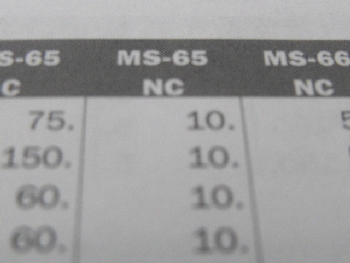 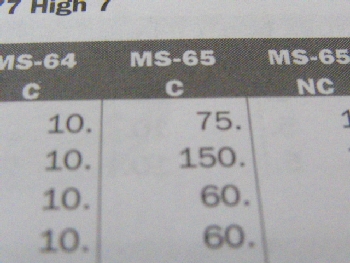 |
|
Pillar of the Community
Canada
3692 Posts |
If you've ever seen Canadian mint sets from around the 1950s-60s, they have proof-like coins. You'll know when you see one. They seem whiter from the reflection.
BU is just a generic term for UNC with more lustre and eye appeal. Some dealers mark their coins BU or BUNC so that there's more subjectivity to the grading.
The whole C and NC thing refers to business strikes and colectors' sets. It's much more impressive to find a business strike in mint-state than it is to find a collectors' coin in mint-state (because they come like that), so the price reflects that.
Edited by Libertad
10/15/2010 10:40 am
|
|
Valued Member
Canada
367 Posts |
and buisness is circulated right?
|
|
Pillar of the Community
 Canada
9903 Posts |
NC=non circulation, i.e. coins from sets with the same finish as circulation coins C=circulation ,coins for everyday commercial use circulated=used BIG difference between the words circulated and circulation A circulated coin graded MS65? It doesn't make sense. Edited by DBM
10/15/2010 11:00 am
|
| |
Replies: 21 / Views: 5,740 |








 Posted 10/11/2010 7:32 pm


