| Author |
 Replies: 369 / Views: 64,768 Replies: 369 / Views: 64,768 |
|
|
|
Bedrock of the Community
 United States
14454 Posts |
well looks like we both added pictures about the same time. Anyhow, you can see the differences between the two stems
|
|
Pillar of the Community
3660 Posts |
Thanks very much both of you.....Now I've got something to think about for a bit.
So I can sort of relate the 83 and 84 stem connections to the individual feather additions of the 8TF dies I guess? Since the 83 and 84 are obviously different, I would think that the 70-82 dies are absolutely identical in that same area, and that the stem is lacking in the m.hub.... m.die.... and w.hub. meaning that the 70-82 were actually used prior to the 83 and 84. Consequently, Bryan's coin was a predecessor of the 83 and 84 as well as the 80 and 22. Am I making sense?
|
|
Moderator
 United States
23522 Posts |
I'm not sure we can conclude which dies (70-82 or 83/84) came first. We'll probably never know why only the two dies were touched up. One theory is that they were the worst in terms of the gap. It might just have been someone with a few idle minutes on their hands. I've noted that the degree of disconnection varies between B1 stems, leading me to think that some research might turn up a rough timetable of which dies were produced when. Assuming the disconnected stem is a hub defect, one could reason that the gap would increase with successive dies impressed, as more and more metal was obliterated. Back to Heritage. See you in a few.  |
|
Bedrock of the Community
United States
14454 Posts |
Quote:
Back to Heritage. See you in a few. thats why the pages were loading slow for me |
|
Moderator
United States
23522 Posts |
Inconclusive, even with Heritage's huge images. I have the ones you sent me a while back, Bryan. Your shots are perfect; I have the stem detail from your 70, 79 and 81. They're very similar.
Makes the doctored dies curiouser and curiouser.
|
|
Pillar of the Community
3660 Posts |
Now the way I see it, this hub was created in a hurry. The stem is a design element, and in haste, it was omitted in the engraving of the hub. This stemless design passed on to the master die, and to the working hub. This stemless working hub stamped out the 70-82 dies which struck coins. It also stamped out the 83-84 dies, but these dies were engraved intaglio to add the stem. I do not see how things could possibly have been otherwise.
Engraving cannot be removed from a die without drastically affecting other design elements in close proximity. I think that it is pretty clear that 83-84 were certainly last in the progression of these coins.
I like the way that you are thinking Dave, and if you are correct that even the disconnected leaves are not identical on the 70-82, that will be something to really think about.
I think that a working hub could stamp out at least a couple hundred dies before wear would become a factor, so if there is a difference between the 70-82 dies in that area, might it be simply from exacting replacement between hubbing stages, since we are only dealing with 5 or 6 dies, or are we to consider those that were also sent to CC and SF.... I guess we should 'eh, especially if some of those also have disconnected leaves?
edited to add;
By the way, thank you both very much for indulging my curiosity.
Edited by zeewool
10/24/2010 11:49 pm
|
|
Bedrock of the Community
United States
14454 Posts |
VAM-43 has a disconnected leaf as well (but looks a little different) and its a 7/0 coin (there may be more but this one is fresh on my mind since I have been looking at one thinking of purchasing it myself)
|
|
Moderator
United States
23522 Posts |
Given the speed with which they were changing the design, I would think there weren't many B1 Reverse working hubs. No more than a couple, certainly; even as they were creating the B1, they knew further changes were coming as fast as they could create a new galvano. There are only (quick count) 23 B1 1878-P VAM's (counting 7/8TF) - Bryan will make the 24th - and 24 B1 VAMs combined from San Francisco and Carson City. Given that some of these are shared reverses, I see no reason to think there was need for more than one B1 working hub. Yet the weight of the stem on these is all over the place, ranging from wispy to robust. |
|
Moderator
United States
23522 Posts |
Quote:
VAM-43 has a disconnected leaf as well (but looks a little different) and its a 7/0 coin ....and a disconnected nostril. Fascinating. Knowing the 7/8TF's were double-hubbed (A and B1), how do we explain it? I keep coming back to how really, really wispy the stems are on some of these coins. It lends credence to the idea that basining might be involved. |
|
Bedrock of the Community
United States
14454 Posts |
yeah I know. as I said the 43 is fresh in my mind because I have been looking at one the past few days thinking about purchasing it and at what even caught my attention was the broken nostril and disconnected leaf (you know I am a sucker for B1's) but when I checked it I found out what VAM it really was and kind of threw me for a loop how many characteristics like the nostril and leaves it shares with the B1 |
|
Pillar of the Community
3660 Posts |
The possibility of basining is something that I cannot answer with any degree of certainty even in my own mind. There must have been a reason for the 8TF to have been added feathers below the wings. Perhaps that is the case here as well. If so, it would indicate that the hub was afflicted with great unevenness of relief.
If an area of relatively low design relief coincided with an area of high point in the field, I could see how the design in that particular area would hit the polishing plate first and be worn completely away by the time the plate made full contact with the remainder of the die face. Possibly the B1 was of no better topographical symmetry than were the A1 & A2 ?
By 'dual hubbed' I assume you refer to a B1 working hub impressing into A1 or A2 working dies?
Edited by zeewool
10/25/2010 01:15 am
|
|
Moderator
United States
23522 Posts |
Quote:
By 'dual hubbed' I assume you refer to a B1 working hub impressing into A1 or A2 working dies? Exactly, which is why the old 8TF tips, incompletely removed, are still visible. I've often wondered how they could have removed the 8TF tips without affecting the surrounding field. |
|
Pillar of the Community
3660 Posts |
What causes you to think that 'they' did?
|
|
Moderator
United States
23522 Posts |
Quote:
What causes you to think that 'they' did? Some they didn't, some they did. VAM-36: 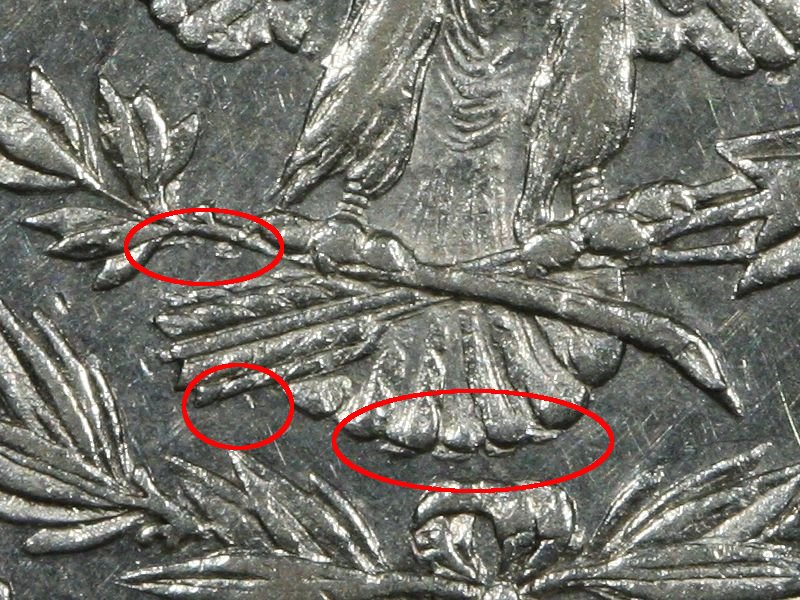 VAM-38: 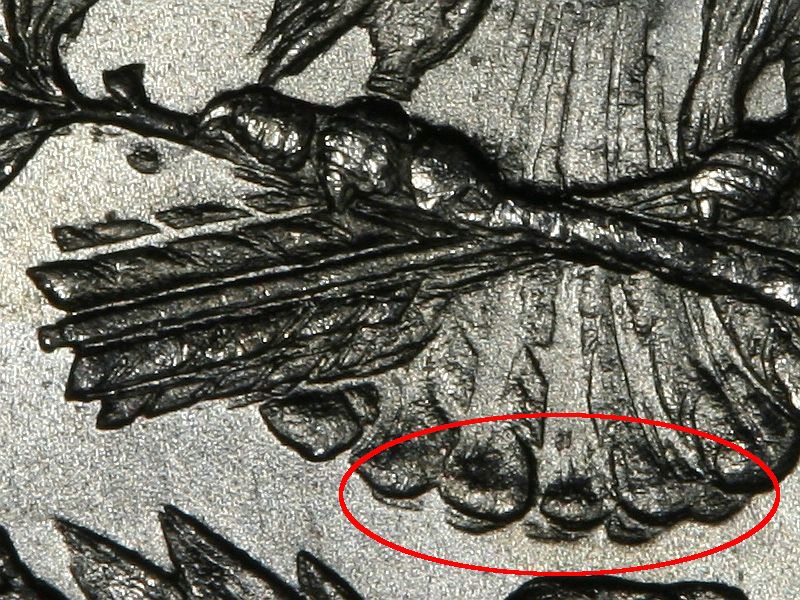 VAM-33: 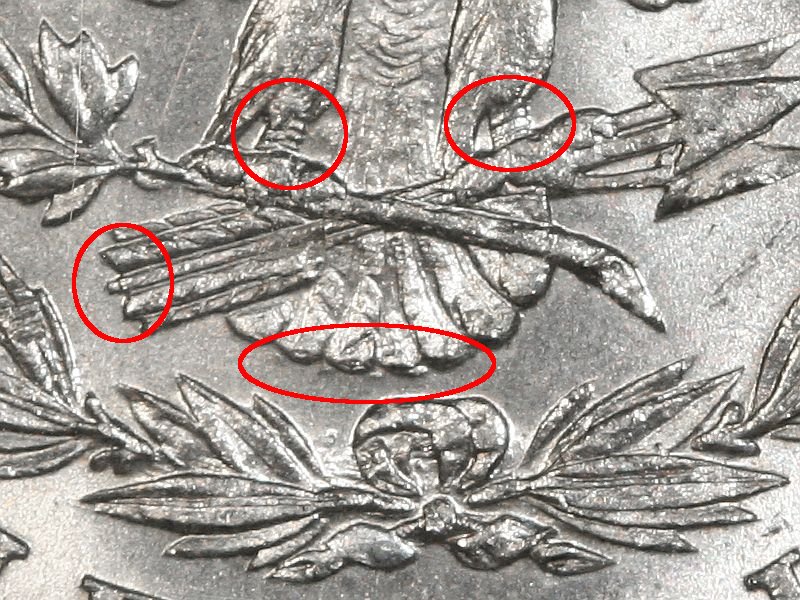 VAM-41: 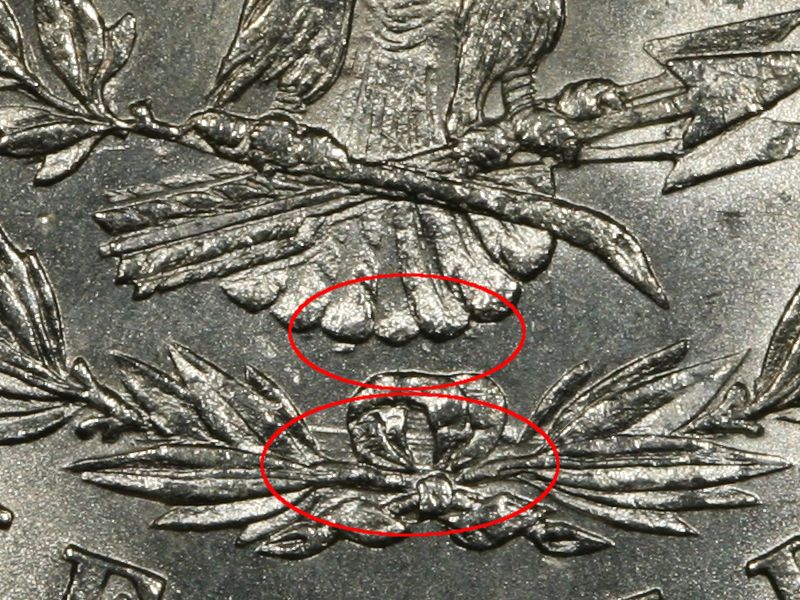 |
|
Pillar of the Community
3660 Posts |
Hmmm, we have differing thoughts on this then...... I do not see that these tips were removed on some and not others, but I see it rather that the old design was not completely obliterated on some yet was (to varying degrees) on others..... I attribute this to the rehubbing of the individual dies..... I would think that the effect of impressing the B1 hub into these various, distinctly different, 8TF dies would produce different results with each particular die.... Each die was different in that some were harder, some were softer, and with renewed annealing each die could be expected to react differently to reimpression. It would not surprise me if in the rush to get these dies completed, some of them may not have cooled completely before hubbing.
I might assume that at least some of these dies had been previously haphazardly basined, so they were most likely of varying degrees of relief?
I think that since most of the A1 or A2 design was retained, and the bulk of the hub relief fit into the die depressions perfectly, no die metal was required to be displaced.
It was the tailfeather area that required the lion's share of die metal displacement.....
The TF area absorbed most of the rehubbing impact, and the feather tips would be where insufficient displacement of the die steel would occur.....
(The void in the tailfeathers was already there in the 8TF), and the tailfeather relief mass of the 7TF hub was insufficient displace metal to fill that void.
Those tips are not something that could (or would) have been attempted to polish out....those are voids in the die.....Liken them to big, big chips.
edited for spelling
Edited by zeewool
10/25/2010 12:25 pm
|
| |
Replies: 369 / Views: 64,768 |








 First Page
 Previous Page


 Posted 10/24/2010 11:05 pm


