






 Posted 10/23/2010 11:16 pm


RealPeso The coin is real so no worries there.
The test scratch is also a rather normal thing for the 1845 Go coins because of the "odd" short beak eagle seen on your coin. People used to seeing the old eagle that had been in use from 1830 to 1843 or with the more familiar Mexico City eagle might be suspicious. It only got worse as the style degraded up through 1851 or so. Many original coins were cut because they didn't look right. If they didn't cut them they often threw them onto hard surfaces to get a ring - so big rim bumps are also common.
But the final digit of the date is punched individually into each die. There is no added value to any one variety because every die is its own variety. Some people identify a Narrow and a Wide date in this time frame as well. That is actually a function of the fact that there were multiple hubs in use. One hub had a wider date than the other 2.
You can choose to collect 1840's Guanajuato 8R's by the position of the final digit but you could just as well collect them by changes or variations in any of the finishing elements added to each die individually. The eye of the eagle, the lower beak, tongue and nostril were all finishing touches involving just the eagle's head. So you can find straight lower beak, curved lower beak, eyes with and without central dots, a couple odd double eyes and various nostril positions. I have one die where the nostril is omitted. Each die is unique and so with that many varieties NONE STANDS OUT.
I would suggest that you would be better off to collect the different hub design pairings used in the 1843-1848 period. During that time Guanajuato used multiple hubs for the cap and eagle. There are three eagles and three caps. The eagles are easy to spot based on the length of the beak and the radically different feathering patterns. (the feet, lower beak, eye position and nostrils also vary as noted above).
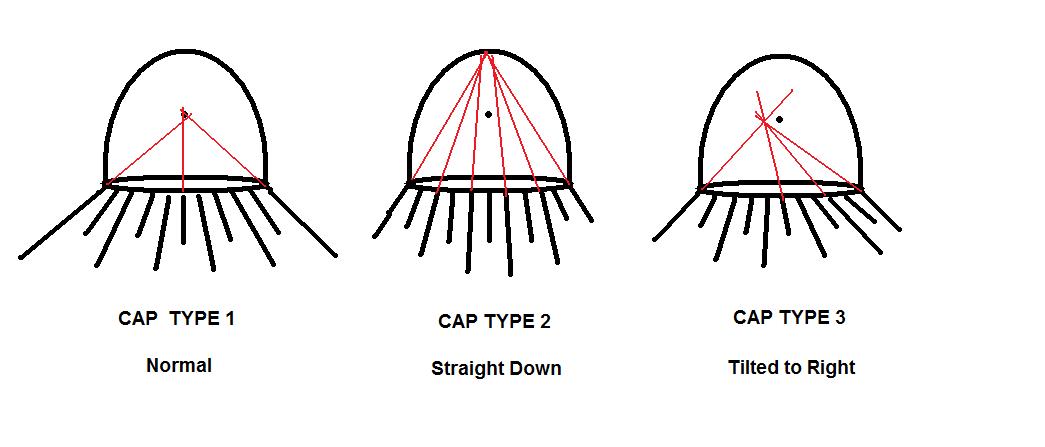
The cap hubs vary by the angles of the lower rays. On Type 1 (the normal variety) the rays all radiate out of a central point. On the second style the central lower rays are closer to parallel and if you project them back the focal point moves to the top or just above the top of the cap. On the third hub the rays on the right side of the cap are tilted too far over so that the center point moves to the left side of the cap.
Here is a sketch of what I mean by the rays on the cap.
The thing to do is see how many combinations of these hubs you can get for each date. For 1843 you can also add the change of axis from Medal to Coin rotation. The rare combination for 1843 is the early hub style with the COIN AXIS.
In 1843 Cap Type 1 is on all coins made after the transition from the hub of 1830-1843. These coins are always paired with Bird 1. Look for both a coin and medallic axis for the year.
In 1844 the cap shifts to Cap 2 seen with Eagle 1 (the LONG beak) and Cap 3 seen with both eagles 1 and 2 (the long and short beaked eagles.) There is one reported mating of Cap 1 and Eagle 1 for this year which I have not personally seen.
In 1845 you usually see Cap 3 but a few Cap 2s were made. There are pairings of both caps with both eagles. The 4 matings are fairly common with Cap 2 slightly scarcer than Cap 3. I have not located a Cap 1 for the year but I am still searching.
In 1846 Caps 2 and 1 are used with Cap 2 being scarcer in my experience. Cap 2 always pairs with the Long beak but Cap 1 pairs with both long and short beaked birds.
In 1847 the Long Beak eagle is seen almost exclusively paired with Caps 1 and 2. Cap 2 is again the scarcer.
In 1848 the 3rd eagle a refeathered short beak eagle (perhaps a re-worked hub) is back paired with caps 1 and 3.
The relative populations cited above are based on my experience with these dates and the pool of coins for much of my collecting career were those seen in the NE United States. Populations elsewhere MAY vary. I also expect that since all three hubs were used at both ends of the period in question that there are many more pairings to be discovered.
The test scratch is also a rather normal thing for the 1845 Go coins because of the "odd" short beak eagle seen on your coin. People used to seeing the old eagle that had been in use from 1830 to 1843 or with the more familiar Mexico City eagle might be suspicious. It only got worse as the style degraded up through 1851 or so. Many original coins were cut because they didn't look right. If they didn't cut them they often threw them onto hard surfaces to get a ring - so big rim bumps are also common.
But the final digit of the date is punched individually into each die. There is no added value to any one variety because every die is its own variety. Some people identify a Narrow and a Wide date in this time frame as well. That is actually a function of the fact that there were multiple hubs in use. One hub had a wider date than the other 2.
You can choose to collect 1840's Guanajuato 8R's by the position of the final digit but you could just as well collect them by changes or variations in any of the finishing elements added to each die individually. The eye of the eagle, the lower beak, tongue and nostril were all finishing touches involving just the eagle's head. So you can find straight lower beak, curved lower beak, eyes with and without central dots, a couple odd double eyes and various nostril positions. I have one die where the nostril is omitted. Each die is unique and so with that many varieties NONE STANDS OUT.
I would suggest that you would be better off to collect the different hub design pairings used in the 1843-1848 period. During that time Guanajuato used multiple hubs for the cap and eagle. There are three eagles and three caps. The eagles are easy to spot based on the length of the beak and the radically different feathering patterns. (the feet, lower beak, eye position and nostrils also vary as noted above).
The cap hubs vary by the angles of the lower rays. On Type 1 (the normal variety) the rays all radiate out of a central point. On the second style the central lower rays are closer to parallel and if you project them back the focal point moves to the top or just above the top of the cap. On the third hub the rays on the right side of the cap are tilted too far over so that the center point moves to the left side of the cap.
Here is a sketch of what I mean by the rays on the cap.
The thing to do is see how many combinations of these hubs you can get for each date. For 1843 you can also add the change of axis from Medal to Coin rotation. The rare combination for 1843 is the early hub style with the COIN AXIS.
In 1843 Cap Type 1 is on all coins made after the transition from the hub of 1830-1843. These coins are always paired with Bird 1. Look for both a coin and medallic axis for the year.
In 1844 the cap shifts to Cap 2 seen with Eagle 1 (the LONG beak) and Cap 3 seen with both eagles 1 and 2 (the long and short beaked eagles.) There is one reported mating of Cap 1 and Eagle 1 for this year which I have not personally seen.
In 1845 you usually see Cap 3 but a few Cap 2s were made. There are pairings of both caps with both eagles. The 4 matings are fairly common with Cap 2 slightly scarcer than Cap 3. I have not located a Cap 1 for the year but I am still searching.
In 1846 Caps 2 and 1 are used with Cap 2 being scarcer in my experience. Cap 2 always pairs with the Long beak but Cap 1 pairs with both long and short beaked birds.
In 1847 the Long Beak eagle is seen almost exclusively paired with Caps 1 and 2. Cap 2 is again the scarcer.
In 1848 the 3rd eagle a refeathered short beak eagle (perhaps a re-worked hub) is back paired with caps 1 and 3.
The relative populations cited above are based on my experience with these dates and the pool of coins for much of my collecting career were those seen in the NE United States. Populations elsewhere MAY vary. I also expect that since all three hubs were used at both ends of the period in question that there are many more pairings to be discovered.


