| Author |
 Replies: 41 / Views: 10,851 Replies: 41 / Views: 10,851 |
|
|
|
Pillar of the Community
United States
4992 Posts |
Just noticed that the original post indicated his was a proof strike in MS. Those are extremely valuable and, in this case, the engraving could augment rather than detract from the value since it has some historical documentation.
In Gem Cameo Proof MS-65, an 1864 Seated Liberty is worth about $5,000. If you have your hands on a Gem Proof with that engraving, could be a monster coin since it would lend great credibility to the story that a special (presumably proof) strike and engraving was done at the mint. Might also mean there were more than 470 proof coins struck? (476?)
|
|
Bedrock of the Community
United States
17884 Posts |
He also says that his has KT on it for Knights Templar, but the Knights Templar and the Masons are two totally different groups. He says he thinks his is a proof striking, but he says it is in beautiful uncirculated condition. My take is that he may not know the difference between a proof and an Unc. I believe the others are business strikes so his piece is probably most likely also a business strike. (Note that this was his first post, and he hasn't been back, so we can't really judge his numismatic knowledge.)
|
|
Bedrock of the Community
United States
12437 Posts |
Quote:
since it has some historical documentation What historical documentation? The fire at the Masonic Temple obviously occurred per historical records but the Mint's linkage to these coins is tenuous at best. The OP provided a link to an overhyped auction listing and an inaccurate journal article written 7-8 years after the fact, neither proves much at all. Without official Mint records confirming that the engraving was done by mint employees, it is nothing more than a fanciful story to hype a damaged coin. Of course, it doesn't help matters that the OP was a one post wonder with no photographs of the coin they supposedly own. |
|
New Member
 United States
3 Posts |
I have little to no numismatic knowledge. I'm not a collector, this coin was in my father's safe. I'm not trying to offer assumptions as facts, I'm just sharing what I've come up with, which is nothing concrete. That is why I'm here and I really appreciate everyone's comments. Thank you so very much! Everything I know is from second hand sources on the internet and "The Numismatist, Feb 1993". I'm in the process of confirming with the mint on the engraving. 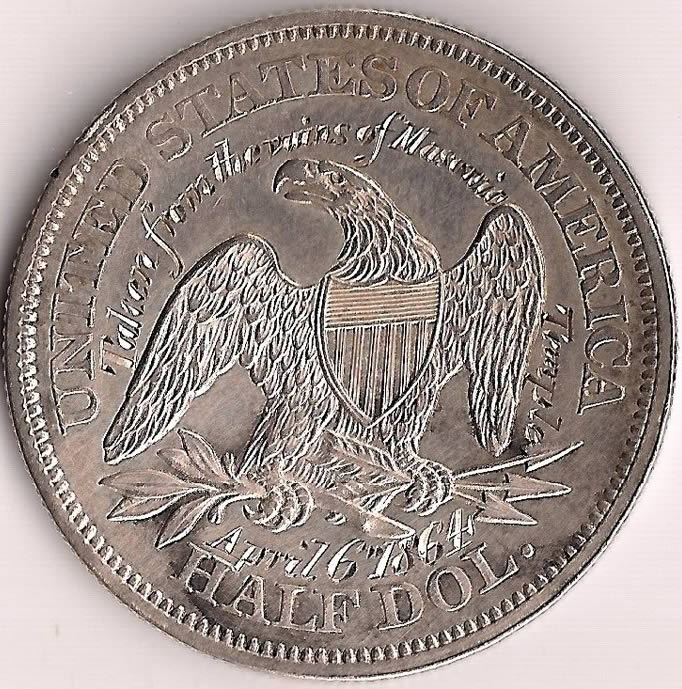 *** Edited by Staff - Rescued Vaporized Photobucket Image. *** *** Edited by Staff - Rescued Vaporized Photobucket Image. ***Sorry about the quality, it's a scan Edited by Metacomet
11/30/2010 7:54 pm
|
|
Pillar of the Community
United States
4992 Posts |
Hard to tell from a scan but that appears to be a business strike with AU or better details. I think it would go for $400 at auction with a "certified genuine" type slab. Much more if the strike is proof (does not appear to be the case).
|
|
New Member
United States
1 Posts |
Contrary to what others have stated in the past, there is no evidence that these were engraved by the US Mint and are not what one might describe as "commemoratives".
The silver was deposited by the masons and was coined into half dollars per their request (as any other depositor could do at this time), then returned to them in coin form. It is more likely that they then paid an engraver to engrave the coins to sell as a conscription to raise funds for rebuilding the temple.
There are examples known with no name on the obverse, just "Boston Encampment", but most have a persons name engraved in the left obverse field. All but one known example has "Taken from the ruins of Masonic Temple / April 6' 1864" engraved on the reverse. I have been researching these items for several years and own several examples. At this point I have documented just under 20 examples. I am sure there are more out there.
As to value, that is hard to say with any certainty. They have sold from $100 to $1000 over the years. For the ones with a name on the obverse, most have sold for around $500 or so.
I would be happy to talk to you more about the coin, just let me know.
BN
|
|
Pillar of the Community
United States
4992 Posts |
Good information that makes sense that they would send the silver to the mint, get the coins back, and then do their own engraving. One risk from an investor standpoint is there aren't nearly enough examples to prove whether the engraving is original. Hence, someone could just buy an AU example, engrave it, and try to sell it as a Mason coin. Hence, I think they are unlikely to trade much higher than a normal AU example.
|
|
Pillar of the Community
United States
3076 Posts |
well I can't say its PROOF.... AU? thats rediculous........
No way is this coin AU..........
but I can see the argument
|
|
Pillar of the Community
United States
4992 Posts |
Yeah I'm just giving AU as an example I'm not sure what his coin grades would need to see high resolution photos of the obverse and reverse with multiple light sources to show luster.
All I can really say from the Reverse scan is the coin is not proof and has no obvious traces of wear can't really judge the luster.
|
|
Pillar of the Community
United States
4992 Posts |
I sent an email to World Exonumia inquiring about the 1999 auction. Rich Hartzog responded that the VF example sold for $495.
|
|
Pillar of the Community
United States
3076 Posts |
Mind you I love history and a great story, but I must pint out...Why is the engraving so shiney? when the coin is toned, and the engraving stands out so shiney?would not the engraving done in the same year as the coin be toned the same? or was that the second persons example?
|
|
Bedrock of the Community
United States
14454 Posts |
Quote:
Why is the engraving so shiney? I believe that is a result of the scanner trying to compensate for the engraving on the coin. I bet in hand its not as shiny as it appears in these photo's but it is sunk in to the coin when all the other details are raised so the scanner doesn't really know how to project that in the photo. It is probably a little more shiny because it was engraved and moved metal around which could hinder the toning in those areas but I doubt it is as prominent as the photo shows |
|
Pillar of the Community
United States
1283 Posts |
Quote:
Why is the engraving so shiney? It looks to me like simple light reflection. Notice it's also reflecting off of some of the recesses of the feathers, making them look shiny. |
|
Pillar of the Community
United States
4992 Posts |
I'm thinking the coin pictured may be more like a $1,000 item given the premium that seems to have been paid for an F/VF example at auction. Condition seems really good from the scan.
|
|
Bedrock of the Community
United States
17884 Posts |
Quote:
Why is the engraving so shiney? Because the surfaces were created by a different method. The coin surfaces are created by the striking which resulted in a satiny finish, but the engraving was created by a cutting of th urface resulting in a shiny worked surface. The engraving would have been much shinier when new and will still be shinier even after toning. |
| |
Replies: 41 / Views: 10,851 |








 First Page


 Posted 11/30/2010 3:14 pm


