| Author |
 Replies: 16 / Views: 2,762 Replies: 16 / Views: 2,762 |
|
Valued Member
United States
232 Posts |
|
|
|
|
Valued Member
 United States
232 Posts |
here is front 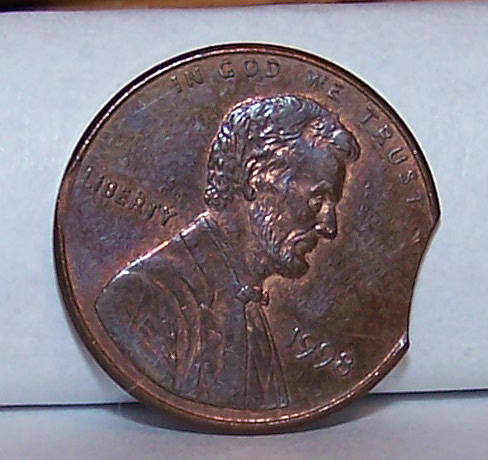 if needed |
|
Pillar of the Community
United States
1807 Posts |
|
|
Moderator
 United States
56855 Posts |
Welcome to CCF. I agree with rockdude, It's worth about $4. Congrats on a nice find.
John1 
|
|
Valued Member
United States
76 Posts |
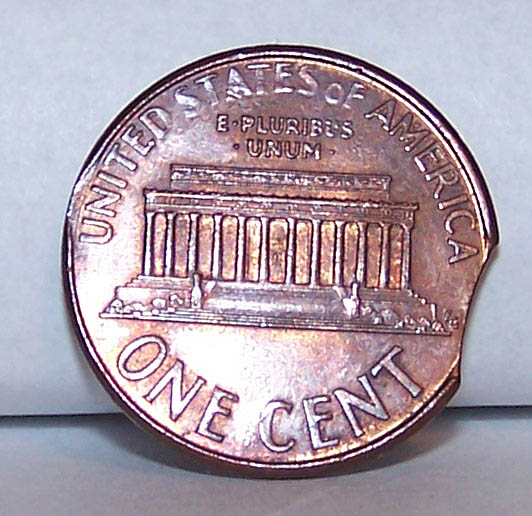
 So what about the other end around 9 o'clock. Why is the rim missing there? Also looks like several die chips or gas bubbles on the reverse, in the valley on the "M", and in the area around "cent" Edited by AndrewLynn
11/24/2010 07:07 am
|
|
Pillar of the Community
United States
2661 Posts |
I must play the devils advocate here, sorry. I am a machinist and have seen what people can and will do to a coin so I am going to throw this out there. It is possible that it was machined that way on purpose. I say this because of the missing/indented rim between the 8 and 9 o'clock position. I appears to be where the coin was clamped with excessive force in order to hold it while it was being ravaged. I am not saying that is what happened, just laying that theory out there for one to ponder.
|
|
Pillar of the Community
United States
4846 Posts |
actually, the weakness is an effect called the blakesley effect. when you have a Cud or a clip, the opposite side of the error is weak. |
|
Valued Member
United States
123 Posts |
Agree with adam.That is one of the ways to tell if it is a legit error.
|
|
Rest in Peace
United States
1943 Posts |
I agree with everything above except the weakness opposite a Cud is not the blakesley effect. The blakesley effect applies to clips only and verifies a legitimate clip but it is possible to have a legitimate clip without the blakesley effect. The coin pictured is a nice clip and a nice find. Tim, it's good to see fellow machinists on the forum. |
|
Bedrock of the Community
United States
62064 Posts |
The rim tapers just like it should on a real incomplete planchet. If it were done by a machine the rim would be strong next to the area in question. I say it's real.
|
|
Pillar of the Community
United States
2661 Posts |
The blakesley effect.  Thanks for enlightening me guys. I was not aware of such a thing. That is what I love so much about this forum. There is such a combined wealth of knowledge here. |
|
Bedrock of the Community
United States
12437 Posts |
The proper term is "incomplete planchet" because nothing actually get clipped. Blanks are punched from the metal stock and if the stock does not advance far enough before the next group is punched, the punches will overlap and create incomplete planchets.
The Blakesley Effect is a byproduct of the initial formation of the rim. The blanks are punched and are then turned into planchets by being run through an upsetting mill. The blanks are force-spun through the upsetting mill which narrows the diameter of the planchet and builds up the protorim. If an incomplete(clipped) planchet goes through the upsetting mill, there is no opposing force at the site of the clip so the rim opposite the clip is not formed. The larger the clip, the more dramatic the Blakesley Effect while very small clips may not show any signs of it.
|
|
Valued Member
United States
420 Posts |
thats the best blakesley effect example I've seen on CCF in a while, perfect for teaching us noobs thanks for the great photo ! |
|
Pillar of the Community
United States
4846 Posts |
yeah, I thought it applied to Cud's too, apparently not, lol |
|
Pillar of the Community
United States
7629 Posts |
I agree that the coin in question is a true incomplete planchet error, and that the weakness in the rim opposite the missing area is indeed the Blakesley effect. I also agree that this effect does not necessarily have to be readily apparent for a coin to be a genuine incomplete planchet. I do disagree with the "value" given to this coin. Genuine errors like this after 1995 have significant value over that of earlier years because they are far more scarce. I would give it a value of $10-$15 easily, possibly more. The part that is probably being confused regarding Cuds is that with incomplete planchets the rim at the opposite side of the coin is usually weak. With Cuds, the design on the opposite side of the coin is usually weak. A simple understanding of the minting process would pull all this into perspective. |
|
Pillar of the Community
United States
4000 Posts |
That is a textbook example of an incomplete planchet.
|
| |
Replies: 16 / Views: 2,762 |








 Posted 11/24/2010 06:03 am





