| Author |
 Replies: 16 / Views: 24,846 Replies: 16 / Views: 24,846 |
|
Pillar of the Community
Netherlands
626 Posts |
Hi all, someone told me these 2 coins are probably fake ones... so I looked around on the net for resembling pictures and information. However I don't have a very accurate scale to weight the coins. Therefore can you guys axplain where I should look for, or can anyone point out if it's real or not! WOuld be appreciated  KM# 5a.1 Piastre de Commerce, 1908 (Indo-Chine-Francaise) 27.0000 g., 0.9000 Silver 0.7812 oz. ASW Obv: Liberty seated KM# 5a.1 Piastre de Commerce, 1908 (Indo-Chine-Francaise) 27.0000 g., 0.9000 Silver 0.7812 oz. ASW Obv: Liberty seated
left with fasces Rev: Denomination within wreath
Rev. Leg.: TITRE 0.900 POIDS 27 GR.  This one weighs between 25/30 grams and feels / sounds like silver 5 Francs, 1883 - Zwitserland ( tiro federale in lugano 1883)A socalled Shooting Thaler from old shooting festival   HEre are som websites to compare: http://www.kittredgecollection.org/...ead/d1e60421http://www.roetta.it/monete/monete_...nd_coins.htmI hope someone can clear it up for me! Edited by Kingz
11/25/2010 12:06 am
|
|
|
|
Pillar of the Community
Australia
3841 Posts |
Second coin is clearly fake. The first one, I'm quite sure it's a fake too. If they are magnetic, you know they aren't genuine.
|
|
Valued Member
United States
451 Posts |
gxseries : Any specific signs you notice on the coins that makes you think it's a fake? Please share with us beginners :)
|
|
Pillar of the Community
United States
3098 Posts |
The details of these coins, especially near the center of the coin, are extremely weak. this is because for cast coins (most counterfeits are cast) the details can't reach the middle.
|
|
Pillar of the Community
United States
4992 Posts |
If the first coin is a forgery, it is a very good one. Seems to have some good detail in the middle and wear where one would expect it.
|
|
Bedrock of the Community
Australia
21789 Posts |
Just have a look at the word 'PIASTRE'...The letters ain't in a straight line.
Finding one thing wrong usually means that most things are wrong.
I'll let others identify them all.
Let us say: One poster each identifies only one thing wrong, although he/she may find many.
How many posters will we have altogether? That way, we all get a go!
|
|
Pillar of the Community
United States
2661 Posts |
The dentils stand out in the 1 Piastre. At closer examination you can see that they are not all the same length or width.
The 5 Franc has the tell tale signs of where the two halves of the casting mold come together around the rim. It is especially obvious from the 5-9 O'clock positions on the obverse.
|
|
Valued Member
United States
230 Posts |
It always helps to compare a suspect coin with the real McCoy but not easily done on the internet. Here is a photo of one of my French Indochina Piasters for comparison. The photos may be a little better than what you linked to but my coin is not the best example. It is from my Chinese Chopmark collection and so it has been slightly hammered. Compare the rims per the comments by Tim and sel691 and the other features as noted by the other posters. 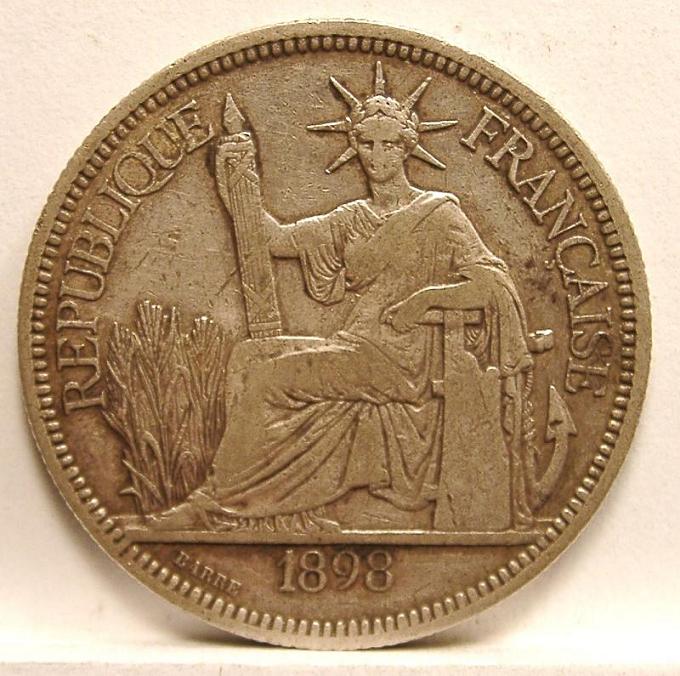 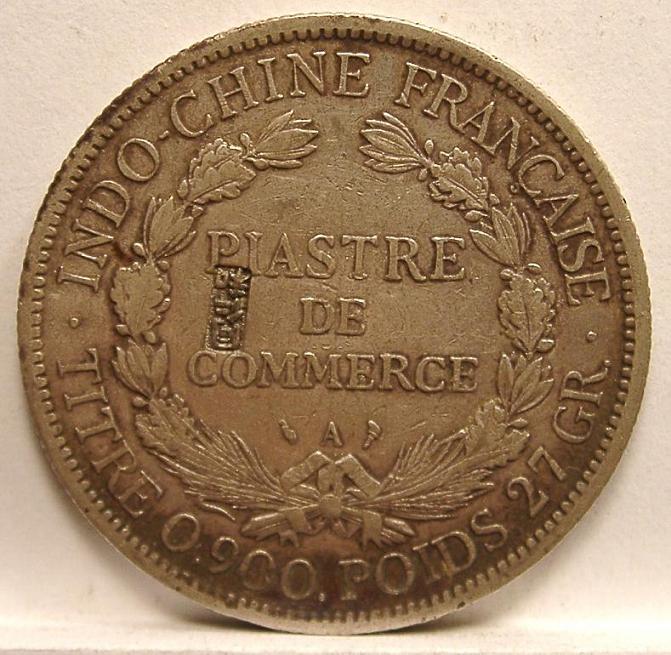 |
|
Valued Member
Greece
425 Posts |
This is mine 1908 piastre coin.It is same as yours or it is different? 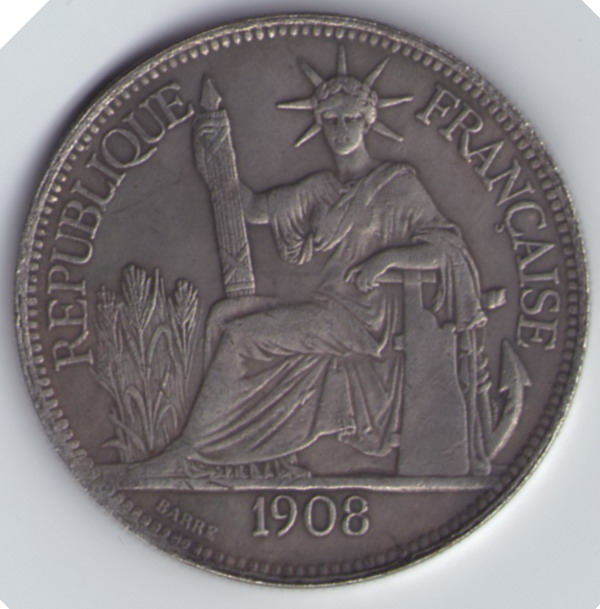 |
|
Valued Member
Greece
425 Posts |
and now look another one from my collection also.One is fake and one is real.You can compare it with yours and make out your own mind. 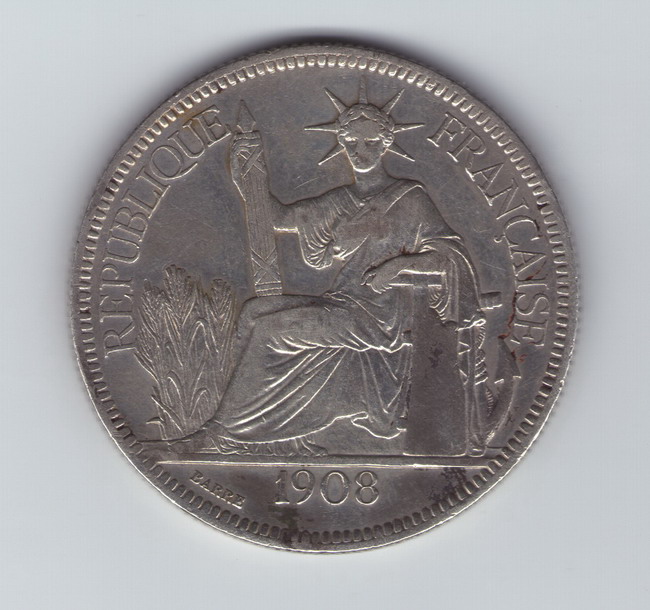 |
|
Pillar of the Community
United States
5362 Posts |
I am jumping in a bit late, but there are some things that you can do to be sure.
First the suggestion of a magnet is good because many of the modern forgeries are nickel (the second magnetic metal). The weight is also a dead give away because most of the modern cheap knock-offs will weigh closer to 20 grams.
However, no one has mentioned the edge yet. The reeds on an original coin should show the same level of wear as the rest of the coin. Sharp reeds (no wear) points to a forgery if the faces of the coin show wear at Fine of Very Fine levels. Most cast copies are edged after they are cast and the edges can be too sharp.
The next thing to look for is an overlap in the reeds or reeds that are not uniform in spacing.
Finally look for split top reeds with split ends. The top of the reeds has a folded seam at the center (a line along the top center of the reed where metal from the adjacent grooves is forced together. Remember a ring die applied edge causes metal flow from the grooves to the reeds. The ends split because the metal runs out. To cover this trait there is a final finishing step that involves grinding the two edges (90 degree corners between the edge and faces) and the surfaces of the reeds. Look for parallel scratches which are an indication of grinding. A real coin will have random wear lines and scratches. All the surfaces should be similar.
Now a word about the coin surfaces look for a dimpled surface or weakness at the center. Someone mentioned the weakness but thought it was from a failure of the mold to fill in. That is unlikely. Most molds will fill fully (a failure is obvious) but what is really happening is that the transfer step which takes the original image and places it on the mold - that is the problem.
Image transfer can be done several ways. There are molds cut from photos (laser etched). There are molds made from IMPACT transfer which invariably results in weakness of details either at the perimeter or at the center (for different reasons based on impact pressure). There are spark erosion molds as well.
Now for the coins. In my opinion BOTH of the original two postings are counterfeit - I have NO DOUBT. The second coin is far more conclusive because of the central weakness AND the total loss of fine details at the transitions. An original would have had to be tumble polished to look that way. There are also clear traces of edge grinding and reeding done with a ring die.
The first coin the 1908 French Indo-China also has a visible GROUND edge and traces of grinding on the date side as well. The date side also has clear traces of the reeds visible on part of the edge. This could possibly be real BUT I bet it is a trace of the direction that the coin was forced through a ring die. The raised bits of metal are an indication that the date side went through the ring die LAST. I am not 100% positive about which die is the anvil in this issue but the edge would indicate the anvil die is the date die. For coins struck with known orientation you can use these metal bits to prove or disprove that the damage is due to the collar or a ring die.
Both of the first two show streaky toning typical of nickel forgeries from China.
The 1898 coin pictured next has nice clear rims. No grinding evidence and finer details are good. If this one is bad it is a GOOD copy.
The next 1908 is the worst copy of the group - that one uses a laser etched or spark erosion mold. There are clear seams on the edges which are not flat. The surface details are VERY weak - it will have a bubbled surface appearance under magnification. No doubt whatsoever that it is a forgery.
The final 1908 is real or an EXCELLENT copy. Note the details. There are no edge problems and no trace of grinding.
KINGZ Make a visual comparison with an original. Check them with MAGNETS and definitely invest $20 of so for a digital scale that weighs to the 1/10th gram. It is ESSENTIAL.
I hope you didn't pay too much because I just picked up a lot of 100 similar coins for 50 cents each. ALL were nickel.
Edited by swamperbob
11/25/2010 11:54 am
|
|
Pillar of the Community
United States
4992 Posts |
Note the original poster stated that the 1908 Piastre (1) Weighs 25-30 grams and (2) Has the distinctive sound of silver.
Unless he is mistaken about the silver, that makes me doubt it is a modern nickel Chinese counterfeit. It could be a reproduction but I doubt anyone would do one in silver with a mold constructed from a worn coin.
Since 1908 is a common date, not sure why anyone would be counterfeiting it in silver. Any chance it is real but just an uncommon die?
|
|
Valued Member
Greece
425 Posts |
The first of my coins is a copy easily spotted.The second of course is a real one.You do;'t have to look the edge or anything else.Simply look at the engravers name.It's different.Yours fake is exactly as mine.If you handle 10 or 15 real silver crowns the n it;s too easy to spot the Chinese fakes.
|
|
Pillar of the Community
United States
5362 Posts |
Unless the person has perfect pitch, I don't think that there is a lot of difference between silver and nickel. Nickel rings but is not as high a pitch as copper or brass. Duration of the ring is critical as well. Nickel has a shorter ring. The ring test is far from fool proof. It is best for zinc, pewter or simple castings with air pockets. But modern injection molding can create a ring of sorts - especially with nickel. The counterfeits I bought in Boston all will ring and the original owner believed they were silver. He was NOT convinced I was right until I used a magnet to pick them up. The price then fell DRAMATICALLY once he realized he had been taken.
epop What exactly are you referring to regarding the engraver's name? I don't see what you are getting at. I agree that weight is an obvious problem for anyone familiar with the feel of a real dollar - but a good scale removes the guessing game and the results are factual.
The edge analysis applies to a lot coins that are being faked currently in China and can be used regardless of the coin type - provided the coin was made in a three die press. Understanding the working and characteristics of a collar would prevent most of these Chinese coins from ever being accepted.
There is very little chance the 1908 is real or silver, in my opinion.
|
|
Pillar of the Community
 Netherlands
626 Posts |
thank you all for the information, very helpfull.! However the first comment was the easiest, take a magnet and indeed both coins are fake, since they ate deffinetly magnetic!
Ah well I already sold the Shooting Thaler for €12,50 (even though I sold it clearly as a fake!)
Now I can buy some real coins with the money :)
|
|
New Member
United States
5 Posts |
The Coin is a fake... This weekend I found a bucket full of them at a craft fair $0.50 Each.
|
| |
Replies: 16 / Views: 24,846 |






 Posted 11/25/2010 12:16 am





