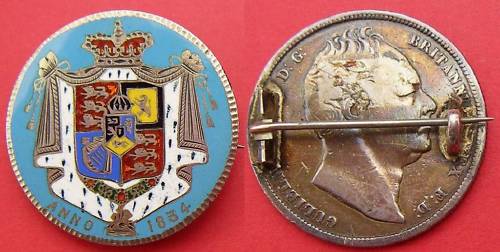
Enamelled coins were a fashion in the 1800s. They were not officially made by the mint, they were made by jewellers from coins pulled out of circulation.
From a numismatic perspective, an enamelled coin is a damaged coin. Since most coins don't have a high enough relief to hold enamel, the enameller would have had to carve away much of the original surface of the side of the coin that was being enamelled. However, seeing such a piece as merely a "damaged coin" is to look at it wrongly! It has become a work of art in it's own right, with a value completely independent of the value of the coin it was originally made from.
Enamelling is something of a lost art today, with epoxy resins largely replacing it in badges, jewellery etc. Each colour had to be fired separately; the more colours a piece had, the more difficult it was to make (with a resulting increase in expense). The one above from the
ebay lot is a six-colour piece (red, yellow, black, dark blue, light blue and green). They were even a little enthusiastic about applying lots of colours; the
actual coat of arms at the time had fewer than that.
As for the date: as I said, the original surface of the coin has been significantly altered. It wouldn't have been too hard for the enameller to put whatever date on the coin he wished. This design was not used on halfcrowns until the William IV series was issued in 1831. As svslav said, 1830 was the year George IV died and William IV ascended the throne; I suspect this piece might have been made from one of those early 1831 coins, and sold at the time of the coronation in 1831.
Don't say "infinitely" when you mean "very"; otherwise, you'll have no word left when you want to talk about something really infinite. - C. S. Lewis










 Posted 11/25/2010 11:54 pm