| Author |
 Replies: 18 / Views: 7,657 Replies: 18 / Views: 7,657 |
|
Pillar of the Community
United States
4000 Posts |
I probably overpaid for these, but I didn't care. The cool factor was off the chart! Any thoughts to grade and background info appreciated! Of course, if you want to tell me what they are really worth, that would be cool, too.  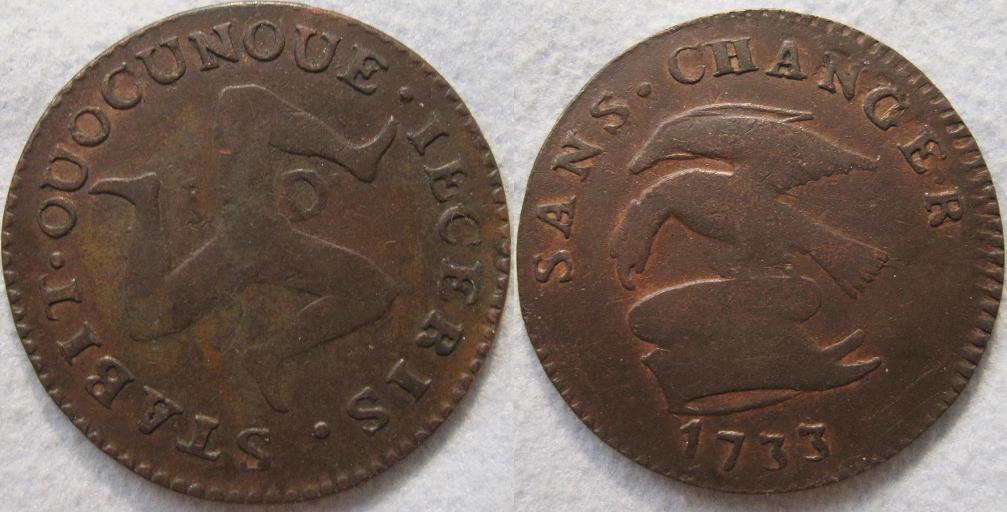 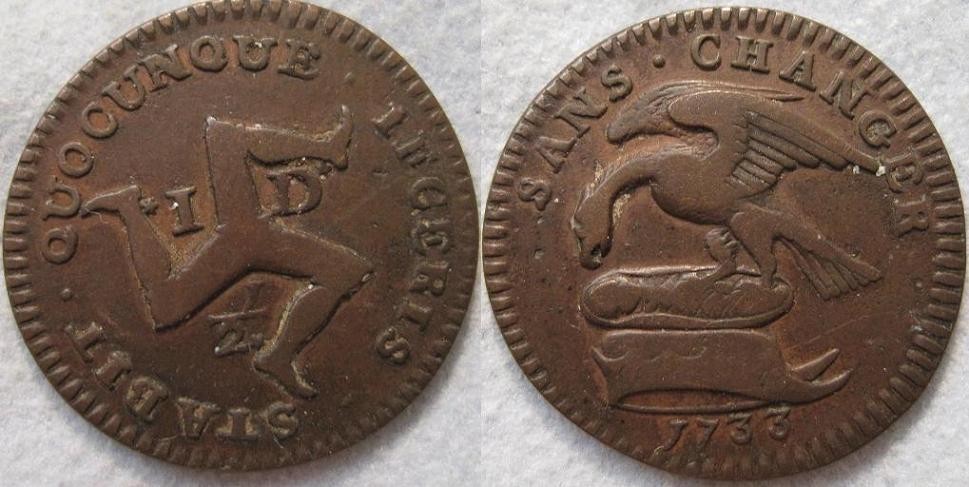 |
|
|
|
Moderator
 United States
23731 Posts |
Interesting pieces. The first one I'd say is F-12 and the second is VF-20.
|
|
Pillar of the Community
United States
2605 Posts |
Scooby, you half identified them yourself  They are not from Man O'Man, but from Isle of Man (British Dependency, an island between Scotland and Ireland). Halfpenny, 1733. My Krause catalog gives values $15 in F, $45 in VF ($175 in XF). |
|
Pillar of the Community
United States
2605 Posts |
Here's an example of a later Manx halfpenny (which I'm currently trading because I have another one) 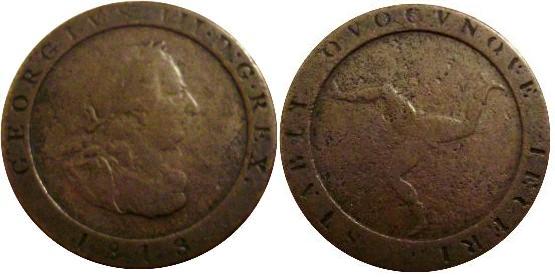 |
|
Pillar of the Community
United States
2605 Posts |
Oh, wait, the top one looks like it's a penny!. Is it slightly bigger? Is there "1" between the legs  instead of "1/2" - it's hard to tell from the pic. |
|
Moderator
United States
15641 Posts |
Great coins Scooby .... and great fun seeing them.  Geepers ..... I have a lot to learn. David |
|
Valued Member
United Kingdom
498 Posts |
The second one is great, a nice piece. They can fetch a decent amount of money, so you pay not have overpaid
www.kingstoncoincompany.co.uk
|
|
Valued Member
United States
451 Posts |
Mind sharing how much you paid for them? :)
|
|
Moderator
United States
16684 Posts |
Yep, Isle of Man
The '"pinwheel legs"
swcoin.ecrater.com
|
|
Pillar of the Community
 United States
4000 Posts |
Yes, they are different. The top one he called a penny, the bottom one a half-penny.
They both look like they have doubling on some of the letters (more like repunched).
The only other thing I have learned is that the 3-legged monster dude is a triune or triskellion and
QUOCUNQUE JECERIS STABIT means "wherever you throw me, I will land".
I was a deer in the headlights after he told me that.
|
|
Pillar of the Community
United States
2605 Posts |
Scoob, I have an idea for you. If you follow the "auctions" link in my signature you can find the "anniversary of Manx coinage" crown. It has nine different coins on the reverse, one of yours included. So, you can compile a minicollection of all coins on that crown. You have a start already  |
|
Pillar of the Community
United States
2605 Posts |
Speaking of triskelion. I always saw in the Krause' quick identifier guide that it pointed to IOM and/or Sicily. I realized I'd never seen a Sicilian coin with one. I checked the 1800's coins catalog, 1700's, 1600's ... nothing! It was time to go on the net. There I encountered this page, titled "Perseus - Medusa coin series" where I found some, and they were in no way recent. Below are some examples from that site - now I would agree with Scooby about the "monster" classification. I'd like to point out that the last one in this group is not Sicilian. 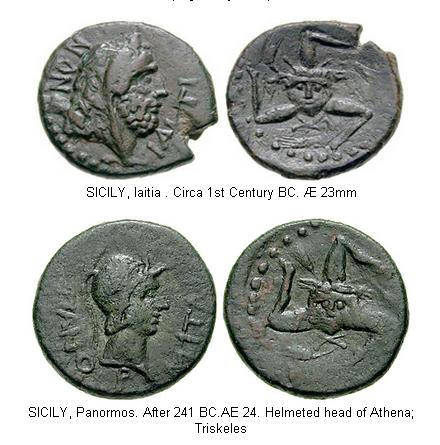 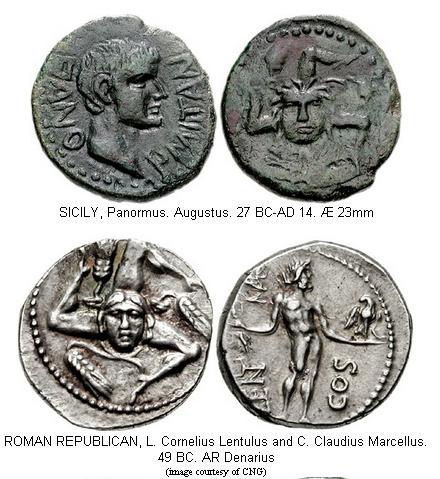 Edited by svslav
11/27/2010 10:30 pm
|
|
Bedrock of the Community
Australia
21789 Posts |
svslav: They are also interesting coins; thanks for sharing.
|
|
Pillar of the Community
United States
2605 Posts |
One of the reasons I like putting up pics of coins is that I see details I had not seen on the coins themselves. It's easier to stare at a computer screen or something. I looked at all the coins in this thread and noticed an interesting thing - the directions of the "pinwheels" are different. The Sicilian and Scooby's 1700's Triskelions "run" counterclockwise. On mine and modern Manx coins it's clockwise. I checked the "official" "3-legged monster dude" on Sicilian and Manx flags, they all "run" clockwise. I guess the old mintmasters got it wrong. Can we consider it a mint error? |
|
Moderator
Australia
16898 Posts |
The triskelion was symbolic of ancient Sicily mainly because the shape of the island is more-or-less triskele-shaped (the ancient Latin name for the island was Trinacria, "three-pointed star"). The fact that possession of the island was fought over by three great powers (Romans, Carthaginians and Greeks) perhaps also perpetuated the three-legged imagery. Sicilian revolts in the 1200s adopted the symbol, no doubt copied off the ancient coins, and the symbolism was revived again by Joachim Murat, Napoleonic puppet king of Naples and claimant of Sicily from 1800 to 1815; it's seen on a few of his coins, listed under "Naples and Sicily" (such as the 120 grana, KM/C# 100). Since the British Navy protected all the island states in the Mediterranean from invasion by Napoleon's armies, Murat never actually ruled the island. The Sicilian triskelion always has the Medusa-head in the middle; The Manx one does not, and is usually shown armoured and spurred rather than bare-legged. The Celtic peoples, of whom the Manx are a part, have a long history of using the triskele-shaped symbols in their own art, and the old Kings of Mann probably came up with the triskelion symbol on their own, without copying it from the ancient Sicilians. The crest on the reverse of the tokens posted in the OP is the crest of the Earl of Derby, who held the hereditary Lordship of Mann at the time the tokens were struck. The reason why the Earl's badge was "an eagle perched over a child" has now been lost to us, though several myths (such as the heir being carried off by an eagle but later found unharmed) arose later to explain it. The reverse motto is also that of Derby: French for "without changing". I paid AU$29 for a 1733 penny in worse condition than yours from one of the pricier local dealers here back in 2007, if that helps your price comparisons any. Don't say "infinitely" when you mean "very"; otherwise, you'll have no word left when you want to talk about something really infinite. - C. S. Lewis
|
|
Valued Member
United States
66 Posts |
Interesting coins nice shape!
|
| |
Replies: 18 / Views: 7,657 |










 Posted 11/27/2010 5:31 pm


