| Author |
 Replies: 10 / Views: 5,696 Replies: 10 / Views: 5,696 |
|
|
New Member
United States
4 Posts |
Edited by megaupload245
12/10/2010 10:51 pm
|
|
|
|
Bedrock of the Community
United States
62064 Posts |
Just a normal dime for business strike Philly. The Proof ones missing the S mint mark are 1968, 70, 75, 82, 83.
|
|
New Member
 United States
4 Posts |
how can I tell if its a proof?. The date is 1968
|
|
Bedrock of the Community
United States
62064 Posts |
A proof coin will have mirrored fields Not this example of business strike coin and a proof: 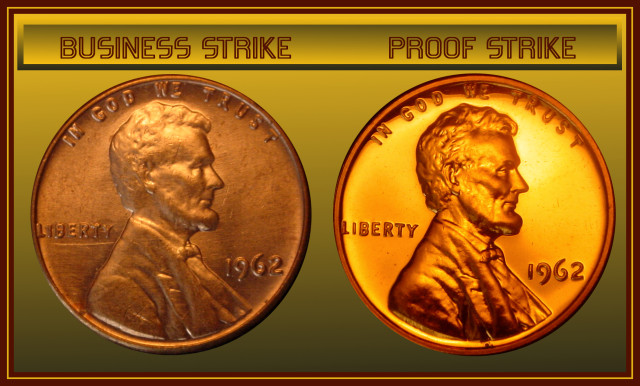 |
|
New Member
United States
4 Posts |
so since my coin is 1968 and has no s that means it is a proof? its just obviously been circulated, as the "proof" adjective has nothing to do with how the condition my coin is, that would be the grade - or condition its in, it is safe to assume it is rare and valuable?
|
|
Bedrock of the Community
United States
62064 Posts |
No, just the opposite. It is a business struck dime from Philly. Just a common dime.
|
|
New Member
United States
4 Posts |
so whats makes this coin listed here (052) This link is not allowed by the Staff .com/Roosevelt_Dime_Mintages_Price_Guide.html different than mine, am I missing that the adjective "proof" is the current condition its in?
|
|
Valued Member
United States
123 Posts |
Not all proofs are mirror proofs. When you go to early proof coins they can be proofs with not the foo,foo wow thing.There are major proof coins that really have been used as regular coins.I sent mine a 1909 VDB to ANACS that I thought was just a MS penny... ANACS sent it back as a Proof 65.From a 12 dollar coin to a 2,600 coin.
|
|
Moderator
 United States
16697 Posts |
I agree, business strike and not a proof.
swcoin.ecrater.com
|
|
Pillar of the Community
United States
1027 Posts |
The numismatic definition of proof is (my words): A coin, struck at least twice, on a specially prepared planchet using specially prepared dies and given special handling after striking and not intended for normal circulation. That definition says nothing about the finished appearance of the coin. Proof coins may appear as the familiar ultra cameo of modern coins and those of the late 1800s, the fully brilliant of the 1950s, the matte/satin of the early 1900s, the reverse cameo of some modern British and American silver and gold coins, or anything else that the designers can produce. The mint has not done us any favors by misusing the term to mean the look of modern proofs (much like their use of the term uncirculated for satin finish coins) and by referring to one very prominent proof as a business strike (the UHRDE of 2009 is a proof in every sense). All proof versions of circulating coins made since 1968 have been of the ultra cameo variety. Proof coins can and do sometimes enter circulation but evidence of the fact that they started life as proofs is maintained until the coin has seen very heavy use. The mirror fields and the sharpness of strike produced by two high force hits with the proof dies makes the coins stand out from the crowd for a long time. Your coin is not heavily circulated but it lacks the telltale features of a proof. The strike is not sharp enough and there is no evidence of mirror fields or frosted devices. These features would still be very evident on this coin if it were a proof.
|
|
Rest in Peace
United States
1943 Posts |
The term proof descibes the process used to make the coin and is not a condition of the coin. You can have a PF-45 coin which is a circulated proof coin with Extremely Fine details and you can also have a EF-45 coin which is a circulated business strike with Extremely fine details. Proof is a process to make coins currently sold at a premium to collectors while business strike is the process used to strike coins for circulation. Your coin is a business strike instead of a proof.
|
| |
Replies: 10 / Views: 5,696 |
|







 Posted 12/10/2010 10:59 pm





