








 Posted 12/28/2010 12:00 pm


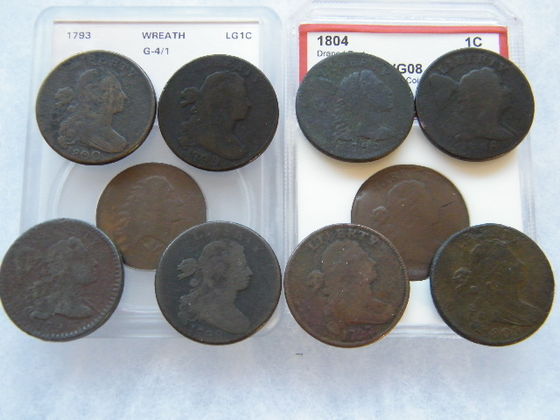
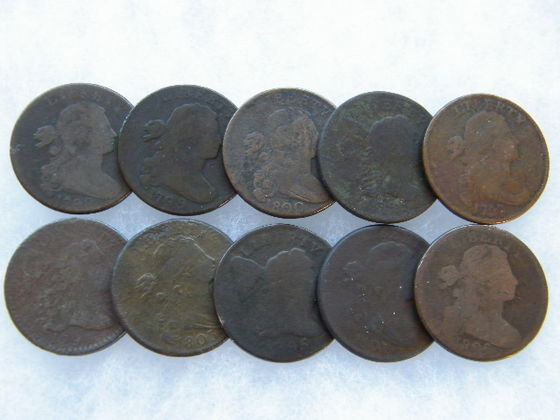
The going rate would of course depend on the year/grade/variety and any "problem" identifiers they may or may not have, i.e. Good details on a corroded coin. If you can, I would recommend cherry picking one with no corrosion and with the smoothest surface possible. Almost all 200 year old copper is very porous, and even most examples graded in 'problem free' PCGS holders aren't perfectly smooth.
ALL old, problem free coppers are very desirable. And depending on the year and variety they can actually be affordable in low grades.
Point being - given the choice I would definitely opt for a problem free, lower grade coin than a corroded coin with more detail. But every buyer has their own taste.
As for prices, you first need to learn the different varieties and have a cheat sheet with you if need be. You can consult price guides (as a guideline!). The best overall IMO is Graysheet, but I don't know how accurate they are with large cents. If possible, the best guide is to look at closed auction prices on the same coin. When doing so don't mistakenly compare the same coin of a different variety, or compare a problem free coin to one that's has an issue like corrosion, cleaning or altered surfaces. Also pay attention to how long ago the auction took place, and for fine tuning the estimated value compare the eye appeal.
ALL old, problem free coppers are very desirable. And depending on the year and variety they can actually be affordable in low grades.
Point being - given the choice I would definitely opt for a problem free, lower grade coin than a corroded coin with more detail. But every buyer has their own taste.
As for prices, you first need to learn the different varieties and have a cheat sheet with you if need be. You can consult price guides (as a guideline!). The best overall IMO is Graysheet, but I don't know how accurate they are with large cents. If possible, the best guide is to look at closed auction prices on the same coin. When doing so don't mistakenly compare the same coin of a different variety, or compare a problem free coin to one that's has an issue like corrosion, cleaning or altered surfaces. Also pay attention to how long ago the auction took place, and for fine tuning the estimated value compare the eye appeal.


