| Author |
 Replies: 27 / Views: 16,159 Replies: 27 / Views: 16,159 |
|
New Member
United States
7 Posts |
I have 2 Misprinted dollar bills in very good circulated condition. Both are 1993 with serial numbers that are within 4 digits, ending in 906 & 910, One bill had a folded corner when it went through the printing press and the printing that should have been placed on that bills back corner was offset to the blanket & then printed on the face of the second bill. The unprinted area on the first bill is very large and makes this a misprint that is rare, because it should be easy to catch an unprinted area this big. Now throw in that I also have the second bill with the first offset (proven by the SER#) of what should have been printed on the first bill, is this as rare as I think it is? Thanks for the help all. Doug PS. The black line around the misprinted area was done in photoshop to point out the misprint, it's not on the bills.    |
|
|
|
Moderator
 United States
15858 Posts |
First ....  Your photoshop skills are impressive ..... and this appears to be an interesting set of bills ..... but .... How about just some honest photos of each bill without the overlay/indicators and other photoshop stuff? Sooo ... clean photos at 950 pixels wide to view of each bill are requested.  David |
|
Valued Member
United States
220 Posts |
and please take the paperclip off  |
|
Pillar of the Community
United States
1424 Posts |
I don't know much about how currency is printed but how would the printing that missed the back of the first note end up on the front of another note? I would think it would end up on the back of another note....
|
|
New Member
 United States
7 Posts |
Here is a scan I just did, sorry for the old photos they where taken when I got the bills like 18 years ago. Digital has come along way. 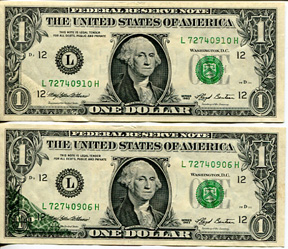 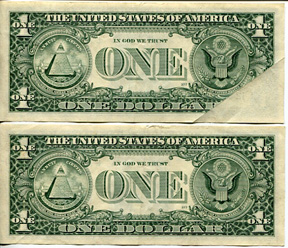 |
|
Pillar of the Community
United States
4846 Posts |
what you have is a wet in transfer on the first and the bill that got its ink transferred on the second. value- I'm not sure but as a pair and with that fold you folded(it lowers the value substantially) i'd say about $150-250.
|
|
New Member
United States
7 Posts |
I worked as a feeder on a printing press when I was younger. This is what happens, when the corner of one sheet is bent as in this case the impression is offset onto the cylinder in stead of the paper as the next sheet comes through the press the offset that is now on the cylinder is place on the underside of the paper as a mirror image. As each sheet comes through less and less ink is on the cylinder.
|
|
New Member
United States
7 Posts |
The fold was how it came to me. Both bills where handed to me as change and where somewhat stuck together like new bills would be.
|
|
Pillar of the Community
United States
1397 Posts |
Quote:
im not sure but as a pair and with that fold you folded(it lowers the value substantially) Are you talking about the corner fold or are you seeing something I am missing? Without the corner fold there would be no ink transfer. Having both those notes together as a set is an awesome find. I can only guess at the value, but I think $150-$250 is too low. How often do you see an ink transfer together with the smoking gun? |
|
Pillar of the Community
United States
1397 Posts |
Staminaboy, could you tell me what the sheet location letter/number is? That will be the small letter/number combo next to the top left district number.
In other words, the letter/number on the left half of the note just to the left of the top 12 (which is the district number).
Edit: My first guess would be D2, but I am wondering why this isn't a butterfly fold error? Notes are printed before they are cut so why is the unprinted fold cut correctly with no extra paper?
Edited by Nickelman
01/18/2011 11:20 pm
|
|
New Member
United States
7 Posts |
|
|
Pillar of the Community
United States
1397 Posts |
I'm also curious about the serial numbers. There would have had to be 4 sheets printed between these two numbers. That would mean that either there were additional errors on these sheets or that the ink transfer was on these as well. I am not an expert so I can't really speculate too much. I would love to hear from someone that could shed light on this.
|
|
Pillar of the Community
3660 Posts |
I saw this thread when it first started, but figured I would give others a chance to put on their thinking caps and see this for what it really is before I responded....... kind of a let down to say the least.... Let me break it down for you all:
The sheet position of D2 is correct for a sheet fold over, so is the note with the blank portion on the back possible?
Yes, it is, and this is a genuine error note..... not a big thing, not terribly uncommon either.
Now, are wet ink transfers possible? Yes, but is the note shown with this alleged wet ink transfer on the face really a wet ink transfer? No, it is a bogus note. There is absolutely no way in the world that this is possible. Here is why:
The backs of the notes are printed first...... if the note faces are printed before the backs are dry, there could be a wet ink transfer..... would the entire back of the note stay wet, or only a portion of the note stay wet? If you say that it is possible that only a portion of the back could stay wet, then you are correct, but imagine what this would look like.... would it be a nondescript portion of the note, or would it be a portion of the note defined clearly by a straight line that aligns exactly with a fold over four sheets away? If this were a true wet ink transfer, it would be over other portions of the face rather than just an exact portion of the face.
Note how strong the green ink is on the face of the note..... it is as strong as both the green ink on the back or the black ink on the face...... This 'wet ink transfer' is clearly a reverse image of back of the note, (as it should be)..... but why is it not transferred to other portions of the face of this note?
The answer is that this was done by someone who wanted to turn one error into a fantastic pair of errors, decided it was not going to fool enough people and abandoned the effort, (or the notes were spent by mistake).... This note is the result of creative computer imaging (by who knows who), and then transferred to a genuine note.
|
|
Valued Member
United States
486 Posts |
My Heroine, Thanks Zee.
The Bill Collector
|
|
Valued Member
United States
171 Posts |
stamina,
Take all of this with a grain of salt. make a post with the difference between a premiere and prestige sets and you will see the difference in opinions which should not be opinions at all but facts. Alot of people want to be experts but few are willing to do what it takes to be one. In the area of coins, I am a newby, but challenge me in the area of other things and we shall see
|
|
New Member
United States
7 Posts |
Zeewool,
Don't take this to bad, I have a question for you, do you know what a printing blanket is, or maybe an impression cylinder?
If you knew the answer to either of those you would know how stupid your answer makes you look.
When a bill goes through a printing press the printing plate is inked by rollers, then offset to a rubber blanket in the form of a negitive image. The paper is then rolled through between the blanket & Impression clylinder ofsetting the image to the paper. if the corner is folded, the impression/ink is not offset to the paper but the impression cylinder. As the next sheet comes through it is printed on the one side as it would normally be, HOWEVER what was on the cylinder is printed on the underside of that sheet! hence the ink on the next sheet or smoking gun.
LEARN SOMETHING ABOUT PRINTING BEFORE YOU CLAIM ME TO BE A FRAUD!
|
| |
Replies: 27 / Views: 16,159 |







 Posted 01/18/2011 9:34 pm





