| Author |
 Replies: 15 / Views: 5,699 Replies: 15 / Views: 5,699 |
|
|
New Member
United States
34 Posts |
|
|
|
|
Pillar of the Community
United States
1801 Posts |
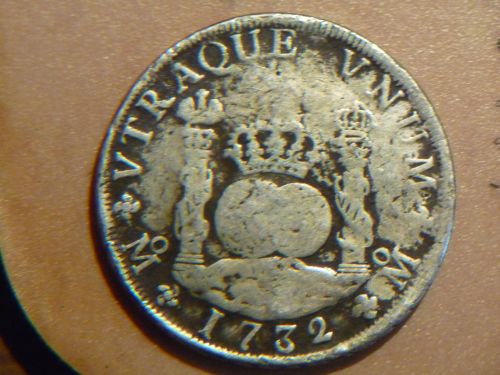
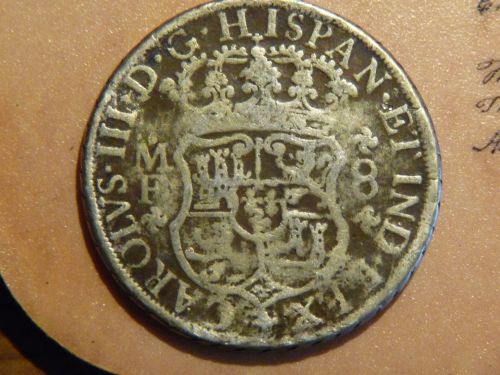
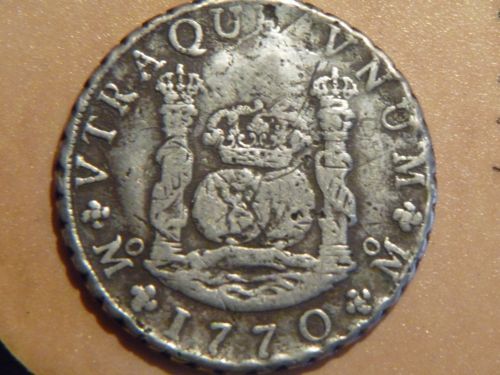
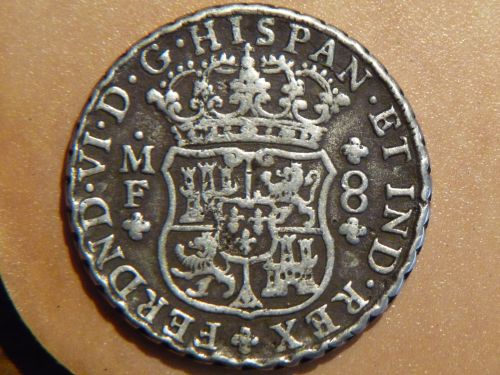
Both are fake. 1732 would have Phillip V, the 1770 would have Carlos III. Besides they just "look wrong". Sorry to be the bearer of bad news.
|
|
Pillar of the Community
United States
5362 Posts |
gdlovgren I agree that these are not what they seem to be at all. They should have reversed the dates.
The 1770 is perhaps easiest to dispose of. The surfaces are very wrong - they have the appearance of a casting. But it is not a casting from a real coin. No 1770 Mexico City coin ever used that reverse. The left Pillar is surmounted with an open sided crown NOT the solid Imperial sides as it should. The crown on the Dos Mundos is crooked and the contents of the hemispheres are wrong. So it is a cast fantasy design.
The 1732 also appears to be cast based on the field irregularities, but these irregularities are not as pronounced as on the 1770 and I could not conclusively say it is a casting. So what are the chances you are dealing with an original with an altered date? Probably not good, but to be certain you should first weigh the coin. I should be between 26 and 26.5 grams based on observable wear. Next look at the edge. Look for wear similar to the other surfaces, Look for the correct lotus pattern and look for a reversal of design pattern or overlaps in the design. Finally check the Specific Gravity of the coin. If the coin is silver it may be an altered original.
|
|
New Member
 United States
34 Posts |
The 1770 weighs about 27 grams.
The 1732 weighs about 30 grams.
I'm using a cheesy little hanging scale, but in a couple days my new digital jewlers scale.
Also what is the Specific Gravity, and how do I check it?
|
|
Pillar of the Community
United States
5362 Posts |
gdlovgren The weight of the 1732 means it was NOT made from an original coin so both are counterfeits.
SG has been discussed on many threads - do a site search on the forum and look for posts on SG. If you need other help just ask.
|
|
New Member
Brazil
1 Posts |
Hi friend,
I saw your comment about the 8 reales 1796 - "R8" error
do you have more information about ?
history, last sale, price, KM number, why this error
thanks and best regards from Brazil
Marcel Ribeiro
please, send your answer in my e-mail:
***Edited by Staff - Email removed - We share info here. ***
|
|
New Member
United States
34 Posts |
I just got a new digital 100 gram scale and have been weighing coins. There seem to be a variance from coin to coin even when I weigh a group of the same coins, like for instance 8 or so Eisenhower dollars. I read that the given weight for coins is actually the minimum and they always weigh at least that or a little more. So far I get from 22.5 to 22.8. Is that normal. I even have a 2001 pristine silver eagle dollar, which is supposed to weigh 31.103 and on my scale it weighs 31.32. Is that normal? I have calibrated the scale. |
|
Pillar of the Community
United States
5362 Posts |
gdlovgren You are speaking about tolerances and the range of possible weight. The Eisenhower dollars (non-silver) types like most other token coins have a very wide range of tolerance since the value is uneffected. But the bullion coin is a different issue. The 2001 ounce coin you have is 31.32 grams instead of 31.103 grams. The difference is 0.217 grams or 0.00697 of the total weight about 7/10ths of one percent. In terms of value in todays market that is about 23 cents. But in terms of 2001 tolerance, I believe it within the allowable weight range at that time. I do not collect these coins so I am not positive but the range for US coins was always good. mrsilv1 If you could tell me which thread you are referring to I might be able to help you.
|
|
Valued Member
United States
167 Posts |
Digital scales vary. I went through the same situation as gdlovgren with a new digital scale. Light coins were underestimated while heavy coins exceeded their dgn wts. Were the coins off, the published weights wrong? Finally I purchased a ASTM (or something) calibrated weight set. This goes from I think 1 g to 100 g and are guaranteed (within a certain tolerance) to be accurate. The more you pay the better the set. I found that my $99 jewler's scale was horribly inaccurate so I purchased a scientific analytical scale from OTIS or some other scientific company. Haven't tested it yet.
|
|
Pillar of the Community
United States
5362 Posts |
I agree - I use a Ohaus 4 beam balance accurate to 1/100th of a gram. It is the step between the triple beam high school scale and a true multi-thousand dollar analytical scale.
|
|
Valued Member
United States
167 Posts |
Correction the scale I have is also an "Ohaus Carat" scale. OTIS makes elevators. We got the scale from Ohaus' website and it was a discounted item. Still it was a bit expensive, I recall $200 or $250 or maybe $300.
|
|
Pillar of the Community
United States
5362 Posts |
The scale sounds fine to me Ohaus is a good company and their scales arre accurate.
|
|
New Member
United States
34 Posts |
I have a slightly worn 1909 barber half that is supposed to weigh 12.5 grams. I now have two scales, and on both it only weighs 12.1 gram. I also have several other barber halfs and several other older silver coins, and they all vary it weight, even though I know they are definitely authentic. Most do weight close to what they're supposed to. Is that normal? If so, how do you tell if they are out of limits and possibly counterfeit?
|
|
Pillar of the Community
United States
5362 Posts |
gdlovgren In each era and for each coin variety weight ranges were established by the government usually by law. The ability of a mint to produce coins of precisely the correct weight also varies often as a result of the technology employed at that time - SO there is NO one uniform answer to your question. The first factor to consider is in my opinion the coinage itself. Are you looking at a token issue, a local issue (one government) or a World Trade coin. I would suggest that three different approaches are used. Token coinages whose value relies on acceptance in society rather than intrinsic metal content are less apt to apply rigid standards for the production of coins. Precision is costly so precision falls to the necessity of cost control. Take for example modern US coins mass produced to tolerances set by the vending machine industry. But a World Trade coin would technically be made to the highest standard because it is accepted based on the accuracy of the end product. The Barber quarter of 1912 was a token coinage with a face value far exceeding silver content. In 1912 the average price for an ounce of silver was 64 cents. The quarter contained 0.18 oz for a value of about 11.5 cents or HALF FACE value. That is why I refer to it as a token coinage and why forgers were active making Dollar coins. Passing a dollar at face value in 1912 could make the forger 50 cents per coin (less costs of production). Doubling your money is a good incentive. But in the days when silver was King (before 1870 lets say) - tolerances were much smaller. That is why older coins are often found with adjustment marks. These scratches from a file or rasp were made in the planchet or blank during the final weight check to make sure planchets were not too heavy. This was the era when 3-5% loss of weight due to wear sent a coin BACK to the mint for use as raw silver. When silver prices plummeted there was in many cases a shift to wider tolerances in weight. After all, the coin was already a token with a face value higher much than the metal content. I recall seeing someplace a very detailed study by the mint on the wearing of coins in circulation that provided statistics about how long a coin could circulate before unacceptable metallic losses were incurred. I am not a collector of the Barber series so I do not know how much weight is lost through normal wear and I can only suspect that in 1912 pressure for accuracy of initial weight was DOWN. You should be able to find the tolerance levels for the Morgan dollar production by using google - I know they have been quoted before and I would suggest that if you follow those roughly you will be in the ballpark. Sorry I can't provide a better answer but as far as I am concerned none exists. However, if you were able to accurately measure SG you would be better off than simple weight. Silver assay tolerance was NOT compromised at any time that I am aware of - not in the US anyway.
|
|
Valued Member
United States
327 Posts |
Man, I always hate to see people wind up with fakes!
|
|
Valued Member
United States
425 Posts |
Quote: "Man, I always hate to see people wind up with fakes!"
Unless that is what they wanted!
|
| |
Replies: 15 / Views: 5,699 |
|












 Posted 03/01/2011 01:35 am


