| Author |
 Replies: 9 / Views: 1,774 Replies: 9 / Views: 1,774 |
|
|
New Member
Spain
13 Posts |
Please, look at this coin: 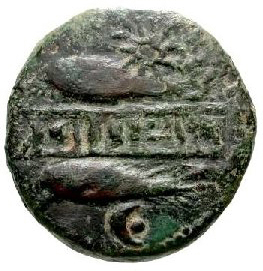 In Spanish, the word referred to the rectangular figure that contains the legend is known as "cartela", which in English could be translated as "cartouche". Is this word used in Numismatics to describe this figure, or is there a more specific term? Advanced thanks. |
|
|
|
Bedrock of the Community
United States
20753 Posts |
 Other than a big Welcome, I really am not the one to even slightly attempt to answer that. Languages in school were always my very, very worst subject. Hope someone can help you here. |
|
Bedrock of the Community
Australia
21789 Posts |
Mallorca: Welcome to the CCF!
I think the use of the word 'cartouche' is perfectly OK here.
I am unfamiliar with this type, but it seems to me to be Roman of a Spanish mint, judging from the style. Perhaps you can tell a bit more about this coin.
In jest, I am a bit like just carl. 'I went to da school where they learned ya top talk propper.'
|
|
Pillar of the Community
United States
4897 Posts |
A cartouche is most associated with a highly ornamental cylindrical object. It can also refer to Egyptian Hieroglyphs. Maybe another word you used "legend" is a closer translation? Oh and Welcome!
|
|
New Member
 Spain
13 Posts |
Thank you all, mates, both for your warm welcome and for your comments!
This the reverse of a Punic Spanish coin from the Sexsi (curious name, ah?) mint. I've taken it as an sample from the coinproject.com web, where I've also learned a lot on how coins are described in English language. I recommend you to visit it in case you don't know it yet.
So, sel_691, have you ever seen a coin description using this term?
|
|
Moderator
 Australia
16956 Posts |
"Cartouche" is an English loan-word borrowed from French. In English it has two meanings: an oval border (like on Egyptian heiroglyphs), or a scrollwork-ornamented border. The inscription on this coin does not appear to be in either, so "cartouche" is probably not appropriate. If it is intended to be a rectangular border, then "in rectangle" would probably be the least ambiguous descriptor. I don't know enough about the varieties in this series. There's only one coin from Sexsi on Wildwinds and they simply describe the inscription as being "between two tunny fish", but I'm not sure if this coin is exactly the same type as yours. Don't say "infinitely" when you mean "very"; otherwise, you'll have no word left when you want to talk about something really infinite. - C. S. Lewis
|
|
New Member
Spain
13 Posts |
You can find more Sexsi coins here: http://coinproject.com/search_city_...UNIC&type=13Actually I'm taking part in a bilingual catalog (Catalan-English) that will list all the ancient coinage of the Iberian Peninsula, whose authors are competent and relevant researchers in this field. Just to have some more opinions from English-speaking collectors: what would you expect from such a catalog? Would it be a handicap the fact of being bilingual? I'm interested in your opinions. |
|
Pillar of the Community
United Kingdom
2925 Posts |
I think the casual English speaking collector want's their reference books in English. For the intermediate or more advanced collector it's doesn't matter. A lot of mine are in Bulgarian, German, French and even Latin!
|
|
Pillar of the Community
United States
4897 Posts |
I agree with Bacchus. Also English is an ever changing language. If you publish this usage and someone else uses it the word will (eventually) gain a new accepted definition. Look at the Oxford English Dictionary. Recently announced that LOL and  will be added to its next edition as WORDS!? |
|
New Member
Spain
13 Posts |
I guess this catalog is mainly conceived for advanced collectors, which does not mean that casual collectors will not be interested in it too. It will be a major compilation and will have a number of pages close to 900.
Thank you for your opinion.
|
| |
Replies: 9 / Views: 1,774 |
|








 Posted 03/25/2011 6:08 pm


